



Tax Information - Retirees 2026

Get Form
Tax Information - Retirees Preview on Page 1

Here's how it works

01. Edit your form online
Type text, add images, blackout confidential details, add comments, highlights and more.

02. Sign it in a few clicks
Draw your signature, type it, upload its image, or use your mobile device as a signature pad.

03. Share your form with others
Send it via email, link, or fax. You can also download it, export it or print it out.

How to use or fill out Tax Information - Retirees with DocHub

Form edit decoration
9.5
Ease of Setup
DocHub User Ratings on G2
9.0
Ease of Use
DocHub User Ratings on G2
  1. Click ‘Get Form’ to open the Tax Information - Retirees document in our editor.
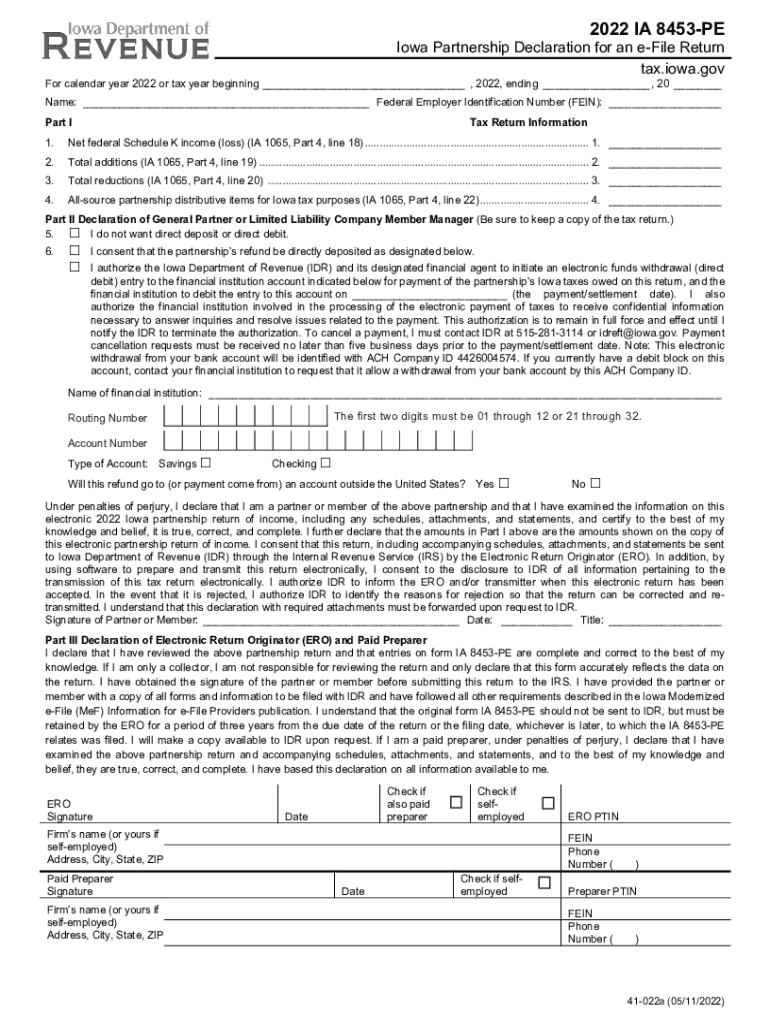
  2. Begin by entering your name and Federal Employer Identification Number (FEIN) at the top of the form. Ensure that these details are accurate as they are crucial for identification.
  3. In Part I, fill out the tax return information. Start with Net federal Schedule K income (loss) from IA 1065, Part 4, line 18. Continue filling in total additions and reductions as specified in lines 19 and 20 respectively.
  4. Complete all-source partnership distributive items for Iowa tax purposes in line 22. Double-check each entry for accuracy.
  5. In Part II, indicate your preference for direct deposit or debit by checking the appropriate box. If opting for direct deposit, provide your financial institution's name, routing number, and account number.
  6. Finally, sign and date the declaration section at the bottom of the form to certify that all information is true and complete before submitting it electronically.

Start using our platform today to easily fill out your Tax Information - Retirees form online for free!

See more Tax Information - Retirees versions

We've got more versions of the Tax Information - Retirees form. Select the right Tax Information - Retirees version from the list and start editing it straight away!
Versions Form popularity Fillable & printable
2022 4.5 Satisfied (44 Votes)
2016 4.1 Satisfied (45 Votes)
2015 4 Satisfied (22 Votes)
2011 4 Satisfied (33 Votes)
be ready to get more

Complete this form in 5 minutes or less

Get form

Got questions?

We have answers to the most popular questions from our customers. If you can't find an answer to your question, please contact us.
Contact us
2. Credit for the elderly or disabled. When baby boomers are retiring, theres a special tax credit youll want to ensure youre familiar with the Credit for the Elderly or Disabled. You can claim this credit if youre at least 65 by the end of the tax year.
Avoid These Common Tax Mistakes Not Claiming All of Your Credits and Deductions. Not Being Aware of Tax Considerations for the Military. Not Keeping Up with Your Paperwork. Not Double Checking Your Forms for Errors. Not Adhering to Filing Deadlines or Not Filing at All. Not Fixing Past Mistakes. Not Planning for Next Year.
In order to maximize the credits and deductions to which you are entitled, here is a quick list for you to keep in mind this tax season. STATE SALES TAX. OUT-OF-POCKET CHARITABLE CONTRIBUTIONS. STUDENT LOAN INTEREST PAID BY MOM AND DAD. AMERICAN OPPORTUNITY CREDIT. COLLEGE CREDIT FOR THOSE LONG GRADUATED FROM COLLEGE.
Key Takeaways If you are at least 65, unmarried, and receive $16,550 or more in nonexempt income in addition to your Social Security benefits, you typically need to file a federal income tax return (tax year 2024).
As a result, the new $6,000 deduction is stacked on top of both the regular standard deduction $15,750 for single filers or $31,500 for married couples filing jointly in 2025 and the 65-plus addition. For instance, a 65-year-old single taxpayer who qualifies for the full $6,000 deduction would be able to deduct a

Security and compliance

At DocHub, your data security is our priority. We follow HIPAA, SOC2, GDPR, and other standards, so you can work on your documents with confidence.

Learn more
ccpa2
pci-dss
gdpr-compliance
hipaa
soc-compliance

People also ask

Unlike the standard deduction, the additional $4,000 deduction for seniors would be available to taxpayers even if they itemize their deductions. This provision is drafted to expire after 2028. Assuming it is not renewed, JCT estimates the 10-year cost at $66 billion.
Yes, Medicare premiums are tax deductible as a medical expense as long as you meet two requirements: You must itemize your deductions on your tax return to deduct them from your taxable income. You can only deduct medical expenses that exceed 7.5% of your adjusted gross income (AGI).

Related links