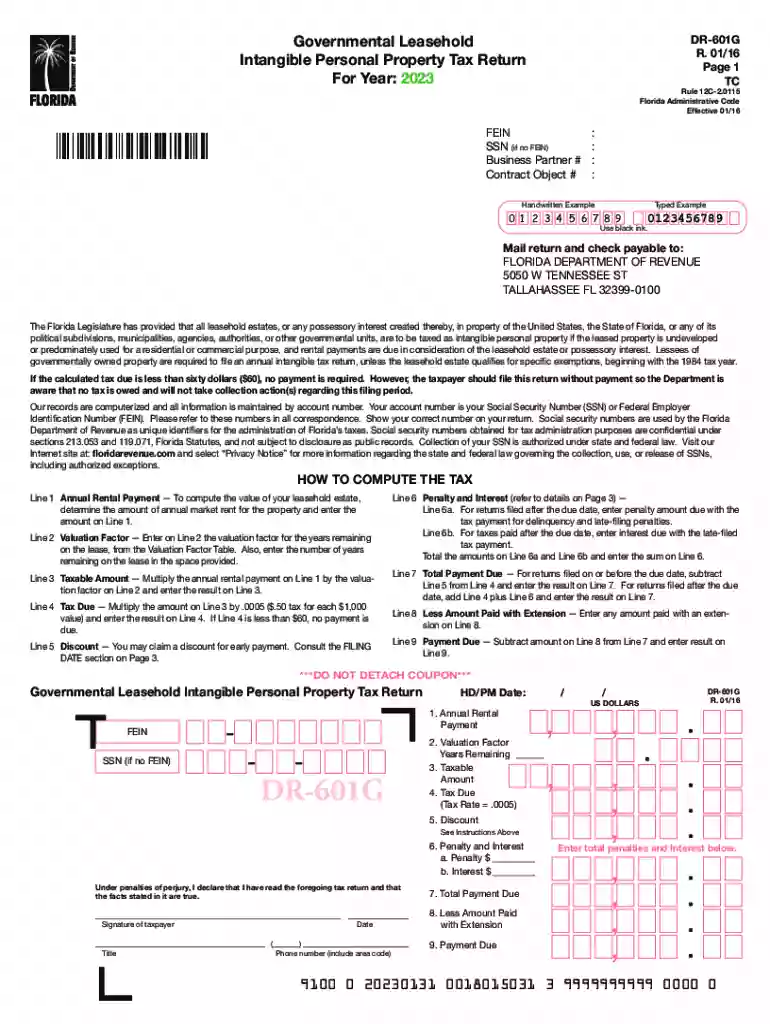
12C-2 : INTANGIBLE PERSONAL PROPERTY TAX 2026

Get Form
12C-2 : INTANGIBLE PERSONAL PROPERTY TAX Preview on Page 1

Here's how it works

01. Edit your form online
Type text, add images, blackout confidential details, add comments, highlights and more.

02. Sign it in a few clicks
Draw your signature, type it, upload its image, or use your mobile device as a signature pad.

03. Share your form with others
Send it via email, link, or fax. You can also download it, export it or print it out.

How to use or fill out 12C-2 : INTANGIBLE PERSONAL PROPERTY TAX with our platform

Form edit decoration
9.5
Ease of Setup
DocHub User Ratings on G2
9.0
Ease of Use
DocHub User Ratings on G2
  1. Click ‘Get Form’ to open the 12C-2 : INTANGIBLE PERSONAL PROPERTY TAX in the editor.
  2. Begin by entering your FEIN or SSN in the designated fields at the top of the form. Ensure accuracy as these numbers are crucial for identification.
  3. Proceed to Line 1 and input your Annual Rental Payment, which reflects the market rent for your property.
  4. On Line 2, refer to the Valuation Factor Table provided in the document and enter the appropriate valuation factor based on the years remaining on your lease.
  5. Calculate your Taxable Amount by multiplying the value from Line 1 by that from Line 2, and enter this result on Line 3.
  6. For Line 4, compute your Tax Due by multiplying the amount on Line 3 by .0005. If this amount is less than $60, no payment is required but still file the return.
  7. Complete Lines 5 through 9 as necessary, including any discounts for early payment or penalties if applicable. Make sure to review all entries for accuracy before submission.

Start using our platform today to easily complete your tax forms online for free!

See more 12C-2 : INTANGIBLE PERSONAL PROPERTY TAX versions

We've got more versions of the 12C-2 : INTANGIBLE PERSONAL PROPERTY TAX form. Select the right 12C-2 : INTANGIBLE PERSONAL PROPERTY TAX version from the list and start editing it straight away!
Versions Form popularity Fillable & printable
2024 4.7 Satisfied (30 Votes)
2023 4.2 Satisfied (57 Votes)
2022 4.7 Satisfied (85 Votes)
2021 4.8 Satisfied (224 Votes)
2020 4.3 Satisfied (191 Votes)
2019 4.4 Satisfied (141 Votes)
2016 4.1 Satisfied (52 Votes)
2014 4.2 Satisfied (68 Votes)
2012 4.2 Satisfied (38 Votes)
2011 4 Satisfied (28 Votes)
be ready to get more

Complete this form in 5 minutes or less

Get form

Got questions?

We have answers to the most popular questions from our customers. If you can't find an answer to your question, please contact us.
Contact us
Is Intangible Property Taxable? Intangible personal property has no physical shape and, as such, has no assigned value. This makes it hard to account for and properly evaluate them. But there are certain forms of intangible personal property that are subject to capital gains taxes.
The term intangible personal property includes stocks, bonds, notes (whether secured or unsecured), bank deposits, accounts receivable, patents, trademarks, copyrights, goodwill, partnership interests, life insurance policies, and other choses in action.
Many states impose taxes on TPP. These taxes are in addition to the taxes on real property such as land and buildings used to help fund various services such as schools, roads, and emergency medical services. TPP taxes are regulated at the state level but are levied primarily by local governments.
Florida Tangible Personal Property Tax Your rental property is considered business property and, as such, you must pay a separate tax on the value of your property furnishings. This tax is in addition to your annual Real Estate or Property Tax.
Floridas intangible personal property tax was an annual tax on the market value of intangible property, such as stocks, bonds, and mutual fund shares, owned by Florida residents and businesses. In 2006, the Florida legislature repealed most parts of the tax effective January 1, 2007 (Ch. 312 (H.B. 209), Laws 2006).

Security and compliance

At DocHub, your data security is our priority. We follow HIPAA, SOC2, GDPR, and other standards, so you can work on your documents with confidence.

Learn more
ccpa2
pci-dss
gdpr-compliance
hipaa
soc-compliance

People also ask

Who must file? Anyone in possession of assets on January 1 who has either a proprietorship, partnership, corporation or is a self-employed agent or contractor must file each year. Property owners who lease, lend or rent property must also file.

Related links