




01. Edit your resale certificate canada online
Type text, add images, blackout confidential details, add comments, highlights and more.

Type text, add images, blackout confidential details, add comments, highlights and more.

Draw your signature, type it, upload its image, or use your mobile device as a signature pad.

Send canada resale certificate via email, link, or fax. You can also download it, export it or print it out.
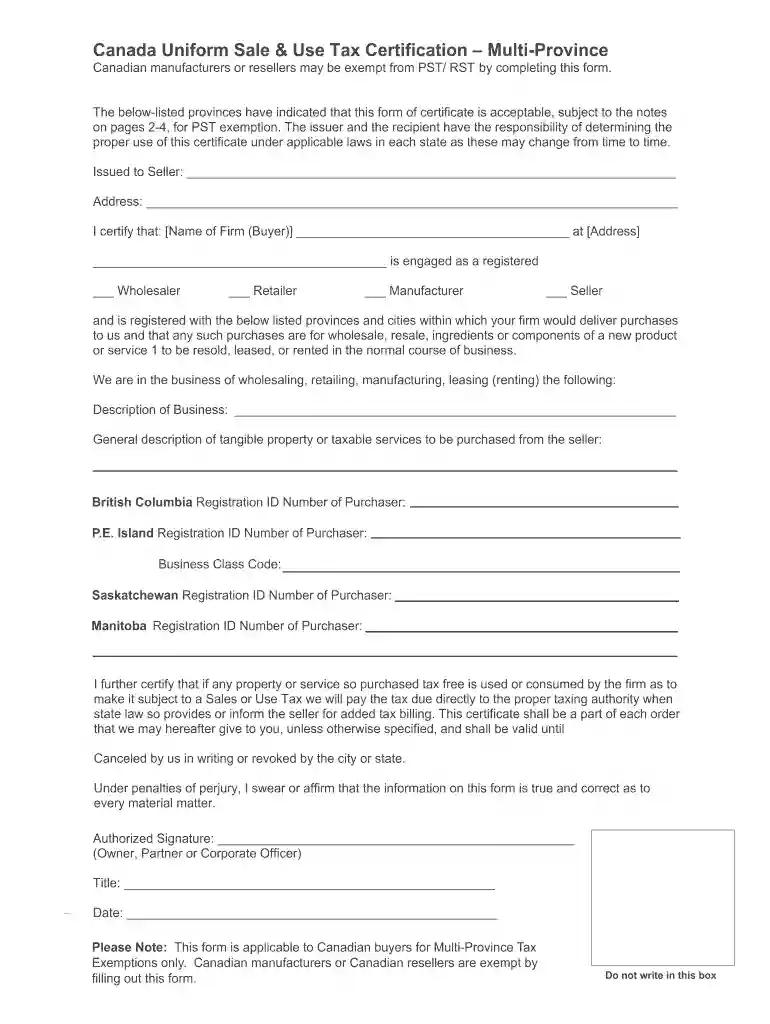
The Canada Uniform Sale & Use Tax Certification form allows businesses to claim exemptions from certain sales taxes. This certification is often utilized by manufacturers or resellers who wish to buy goods without paying sales tax, provided they certify their business status. By completing this form, a reseller asserts that they will only use the products purchased for resale, thus qualifying for the exemption. It is crucial for businesses operating in multiple provinces to obtain this certification as it standardizes the process and facilitates compliance with tax regulations.
The certification holds significant weight in the Canadian tax landscape for several reasons:
Obtaining a Canada resale certificate involves a systematic process that can vary by province. Generally, this is how the process unfolds:
Determine Eligibility: Ensure that your business qualifies as a reseller. This typically requires a valid business number and proof of sales tax registration.
Acquire the Correct Form: The specific form for the Canada Uniform Sale & Use Tax Certification may vary by province. Check provincial revenue websites to obtain the applicable form.
Complete the Application: Fill out the application by providing essential business information, including:
Submission: Some provinces allow for electronic submissions, while others may require physical copies sent through the mail.
Retention of Records: Keep a copy of the certification on file, as you may need to present it for audits or compliance checks.
In Ontario, the process may include additional requirements like obtaining a specific Ontario Resale Certificate to facilitate sales tax exemptions on goods sold in the province. Businesses should verify specifics to ensure compliance.
The certification form comprises several key components that are critical for both issuers and recipients:
Both the issuer of the certificate and the recipient have defined responsibilities:
Businesses must be attentive to specific deadlines associated with the Canada Uniform Sale & Use Tax Certification. These deadlines can include:
In British Columbia, businesses must be aware of the quarterly filing deadlines related to the Provincial Sales Tax (PST) and how these coincide with resale certificate renewals.
Understanding how different types of taxpayers can utilize the Canada Uniform Sale & Use Tax Certification is crucial:


Legally, the use of the Canada Uniform Sale & Use Tax Certification is bound by several principles:
For example, if a business claims an exemption but ultimately uses the purchased items for personal use, they may face significant legal repercussions including fines and assessment for unpaid taxes.
At DocHub, your data security is our priority. We follow HIPAA, SOC2, GDPR, and other standards, so you can work on your documents with confidence.
It is valid as a resale certificate only if it contains the purchasers name, address, signature, and Arizona transaction privilege tax (or other state sales.Read more
by RD Brown 1988 Cited by 2 MY discussion on the competitive aspects of the tax systems of Canada and the United States starts and ends with one simple theme: if we.Read more
A key step in this evaluation is the development of a scoping report that provides a snapshot of the product market, energy use, and savings potentialRead more


