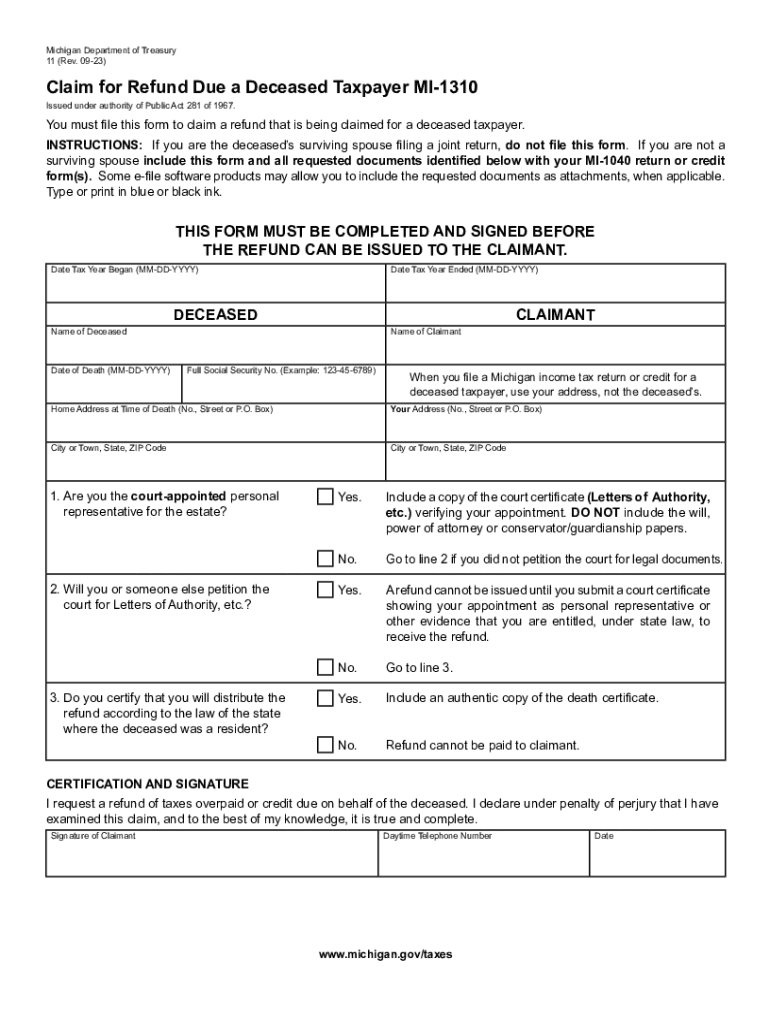
Claim for Refund Due a Deceased Taxpayer MI-1310 Claim for Refund Due a Deceased Taxpayer MI-1310-2026

Get Form
mi 1310 Preview on Page 1

Here's how it works

01. Edit your mi 1310 online
Type text, add images, blackout confidential details, add comments, highlights and more.
02. Sign it in a few clicks
Draw your signature, type it, upload its image, or use your mobile device as a signature pad.
03. Share your form with others
Send form mi 1310 via email, link, or fax. You can also download it, export it or print it out.

How to use or fill out Claim for Refund Due a Deceased Taxpayer MI-1310 with DocHub

Form edit decoration
9.5
Ease of Setup
DocHub User Ratings on G2
9.0
Ease of Use
DocHub User Ratings on G2
  1. Click ‘Get Form’ to open the Claim for Refund Due a Deceased Taxpayer MI-1310 in our editor.
  2. Begin by entering the 'Date Tax Year Began' and 'Date Tax Year Ended' in the specified fields. Ensure you use the correct format (MM-DD-YYYY).
  3. Fill in the 'Name of Deceased' and 'Date of Death'. This information is crucial for processing your claim.
  4. Next, provide your details as the claimant, including your full name and Social Security number. Remember to use your current address, not that of the deceased.
  5. Answer the questions regarding your status as a court-appointed personal representative. Attach any required documents such as Letters of Authority if applicable.
  6. Finally, review all entered information for accuracy, sign the form, and include your daytime telephone number before submitting it.

Start using our platform today to easily complete and submit your MI-1310 form online for free!

See more Claim for Refund Due a Deceased Taxpayer MI-1310 Claim for Refund Due a Deceased Taxpayer MI-1310 versions

We've got more versions of the Claim for Refund Due a Deceased Taxpayer MI-1310 Claim for Refund Due a Deceased Taxpayer MI-1310 form. Select the right Claim for Refund Due a Deceased Taxpayer MI-1310 Claim for Refund Due a Deceased Taxpayer MI-1310 version from the list and start editing it straight away!
Versions Form popularity Fillable & printable
2023 4.5 Satisfied (39 Votes)
2018 4.8 Satisfied (233 Votes)
2017 4.2 Satisfied (41 Votes)
2009 4.2 Satisfied (72 Votes)
2008 4.2 Satisfied (52 Votes)
2003 4 Satisfied (40 Votes)
1999 4 Satisfied (29 Votes)
be ready to get more

Complete this form in 5 minutes or less

Get form

Got questions?

We have answers to the most popular questions from our customers. If you can't find an answer to your question, please contact us.
Contact us
If the deceased taxpayer is a spouse on a jointly filed return, then the return can be filed electronically, and direct deposit information can be provided with the return for the refund.
The steps to be followed for raising the refund re-issue request are: Login to the e-filing portal as the legal heir. Navigate to Services and then select Refund Reissue. Enter the PAN of the deceased taxpayer. Verify the assessment year and ensure that they are correct.
Claim a refund If a refund is due on the individual income tax return of the deceased, claim the refund by submitting Form 1310, Statement of a Person Claiming Refund Due a Deceased Taxpayer.
Form 1310 is an IRS form used to claim a federal tax refund for the beneficiary of a recently deceased taxpayer. This one-page form notifies the IRS that a taxpayer has died and directs it to send the refund to the beneficiary.
A completed death notice form - BI 1663 for credit life claim submission and on request. A death certificate. The IDs of the deceased, the executor, or the Masters office representative and all appointed agents, copies of smart ID cards should show the front and back.

Security and compliance

At DocHub, your data security is our priority. We follow HIPAA, SOC2, GDPR, and other standards, so you can work on your documents with confidence.

Learn more
ccpa2
pci-dss
gdpr-compliance
hipaa
soc-compliance
be ready to get more

Complete this form in 5 minutes or less

Get form

People also ask

What Heirs Must Do Inform the Lender: Let the lender know about the borrowers death as soon as possible. Check for Loan Insurance: Some loans have insurance that pays off the debt if the borrower dies. Obtain Legal Documentation: Apply for a succession or legal heir certificate.
Court-Appointed or Certified Personal Representative This person is typically called a personal representative, executor or administrator. A court-appointed personal representative can claim the tax refund on behalf of the estate by filing the final tax return with the necessary documentation.

michigan mi 1310