Solid Waste Fees, Motor Vehicle Fees, and Gross Receipts 2026

Get Form
Solid Waste Fees, Motor Vehicle Fees, and Gross Receipts Preview on Page 1

Here's how it works

01. Edit your form online
Type text, add images, blackout confidential details, add comments, highlights and more.

02. Sign it in a few clicks
Draw your signature, type it, upload its image, or use your mobile device as a signature pad.

03. Share your form with others
Send it via email, link, or fax. You can also download it, export it or print it out.

How to use or fill out Solid Waste Fees, Motor Vehicle Fees, and Gross Receipts

Form edit decoration
9.5
Ease of Setup
DocHub User Ratings on G2
9.0
Ease of Use
DocHub User Ratings on G2
  1. Click ‘Get Form’ to open it in the editor.
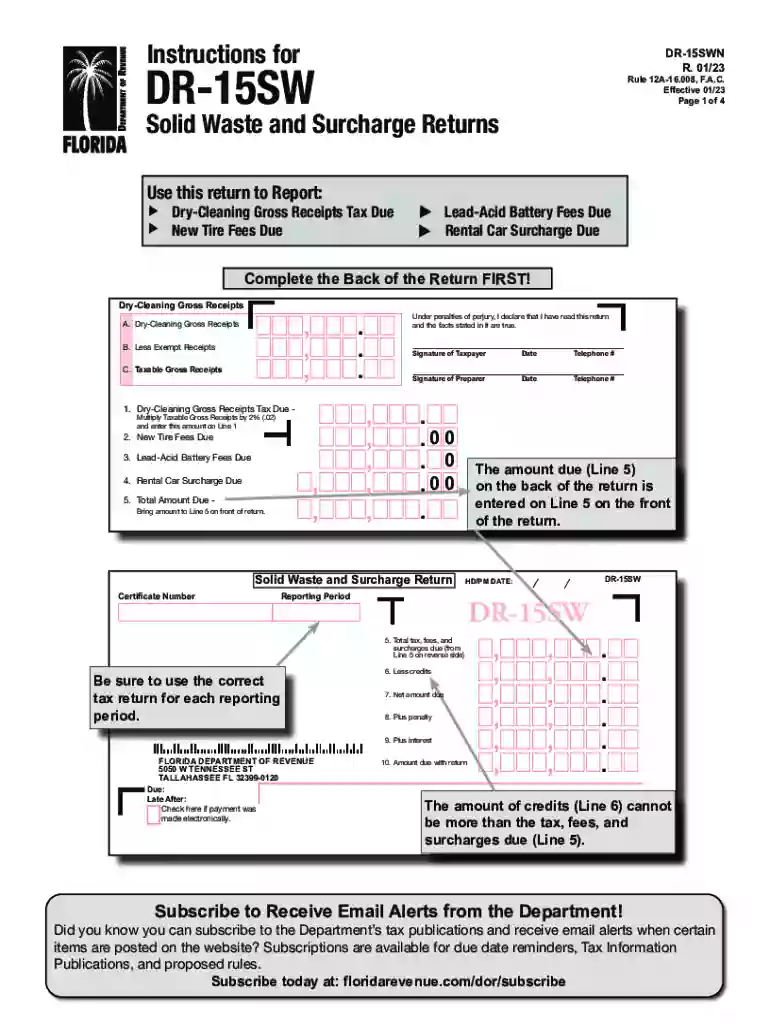
  2. Begin by completing the back of the return. Enter your Dry-Cleaning Gross Receipts on Line A, ensuring you exclude any exempt receipts.
  3. Subtract exempt receipts from your total gross receipts to calculate Taxable Gross Receipts and enter this amount on Line C.
  4. Calculate the Dry-Cleaning Gross Receipts Tax Due by multiplying the taxable gross receipts by 2% and enter this on Line 1.
  5. For New Tire Fees, enter the total fees due during the reporting period on Line 2. Repeat this for Lead-Acid Battery Fees on Line 3 and Rental Car Surcharge on Line 4.
  6. Add all amounts from Lines 1 through 4 to find Total Amount Due and bring this total to Line 5 on the front of the return.
  7. Complete any necessary deductions on Line 6, calculate your net amount due on Line 7, and include any penalties or interest as applicable.
  8. Finally, sign and date your return before submitting it electronically or via mail.

Start using our platform today for free to streamline your form completion process!

See more Solid Waste Fees, Motor Vehicle Fees, and Gross Receipts versions

We've got more versions of the Solid Waste Fees, Motor Vehicle Fees, and Gross Receipts form. Select the right Solid Waste Fees, Motor Vehicle Fees, and Gross Receipts version from the list and start editing it straight away!
Versions Form popularity Fillable & printable
2024 4.1 Satisfied (46 Votes)
2023 4.8 Satisfied (26 Votes)
2022 4.8 Satisfied (78 Votes)
2021 4.8 Satisfied (165 Votes)
2018 4.4 Satisfied (163 Votes)
2015 4.3 Satisfied (168 Votes)
be ready to get more

Complete this form in 5 minutes or less

Get form

Got questions?

We have answers to the most popular questions from our customers. If you can't find an answer to your question, please contact us.
Contact us
Disposal fees: These are paid by the waste generator to cover the cost of disposing of the waste. Landfill closure costs: These are paid by the landfill owner to cover the cost of closing the landfill.
Types of Solid Wastes Construction And Demolition Debris. Hazardous Waste Lamps. Household Hazardous Waste (HHW) Industrial/Commercial Waste. Regulated Medical Waste. Used Electronic Equipment. Used Oil. Waste Tires.
Municipal solid waste (MSW), more commonly called trash or garbage, consists of everyday items that are used and then thrown away, such as product packaging, grass clippings, furniture, clothing, bottles, food waste, newspapers, appliances, paint, and batteries.
Municipal solid waste (MSW) includes all items from homes and businesses that people no longer have any use for. These wastes are commonly called trash or garbage and include items such as food, paper, plastics, textiles, leather, wood, glass, metals, sanitary waste in septic tanks, and other wastes.
Municipal solid waste consists of materials from plastics to food scraps. The most common waste product is paper (about 40 percent of the total). Other common components are: yard waste (green waste), plastics, metals, wood, glass and food waste.

Security and compliance

At DocHub, your data security is our priority. We follow HIPAA, SOC2, GDPR, and other standards, so you can work on your documents with confidence.

Learn more
ccpa2
pci-dss
gdpr-compliance
hipaa
soc-compliance

People also ask

Generally, the term of kg/capita/day is used to express the rate of generation of municipal solid waste. For the total solid waste produced, it can be calculated by multiplying the total population by the generation rate of daily waste per capita [6] .
Solid waste refers to any discarded or unwanted materials. It includes various items such as paper, plastics, glass and food waste.
A Waste Disposal Charge refers to the fee imposed on individuals and companies for disposing of resources that could have been recycled, whether at an incinerator or waste site. These charges are meant to cover the social costs of recycling waste and can be used to fund recycling initiatives and programs.

Related links