




01. Edit your litigation hold letter sample online
Type text, add images, blackout confidential details, add comments, highlights and more.

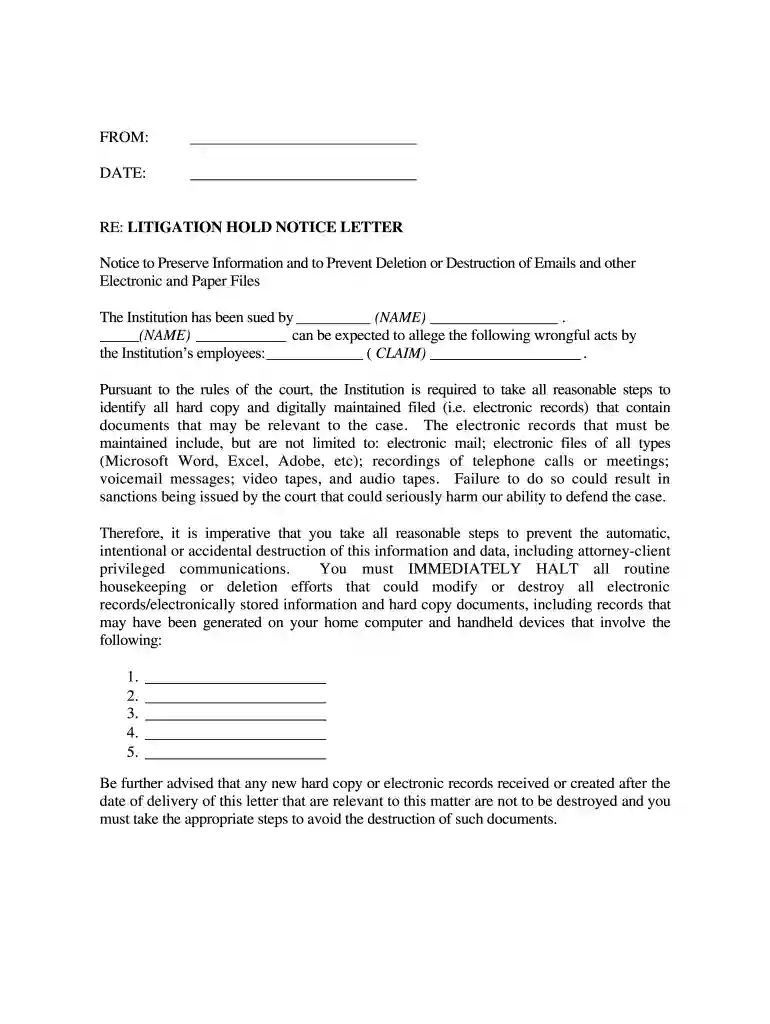
Type text, add images, blackout confidential details, add comments, highlights and more.

Draw your signature, type it, upload its image, or use your mobile device as a signature pad.

Send litigation hold letter via email, link, or fax. You can also download it, export it or print it out.
A hold letter is a formal communication that instructs parties, such as employees or other stakeholders, to preserve specific documents and records in light of a legal or regulatory issue, such as an ongoing lawsuit. This letter serves as a critical measure to prevent the destruction or alteration of relevant materials that may be needed for legal proceedings. The concept of a hold letter is rooted in compliance with legal obligations and the necessity to maintain the integrity of records, ensuring that all relevant evidence is available during investigations or litigation.
Several key components typically characterize a hold letter:
Clarity of Purpose: The letter should clearly state the reason for the hold, referencing any applicable lawsuits or legal issues that prompt the need for preservation.
Scope of Records Required: It should itemize the types of documents and records to be held, including electronic files, emails, and physical documents, to ensure all relevant materials are accounted for.
Instructions for Compliance: The letter must provide explicit instructions on how to comply with the hold directive, including methods for preserving documents and who is responsible for oversight.
Clear language in a hold letter is essential to avoid misunderstandings. Staff should fully comprehend what is required of them to prevent accidental non-compliance, which could lead to legal repercussions for both individuals and the organization.
Using a hold letter involves several critical steps, ensuring that both the sender and recipient understand the obligations involved.
Issuance: The hold letter should be issued as soon as a legal issue arises that necessitates the preservation of documents. Prompt action helps mitigate risks associated with potential evidence loss.
Distribution: The letter must be sent to all relevant personnel, including employees whose roles may involve the handling of documents under the hold. It is often best practice to provide recipients with instructions on how to manage the information.
Periodic Updates: As the situation evolves, it's advisable to issue periodic updates regarding the hold, especially if new information or additional documents come to light that must also be preserved.
Training and Acknowledgment: Provide training sessions or overview meetings for employees impacted by the hold to further clarify the process and ensure understanding. Gather acknowledgment from each employee that they have received and understood the hold letter.
Completing a hold letter effectively involves the following steps:
Identify Relevant Information: Determine the types of documents and data that need to be preserved. This includes emails, physical files, and any other related materials.
Drafting the Letter: Write a clear and concise letter that details the reasoning behind the hold, including specific legal references if applicable.
Review by Legal Counsel: Before finalizing, it can be beneficial to have the letter reviewed by legal counsel to ensure compliance with all relevant laws and practices.
Distributing the Letter: Distribute the hold letter to all required parties via email or physical mail to ensure receipt.
Collect Acknowledgements: Follow up to collect confirmations that recipients have read and understood their obligations as outlined in the letter.
Implementing a hold letter is critical in various legal contexts. Its primary purpose is to:
Preserve Evidence: Ensure that evidence relevant to legal proceedings is not destroyed or altered, thus protecting the integrity of the case.
Comply with Legal Obligations: Adhering to requests for document preservation is often mandated by law or regulation; a hold letter provides a documented compliance framework.
Mitigate Legal Risks: Failure to preserve documents can lead to adverse consequences, including legal sanctions for parties who may be seen as obstructing justice.
A well-crafted hold letter should include the following elements:
Recipient Information: Clearly state who the letter is being sent to and their responsibilities for compliance.
Date and Reference: Include the date of issuance and any relevant case numbers or identifiers to trace back the correspondence to the pertinent legal matter.
Detailed Instructions: Offer comprehensive guidance on what documents to hold, how to preserve them, and any specific procedures to follow.
Contact Information: Provide details for someone to contact if there are questions regarding the hold or if further clarification is needed.
Consequences of Non-Compliance: Explain the potential penalties for failing to adhere to the instructions, reinforcing the seriousness of the obligation.
Real-world scenarios illustrate how hold letters function in practice:
Corporate Context: A corporation facing a lawsuit may issue a hold letter to all departments that handle emails or documents related to the litigation. This allows them to gather pertinent evidence for the court.
Educational Institutions: Schools dealing with legal claims regarding student records might issue hold letters to administrative staff, instructing them to maintain all electronic and paper student files.
Healthcare Providers: A hospital involved in a medical malpractice lawsuit may send a hold letter to medical staff and administrative personnel to preserve patient records relevant to the case.
These examples highlight the critical role hold letters play in various sectors, emphasizing their function in maintaining compliance and protecting an organization’s legal standing.
At DocHub, your data security is our priority. We follow HIPAA, SOC2, GDPR, and other standards, so you can work on your documents with confidence.
A litigation hold is a written directive advising custodians of certain documents and electronically-stored information (ESI) to preserve potentiallyRead more
May 26, 2025 U Up (Hold) ; D Down (Hold) ; F Forward (Hold) ; B Backward (Hold) ; UF: Up and forward (Hold)Read more
[Sample Litigation Hold Letter from a PlaintiffNot Warranting its adequate in every case, but its an example]. Dear : John Doe hereby notifies ABCRead more


