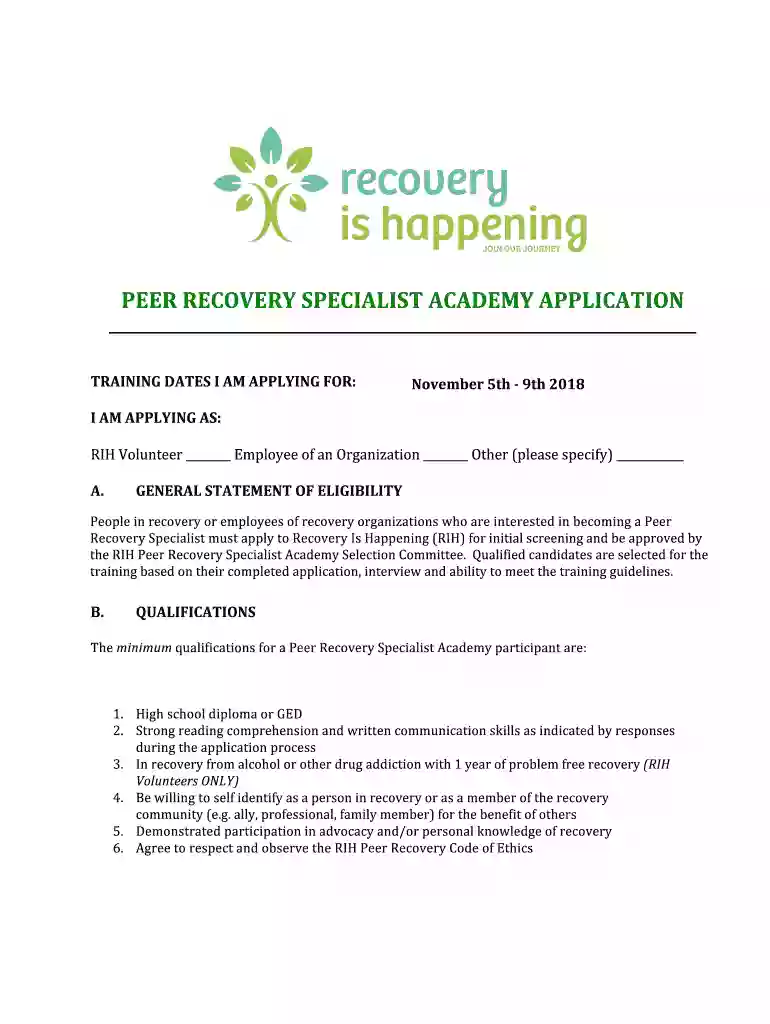
PEER RECOVERYSPECIALISTACADEMYAPPLICATION 2026

Get Form
PEER RECOVERYSPECIALISTACADEMYAPPLICATION Preview on Page 1

Here's how it works

01. Edit your form online
Type text, add images, blackout confidential details, add comments, highlights and more.

02. Sign it in a few clicks
Draw your signature, type it, upload its image, or use your mobile device as a signature pad.

03. Share your form with others
Send it via email, link, or fax. You can also download it, export it or print it out.

How to use or fill out PEER RECOVERYSPECIALISTACADEMYAPPLICATION with our platform

Form edit decoration
9.5
Ease of Setup
DocHub User Ratings on G2
9.0
Ease of Use
DocHub User Ratings on G2
  1. Click ‘Get Form’ to open the PEER RECOVERYSPECIALISTACADEMYAPPLICATION in the editor.
  2. Begin by filling out the 'Training Dates' section, indicating which training session you are applying for. Ensure that you select the correct dates.
  3. In the 'Applying As' section, choose whether you are a volunteer, employee of an organization, or other. If selecting 'Other', specify your role.
  4. Complete the 'General Statement of Eligibility' by reviewing and confirming your qualifications as outlined in the application.
  5. Fill in your personal information accurately in Section C, including your name, address, contact information, and years of recovery if applicable.
  6. Provide details about your education in Section D. Include names of schools attended and degrees earned.
  7. Draft a writing sample in Section E explaining why you should be selected for the program. This should reflect your values and leadership skills.
  8. Gather two reference letters as required in Section F and ensure they are submitted with your application.
  9. Review all sections for completeness using the checklist provided at the end of the application before submitting it via email or mail.

Start filling out your application today on our platform for free!

See more PEER RECOVERYSPECIALISTACADEMYAPPLICATION versions

We've got more versions of the PEER RECOVERYSPECIALISTACADEMYAPPLICATION form. Select the right PEER RECOVERYSPECIALISTACADEMYAPPLICATION version from the list and start editing it straight away!
Versions Form popularity Fillable & printable
2016 4.8 Satisfied (70 Votes)
be ready to get more

Complete this form in 5 minutes or less

Get form

Got questions?

We have answers to the most popular questions from our customers. If you can't find an answer to your question, please contact us.
Contact us
Register today for the entire Certified Peer Recovery Specialist Certificate program, which includes the training, 500 hours field recovery work and volunteer experience, a 25 hours of supervised practicum provided by a certified, experienced CPRS and the fees for the New Jersey Certification Board application and test
Becoming a certified PRS (CPRS) is a three-step process: Take the DBHDS 72-Hour PRS Training. Provide at least 500 hours of direct, supervised peer support, including 25 hours of supervision. After completing the 72-hour training and your 500 hours, you are ready to fill out the application for the ICRC PRS Exam.
In order to qualify for certification as a CRSS, students must have at least a high school diploma, GED or equivalent and must also have 1000 hours of formal work or volunteer experience in a field related to addictions.
Requirements: completion of the DBHDS 72-hour Peer Recovery Specialist training, accumulate 500 hours of experience providing peer support services; pass a certification exam; have at least one year of recovery from mental health and/or substance use challenges or at least one year as a family member supporting a loved
CRPS Credential Requirements a high school diploma or higher. complete 40 hours of peer specialist training. have 500 hours of supervised work experience. submit 3 letters of recommendation. pass the 100-item multiple-choice exam.

People also ask

Serving as an advocate, mentor, or facilitator for resolution of issues that a peer is unable to resolve on his or her own. Assisting in the development of recovery goals. Developing community support. Providing information on ways to maintain personal wellness and recovery.

Related links