Requiring medical intervention: Topics by Science 2026

Get Form
requiring medical intervention: Topics by Science Preview on Page 1

Here's how it works

01. Edit your form online
Type text, add images, blackout confidential details, add comments, highlights and more.

02. Sign it in a few clicks
Draw your signature, type it, upload its image, or use your mobile device as a signature pad.

03. Share your form with others
Send it via email, link, or fax. You can also download it, export it or print it out.

How to use or fill out requiring medical intervention: Topics by Science with our platform

Form edit decoration
9.5
Ease of Setup
DocHub User Ratings on G2
9.0
Ease of Use
DocHub User Ratings on G2
  1. Click ‘Get Form’ to open it in the editor.
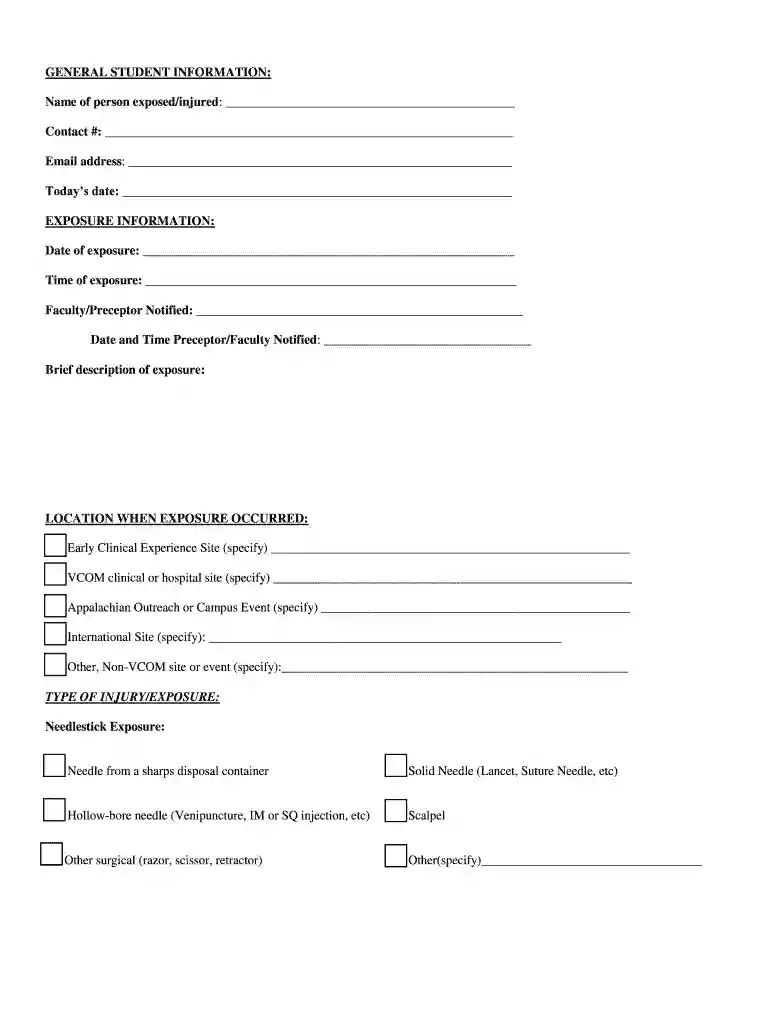
  2. Begin by entering your general student information, including your name, contact number, email address, and today's date.
  3. In the exposure information section, provide the date and time of exposure. Notify your faculty/preceptor and document when they were informed.
  4. Describe the incident briefly in the designated field. Specify the location of the exposure from the provided options.
  5. Indicate the type of injury/exposure by selecting from the list of options such as needlestick exposure or high-risk body fluid.
  6. Document what precautions were in use at the time of the incident, selecting all that apply.
  7. Complete the source information section regarding HIV and Hepatitis status if applicable.
  8. Outline your follow-up plan by providing details for your primary care provider or any urgent care appointments scheduled.
  9. Finally, sign and date at the bottom of the form before submitting it to ensure proper documentation.

Start using our platform today to easily fill out your medical intervention forms for free!

be ready to get more

Complete this form in 5 minutes or less

Get form

Got questions?

We have answers to the most popular questions from our customers. If you can't find an answer to your question, please contact us.
Contact us
What are the main categories of interventions that function to maintain human health? There are several main categories of medical interventions that help us stay healthy. This includes immunology, surgery, genetics, pharmacology, medical devices, and diagnostics.
There are several main categories of medical interventions that help us stay healthy. This includes immunology, surgery, genetics, pharmacology, medical devices, and diagnostics. The medical interventions we will learn throughout the course can all be separated into these main categories.
2. Types of intervention Vaccines. Nutritional interventions. Maternal and neonatal interventions. Education and behaviour change. Environmental alterations. Vector and intermediate host control. Drugs for the prevention of disease. Injury prevention.
4 Education and behaviour change. Some interventions directed at preventing disease are based solely upon changing human behaviour (for example, anti-smoking campaigns or campaigns to promote breastfeeding).
Interventions can be classified into two broad categories: (1) preventive interventions are those that prevent disease from occurring and thus reduce the incidence (new cases) of disease, and (2) therapeutic interventions are those that treat, mitigate, or postpone the effects of disease, once it is under way, and thus

Security and compliance

At DocHub, your data security is our priority. We follow HIPAA, SOC2, GDPR, and other standards, so you can work on your documents with confidence.

Learn more
ccpa2
pci-dss
gdpr-compliance
hipaa
soc-compliance

People also ask

(IN-ter-VEN-shun) In medicine, a treatment, procedure, or other action taken to prevent or treat disease, or improve health in other ways.
What are the types of intervention? There are are various forms of intervention, based on the purpose of the act. Types of intervention include military, cultural, economic, humanitarian and political.
Disorders and Conditions Cancers. Diabetes Mellitus. Genetics/Birth Defects. Infections. Injuries and Wounds. Mental Health and Behavior. Metabolic Problems. Poisoning, Toxicology, Environmental Health.

Related links