Faculty Handbook for Short-Term Faculty-Led Programs 2026

Get Form
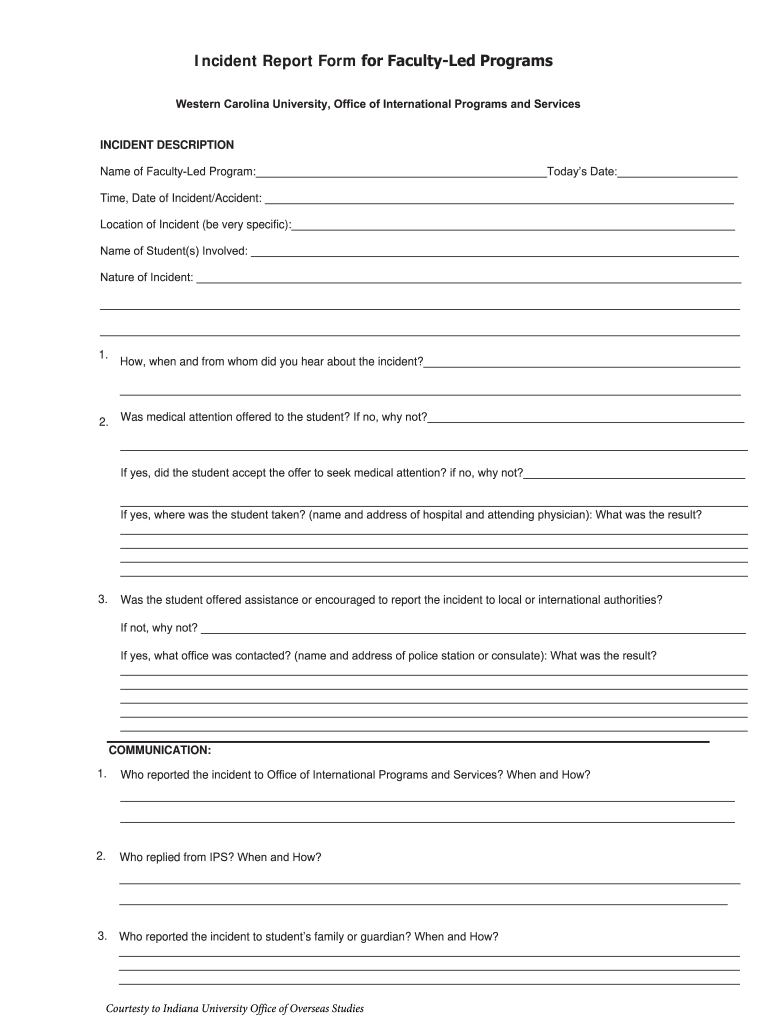
Faculty Handbook for Short-Term Faculty-Led Programs Preview on Page 1

Here's how it works

01. Edit your form online
Type text, add images, blackout confidential details, add comments, highlights and more.
02. Sign it in a few clicks
Draw your signature, type it, upload its image, or use your mobile device as a signature pad.
03. Share your form with others
Send it via email, link, or fax. You can also download it, export it or print it out.

How to use or fill out Faculty Handbook for Short-Term Faculty-Led Programs with our platform

Form edit decoration
9.5
Ease of Setup
DocHub User Ratings on G2
9.0
Ease of Use
DocHub User Ratings on G2
  1. Click ‘Get Form’ to open the Faculty Handbook for Short-Term Faculty-Led Programs in the editor.
  2. Begin by filling in the 'Name of Faculty-Led Program' and 'Today’s Date' fields. Ensure accuracy as this information is crucial for record-keeping.
  3. In the 'Time, Date of Incident/Accident' section, provide specific details about when the incident occurred. This helps in tracking and addressing incidents effectively.
  4. For the 'Location of Incident', be as specific as possible. Include landmarks or room numbers to assist in identifying where the incident took place.
  5. List all students involved in the incident under 'Name of Student(s) Involved'. This ensures that all parties are accounted for in follow-up actions.
  6. Detail the 'Nature of Incident' thoroughly. Use clear language to describe what happened, including any relevant context or circumstances surrounding the event.
  7. Answer subsequent questions regarding medical attention and communication with authorities. Provide comprehensive responses to ensure clarity and thoroughness.

Start using our platform today to streamline your document editing and form completion process for free!

be ready to get more

Complete this form in 5 minutes or less

Get form

Got questions?

We have answers to the most popular questions from our customers. If you can't find an answer to your question, please contact us.
Contact us
These programs typically involve a group of students traveling together to another country for a specific period, usually a few weeks to a few months. The faculty-led model allows for an integrated and cohesive educational experience, as students and faculty share the learning journey in a foreign environment.
Faculty development is essential for supporting faculty in acquiring and transforming their skills, which ultimately leads to the improvement, enrichment and update of facultys teaching practice, positively impacting the quality of students learning journey.
USM travel courses are short-term programs, usually one to three weeks in length, which are led by USM faculty members. Each program has its own specific focus and location. The participants travel and study as a group.
Improving an instructors ability to educate can similarly lead to better student performance. Research suggests that investing in faculty development can result in higher grades among students. By implementing more effective teaching strategies, students are able to absorb more of the subject matter.
Traditionally, the rule of thumb for education has been that at the undergraduate level, faculty would train students how to think. At the masters level, faculty would teach students how to be experts in their field, and then at the doctoral level, students would learn to bring new knowledge into the being.

People also ask

This handbook contains the By-laws of the Faculty and summarizes the most important principles, policies, and administrative procedures of the Institute concerning the faculty and academic staff. It may be modified from time to time by special memoranda as revisions or additions become necessary.
For students, a well-designed curriculum can enhance their motivation, retention, satisfaction, and success by providing clear goals, expectations, and feedback, as well as opportunities for choice, collaboration, and reflection.
Research indicates that the three primary goals that guide faculty development programs are: creating or sustaining a culture of teaching excellence; advancing new initiatives in teaching and learning; and supporting individual faculty members goals for professional development.

Related links