Type text, add images, blackout confidential details, add comments, highlights and more.
02. Sign it in a few clicks
Draw your signature, type it, upload its image, or use your mobile device as a signature pad.
03. Share your form with others
Send stuttering case via email, link, or fax. You can also download it, export it or print it out.
How to use or fill out the Stuttering Case History Form
Ease of Setup
DocHub User Ratings on G2
Ease of Use
DocHub User Ratings on G2
Click ‘Get Form’ to open it in the editor.
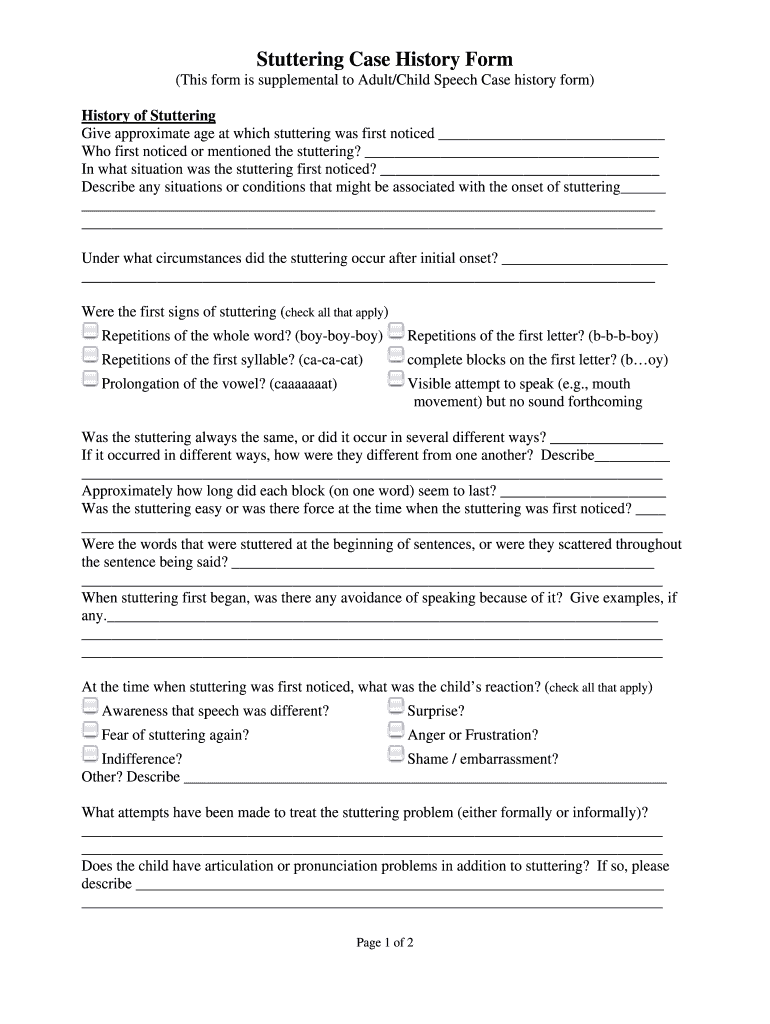
Begin by filling in the approximate age at which stuttering was first noticed. This information is crucial for understanding the onset of stuttering.
Identify who first noticed the stuttering and describe the situation where it was first observed. This context can provide valuable insights into triggers.
In the section regarding symptoms, check all applicable signs of stuttering such as repetitions or blocks. Be thorough to ensure accurate assessment.
Detail any attempts made to treat the stuttering, as well as any additional articulation issues. This helps in evaluating past interventions.
Finally, answer the yes/no questions regarding daily interactions and situations that may exacerbate or alleviate stuttering. This will help in understanding its impact on life.
Start using our platform today to easily fill out your Stuttering Case History Form for free!
The next four levels- borderline stuttering, beginning stuttering, intermediate stuttering and advanced stuttering- reflect the progressive stages of the development of the disorder.
What are the three types of stutters?
There are three types of stuttering: Developmental. Most common in children younger than 5 years old, particularly males, this type occurs as they develop their speech and language abilities. Neurogenic. Signal abnormalities between the brain and nerves or muscles cause this type. Psychogenic.
What are the three types of stuttering?
Common causes include neurological factors, such as brain injuries, strokes, or conditions like Parkinsons disease that affect speech areas in the brain. Psychological triggers, such as stress, trauma, or anxiety, can also lead to stuttering in adulthood.
Is it possible to form a stutter?
Developmental stuttering. This is the most common type of stuttering in children. It usually happens when a child is between ages 2 and 5. It may happen when a childs speech and language development lags behind what he or she needs or wants to say.
What is the 3 factor model of stuttering?
► A 3-factor causal model is presented which proposes to explain moments of stuttering. ► The three factors are (1) a neural processing deficit, (2) triggers inherent in spoken language, and (3) modulating factors.
stuttering case history
Stuttering Case history FORM for adultsStuttering Case History Form childAdult stuttering assessment PDFFree stuttering assessmentStuttering Intake FormOASES stutteringOASES stuttering PDFOASES stuttering free
Cookie consent notice
This site uses cookies to enhance site navigation and personalize your experience.
By using this site you agree to our use of cookies as described in our Privacy Notice.
You can modify your selections by visiting our Cookie and Advertising Notice.