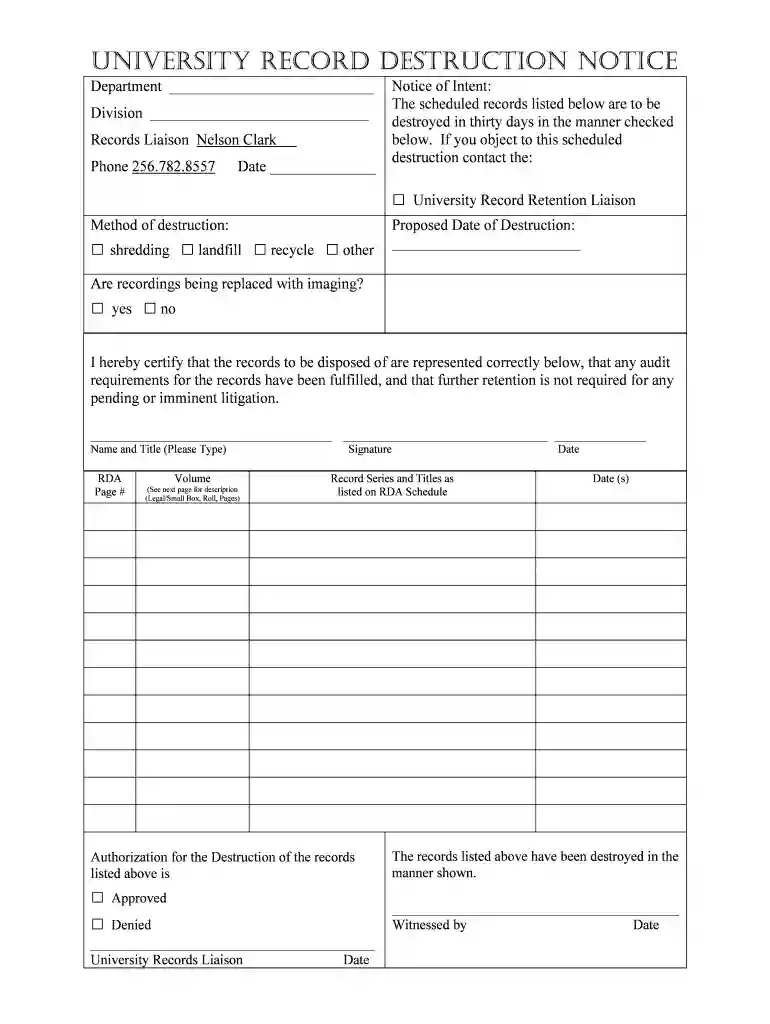
Records Retention and Destruction Form 2026

Get Form
Records Retention and Destruction Form Preview on Page 1

Here's how it works

01. Edit your form online
Type text, add images, blackout confidential details, add comments, highlights and more.

02. Sign it in a few clicks
Draw your signature, type it, upload its image, or use your mobile device as a signature pad.

03. Share your form with others
Send it via email, link, or fax. You can also download it, export it or print it out.

How to use or fill out Records Retention and Destruction Form with our platform

Form edit decoration
9.5
Ease of Setup
DocHub User Ratings on G2
9.0
Ease of Use
DocHub User Ratings on G2
  1. Click ‘Get Form’ to open the Records Retention and Destruction Form in the editor.
  2. Begin by filling in the department and division fields at the top of the form. This information is essential for identifying which records are being addressed.
  3. Enter the date of the notice in the designated field to establish a timeline for record destruction.
  4. In the 'Notice of Intent' section, check the method of destruction that applies: shredding, landfill, recycle, or other. This specifies how you plan to dispose of the records.
  5. Indicate whether recordings are being replaced with imaging by selecting 'yes' or 'no'.
  6. Certify that all records listed for disposal are accurate and that audit requirements have been met by typing your name and title in the appropriate fields.
  7. Finally, submit your authorization for destruction by checking either 'Approved' or 'Denied', and ensure to sign and date where indicated.

Start using our platform today to streamline your document editing and form completion process for free!

be ready to get more

Complete this form in 5 minutes or less

Get form

Got questions?

We have answers to the most popular questions from our customers. If you can't find an answer to your question, please contact us.
Contact us
Does the IRS destroy tax records after 7 years? No, the IRS destroys most individual returns after 6 years, unless the timeline is extended because they are associated with an open balance due. For example, returns filed in 2019 will likely be destroyed in 2026.
Keep records for 7 years if you file a claim for a loss from worthless securities or bad debt deduction. Keep records for 6 years if you do not report income that you should report, and it is more than 25% of the gross income shown on your return. Keep records indefinitely if you do not file a return.
A retention and disposition schedule is a plan of action that indicates the period of time you should retain your records. Records schedules allow you to dispose of records in a timely, systematic manner by setting retention and disposal guidelines based on administrative, legal, fiscal, or research needs.
Minutes of meetings and company resolutions must be kept for at least 10 years from the date of the resolution or meeting to which they relate. Accounting and financial records should usually be kept for at least 6 years from the end of the financial year or accounting period to which they relate.
Keep records indefinitely if you do not file a return. Keep records indefinitely if you file a fraudulent return. Keep employment tax records for at least 4 years after the date that the tax becomes due or is paid, whichever is later.

Security and compliance

At DocHub, your data security is our priority. We follow HIPAA, SOC2, GDPR, and other standards, so you can work on your documents with confidence.

Learn more
ccpa2
pci-dss
gdpr-compliance
hipaa
soc-compliance

People also ask

No, there is no need to keep tax returns that are 20 years old. According to the Internal Revenue Service website, the longest recommended period of time to retain tax records is seven years. This is the recommended time if you plan to file a claim for a loss from bad debt reduction or worthless securities.
Logs should document the destruction of records regardless of format. At a minimum, the log should include: Disposition Authority Number (DAN) of the record series being destroyed; Title/name of the record series; Date range of the records being destroyed (start date to end date); and, Date of destruction.

Related links