




01. Edit your 2019 w 4 form printable free online
Type text, add images, blackout confidential details, add comments, highlights and more.

Type text, add images, blackout confidential details, add comments, highlights and more.

Draw your signature, type it, upload its image, or use your mobile device as a signature pad.

Send ptin renewal form via email, link, or fax. You can also download it, export it or print it out.
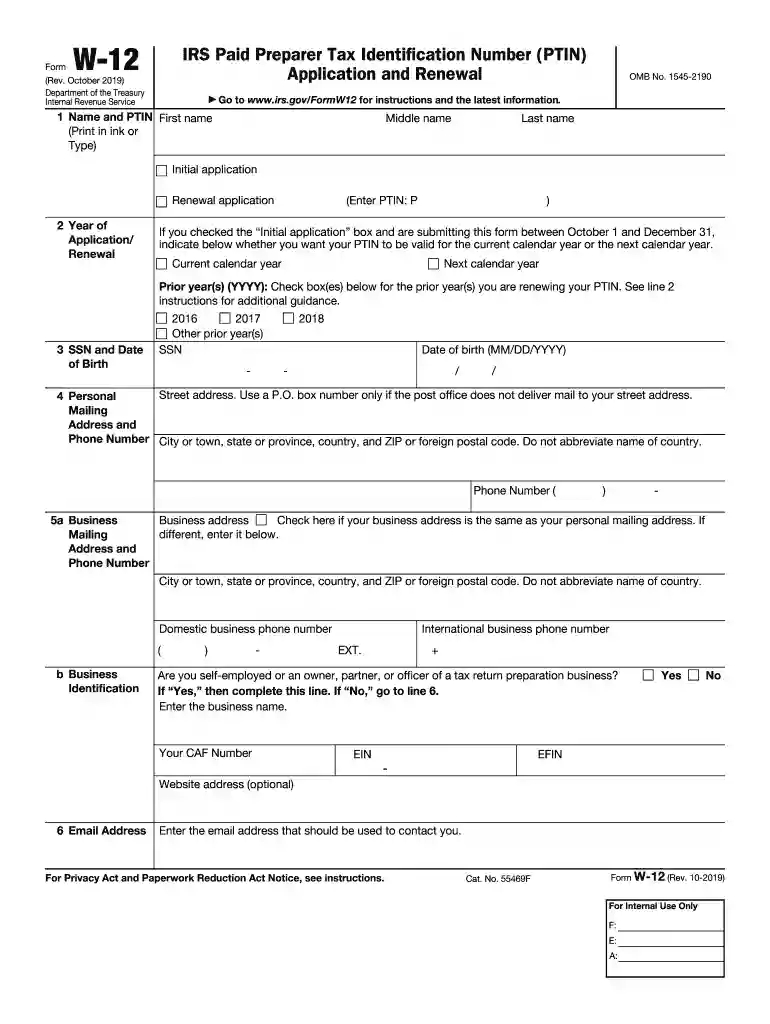
The Paid Preparer Tax Identification Number (PTIN) is a unique identifier issued by the IRS to individuals who are compensated for preparing, or assisting in preparing, tax returns. Any tax professional who receives payment for preparing federal tax returns is required to have a PTIN. It's a critical component for maintaining compliance with IRS requirements and establishing credibility with clients.
The PTIN renewal process involves updating your PTIN annually to ensure continued compliance with IRS regulations. The renewal is crucial to ensure that preparers can legally continue their practice without interruptions.
The PTIN renewal process is straightforward and essential for tax professionals in the U.S. It is an annual requirement to maintain your eligibility to prepare federal tax returns for compensation. The renewed PTIN is used for preparing and submitting tax documents to the IRS. It must be included on all tax returns that you prepare for clients, serving as a mandatory compliance measure.
To effectively use the renewed PTIN, ensure you update your records and communicate any changes to relevant parties. Tax professionals should always verify that their PTIN is current before the commencement of the tax season.
Renewing your PTIN involves accessing the IRS PTIN renewal system, which is available online for convenience. Here’s a step-by-step process:
In some cases, new applicants may be required to submit additional documentation to verify identity or credentials. Always check for specific instructions related to your particular circumstances.
Completing the PTIN renewal effectively involves several systematic steps. These steps help ensure that all necessary information is up to date:
These steps can be completed in relatively little time if all required information is readily available.
Renewing your PTIN annually is mandatory for maintaining your eligibility to prepare federal tax returns for compensation in the U.S. This requirement ensures that tax professionals remain accountable and identifiable, which is crucial in preventing fraudulent practices.
Without a current PTIN, preparing tax returns for pay is illegal and could subject you to IRS penalties. Furthermore, a renewed PTIN demonstrates professional integrity and commitment to legal compliance, which could enhance your reputation with clients.
Understanding how your PTIN interacts with other tax-related identifiers is crucial. While the PTIN is unique to compensated preparers, other identifiers may include EINs for businesses and SSNs for individual tax filings.
The renewal period generally opens in mid-October and extends through the end of the calendar year. Missing this window may lead to delays in your ability to practice.
When renewing your PTIN, several elements are crucial for a successful application:
Correctly managing these elements ensures a smooth renewal process and continued compliance.
Failing to renew your PTIN can have serious consequences. The IRS imposes penalties on tax preparers who operate without a current PTIN, including potential fines and the possibility of being barred from practice.
Maintaining an updated PTIN is critical not only for adhering to legal requirements but also for protecting your professional standing as a tax preparer.
We've got more versions of the 2019 w 4 form printable free form. Select the right 2019 w 4 form printable free version from the list and start editing it straight away!
| Versions | Form popularity | Fillable & printable |
|---|---|---|
| 2025 | 4.7 Satisfied (38 Votes) | |
| 2024 | 4.6 Satisfied (28 Votes) | |
| 2023 | 4.6 Satisfied (29 Votes) | |
| 2022 | 4.3 Satisfied (25 Votes) | |
| 2021 | 4.8 Satisfied (69 Votes) | |
| 2020 | 4.4 Satisfied (86 Votes) | |
| 2019 | 4.4 Satisfied (59 Votes) | |
| 2017 | 4.4 Satisfied (61 Votes) | |
| 2017 | 4.4 Satisfied (205 Votes) | |
| 2015 | 4.4 Satisfied (325 Votes) | |
| 2014 | 4.1 Satisfied (55 Votes) | |
| 2013 | 4 Satisfied (29 Votes) | |
| 2012 | 4 Satisfied (56 Votes) | |
| 2011 | 4 Satisfied (54 Votes) |
At DocHub, your data security is our priority. We follow HIPAA, SOC2, GDPR, and other standards, so you can work on your documents with confidence.


Oct 16, 2025 Renew your PTIN in 3 easy steps: 1. Access your account. If you already have an online PTIN account, login now. 2. Renew your PTIN. CompleteRead more
Apr 27, 2017 You can apply for a PTIN online or by filing Form. W-12, IRS Paid Preparer Tax Identification Number (PTIN). Application and Renewal. For moreRead more


