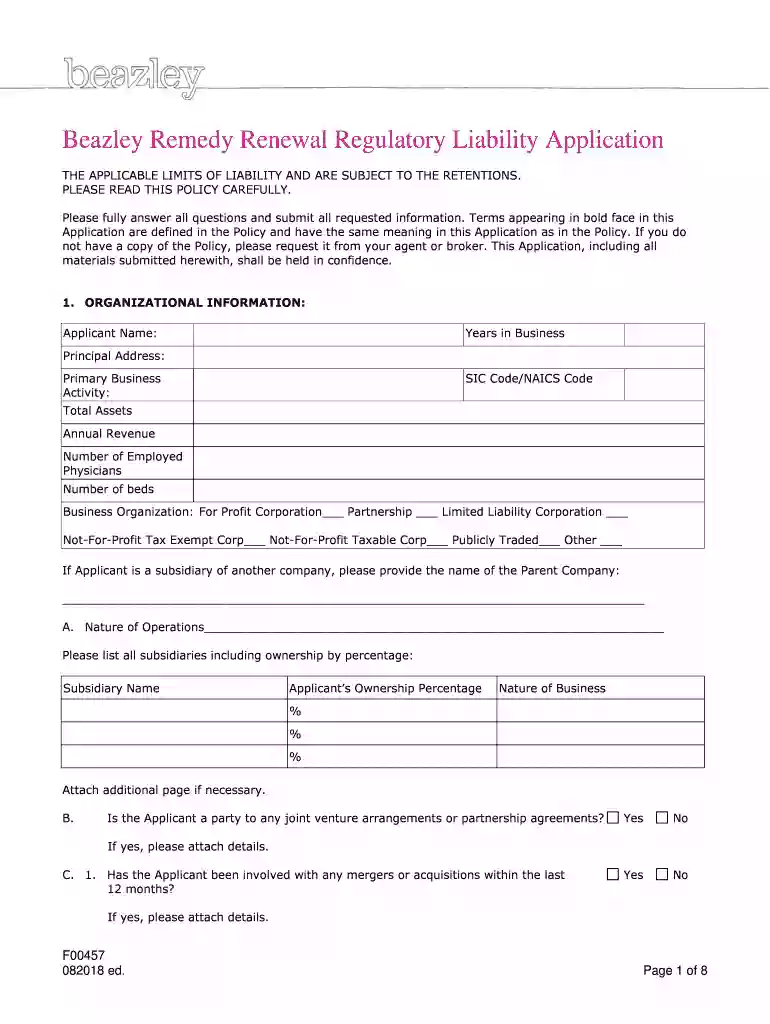
THE APPLICABLE LIMITS OF LIABILITY AND ARE SUBJECT TO THE RETENTIONS 2026

Get Form
THE APPLICABLE LIMITS OF LIABILITY AND ARE SUBJECT TO THE RETENTIONS Preview on Page 1

Here's how it works

01. Edit your form online
Type text, add images, blackout confidential details, add comments, highlights and more.

02. Sign it in a few clicks
Draw your signature, type it, upload its image, or use your mobile device as a signature pad.

03. Share your form with others
Send it via email, link, or fax. You can also download it, export it or print it out.

How to use or fill out THE APPLICABLE LIMITS OF LIABILITY AND ARE SUBJECT TO THE RETENTIONS

Form edit decoration
9.5
Ease of Setup
DocHub User Ratings on G2
9.0
Ease of Use
DocHub User Ratings on G2
  1. Click ‘Get Form’ to open it in the editor.
  2. Begin with the 'Organizational Information' section. Fill in your Applicant Name, Years in Business, Principal Address, and Primary Business Activity. Ensure all fields are completed accurately.
  3. Proceed to the compliance-related questions. Answer whether there have been any changes to your Medical Billings or Chief Compliance Officer, and provide details if applicable.
  4. In the 'Billing Procedures' section, specify who performs government-funded healthcare program billing and indicate if any billing is done by a third party. Include relevant percentages and names as required.
  5. Complete the 'Coverage Information' section by detailing current limits, retentions, and premiums. Make sure to check for any specific instructions related to your state.
  6. Finally, review all sections for completeness before signing. Ensure that all necessary attachments are included as specified in the application.

Start using our platform today to streamline your document editing and form completion process for free!

See more THE APPLICABLE LIMITS OF LIABILITY AND ARE SUBJECT TO THE RETENTIONS versions

We've got more versions of the THE APPLICABLE LIMITS OF LIABILITY AND ARE SUBJECT TO THE RETENTIONS form. Select the right THE APPLICABLE LIMITS OF LIABILITY AND ARE SUBJECT TO THE RETENTIONS version from the list and start editing it straight away!
Versions Form popularity Fillable & printable
2018 4.8 Satisfied (30 Votes)
be ready to get more

Complete this form in 5 minutes or less

Get form

Got questions?

We have answers to the most popular questions from our customers. If you can't find an answer to your question, please contact us.
Contact us
The words retention and deductible are often used interchangeably. Both terms refer to the sum of money that the insured is responsible for in the event of a covered claim.
The retention may be by way of retention of cash or by a more complex mechanism. In the context of insurance, this is also known as an excess, and is a part of the relevant liability which the insured party agrees to pay before the insurer will meet the relevant claim.
A self-insured retention is a dollar amount specified in a liability insurance policy that must be paid by the insured before the insurance policy will respond to a loss.
Retained Limits are the financial thresholds that must be met by the insured before an insurance policy begins to pay for a claim. These limits are usually outlined in policies such as umbrella insurance, excess liability insurance, or certain business liability coverages.
Another way of thinking of a Retention is that the insured retains or selfinsures some of the risk. For example, if a policy limit is $20 million and the retention is $1 million, the insured will pay for all costs associated with a loss that is up to $1 million.

Security and compliance

At DocHub, your data security is our priority. We follow HIPAA, SOC2, GDPR, and other standards, so you can work on your documents with confidence.

Learn more
ccpa2
pci-dss
gdpr-compliance
hipaa
soc-compliance
be ready to get more

Complete this form in 5 minutes or less

Get form

People also ask

With a deductible, your insurer is involved in the claim from the start. With a self-insured retention, youre on your own until you pay the full retention amount. For example, if you have a $10,000 deductible and a $50,000 claim, your insurer pays $40,000.

Related links