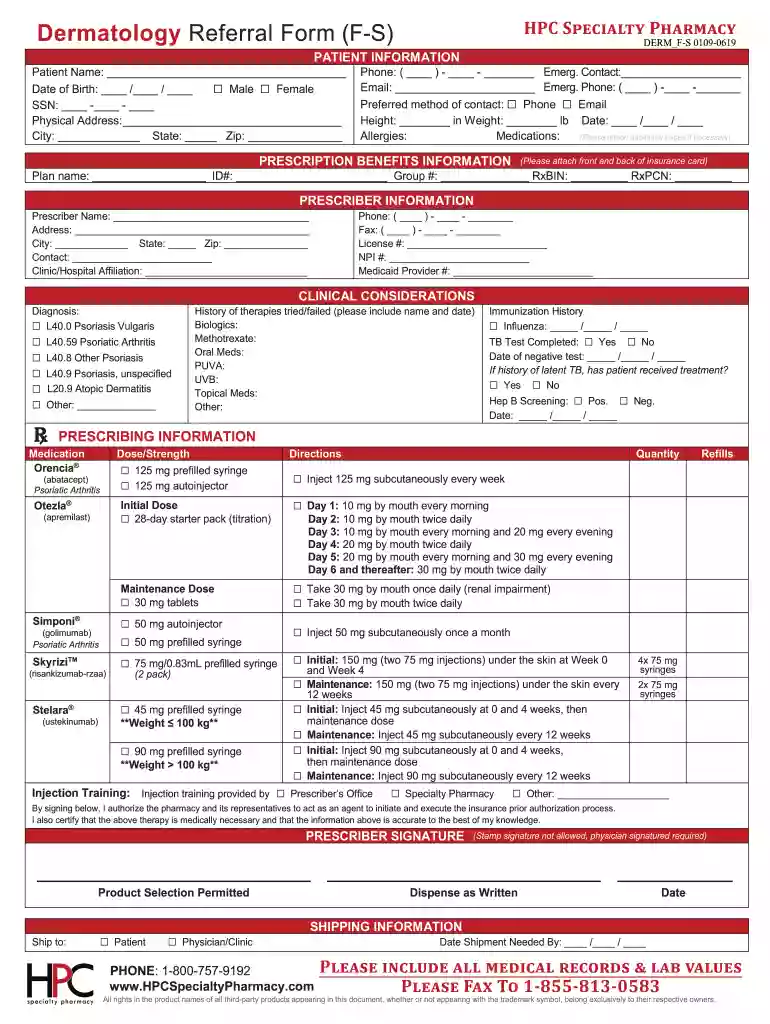
Dermatology Referral Form (F-S) 2026

Get Form
Dermatology Referral Form (F-S) Preview on Page 1

Here's how it works

01. Edit your form online
Type text, add images, blackout confidential details, add comments, highlights and more.

02. Sign it in a few clicks
Draw your signature, type it, upload its image, or use your mobile device as a signature pad.

03. Share your form with others
Send it via email, link, or fax. You can also download it, export it or print it out.

How to use or fill out Dermatology Referral Form (F-S) with DocHub

Form edit decoration
9.5
Ease of Setup
DocHub User Ratings on G2
9.0
Ease of Use
DocHub User Ratings on G2
  1. Click ‘Get Form’ to open the Dermatology Referral Form (F-S) in our editor.
  2. Begin by filling out the 'Patient Information' section. Enter the patient's name, date of birth, gender, and contact details. Ensure accuracy for effective communication.
  3. In the 'Prescription Benefits Information' section, attach a copy of the insurance card and provide necessary details such as plan name and ID number.
  4. Complete the 'Prescriber Information' section with the prescriber's name, address, and contact information to ensure proper referral processing.
  5. In 'Clinical Considerations', select the appropriate diagnosis and document any previous therapies tried or failed. This information is crucial for treatment planning.
  6. Fill out the 'Prescribing Information' section carefully, detailing medication dosages and instructions. Make sure to check off any relevant tests completed.
  7. Finally, sign in the designated area to authorize the pharmacy's actions regarding insurance prior authorization.

Start using our platform today to streamline your form completion process for free!

See more Dermatology Referral Form (F-S) versions

We've got more versions of the Dermatology Referral Form (F-S) form. Select the right Dermatology Referral Form (F-S) version from the list and start editing it straight away!
Versions Form popularity Fillable & printable
2019 4.8 Satisfied (198 Votes)
be ready to get more

Complete this form in 5 minutes or less

Get form

Got questions?

We have answers to the most popular questions from our customers. If you can't find an answer to your question, please contact us.
Contact us
If you ask your GP to refer you to a specialist, theyll probably suggest that you first try various tests or treatment options to see whether your condition improves. Generally, you cannot self-refer to a specialist at a hospital within the NHS, except when accessing sexual health clinics or AE treatment.
Only consider urgent referral (appointment within two weeks) if a person has a skin lesion that raises the suspicion of a basal cell carcinoma and theres concern a delay may have an unfavourable impact, because of the location or size of the lesion.
In order to see a dermatologist you will first need a referral letter from your GP who should be able to direct you. The Irish Skin Foundation (ISF) is a national charity supporting people skin conditions. It provides reliable and independent information reviewed by Irish-based dermatologists, nurses and patients.
While a referral isnt always required to see a dermatologist, it is often necessary to secure insurance coverage and receive a proper diagnosis and treatment. Consulting a GP can be an essential first step in determining whether specialized care is needed.
Also, before you go to the dermatologist, make sure you dont need a referral from your primary care doctor, or else your insurance may not cover the cost. If you do need one, just call your regular doctors office and ask for a referral to be sent to your derm. Theyll help walk you through it.

Security and compliance

At DocHub, your data security is our priority. We follow HIPAA, SOC2, GDPR, and other standards, so you can work on your documents with confidence.

Learn more
ccpa2
pci-dss
gdpr-compliance
hipaa
soc-compliance
be ready to get more

Complete this form in 5 minutes or less

Get form

People also ask

The referral process for dermatological care from an insurance company typically begins when you visit the primary care physician. From there, your physician can diagnose a condition and may refer you to a dermatologist for further evaluation and treatment.
If a GP refers you to a specialist (dermatologist) because they think you could have skin cancer, youll have tests to check for melanoma. The specialist will check your skin and ask you about any changes youve noticed. They may use a magnifying device that lets them look at the skin more closely.

Related links