
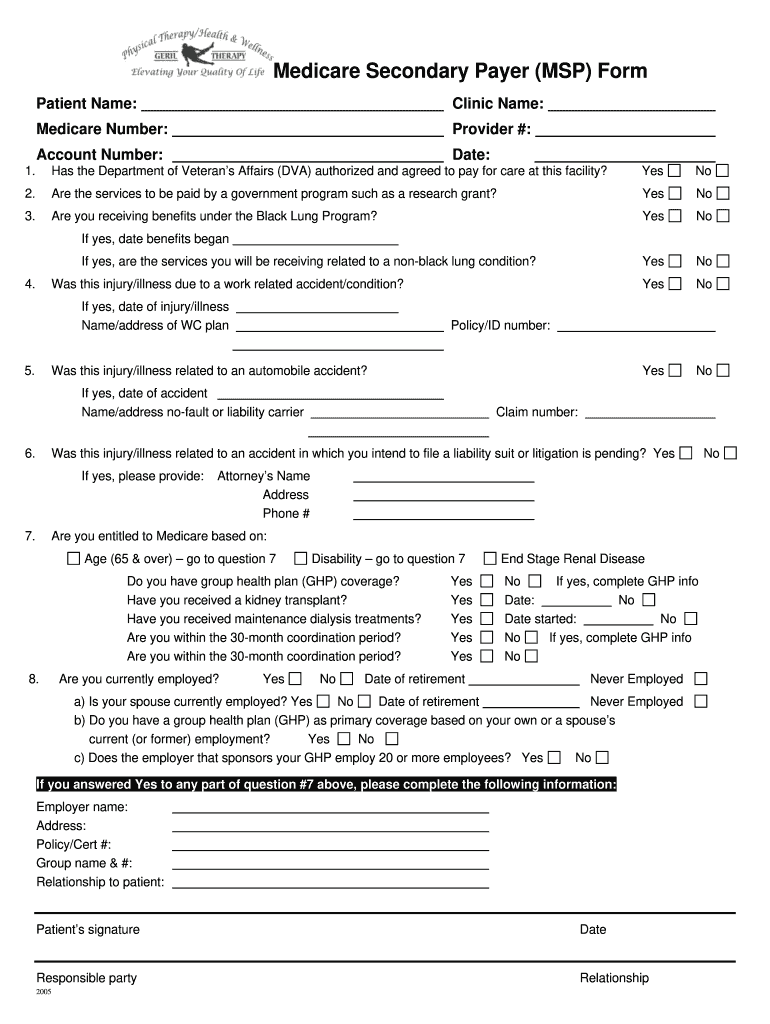







Definition and Meaning of the CMS Secondary Payer Form
The CMS Secondary Payer form, often referred to informally as the MSP (Medicare Secondary Payer) form, is a crucial document used primarily to gather information from patients regarding their insurance coverage when they are beneficiaries of Medicare. This form collects details necessary for determining who the primary payer is in a situation where multiple insurers are present. Specifically, it addresses instances where Medicare may not be the first source of payment due to other existing insurance plans.
Understanding the purpose of the CMS Secondary Payer form involves recognizing that it is essential for healthcare providers to ensure correct billing and to avoid unnecessary costs. The information garnered helps identify if other insurance policies, such as employer-sponsored plans, veteran benefits, or liability insurance, should pay before Medicare. Notably, the effective use of this form can streamline patient billing processes and reduce the chances of claim denials.
How to Obtain the CMS Secondary Payer Form
Acquiring the CMS Secondary Payer form is straightforward. The form can be accessed through various channels:
- Online Download: The CMS maintains a website where versions of the secondary payer forms, including any updates, can be downloaded directly. This is a preferred method for many users seeking immediate access.
- Healthcare Providers: Many healthcare facilities have copies of the CMS Secondary Payer form available for patients upon request, especially during the intake process.
- Insurance Companies: Some insurance carriers also provide the form to assist policyholders who might need to fill it out for claims involving Medicare.
Typically, it's recommended to use the most recent version of the form to ensure compliance with updated regulations and requirements.
Steps to Complete the CMS Secondary Payer Form
Completing the CMS Secondary Payer form involves several specific steps to ensure that all relevant information is accurately captured:
-
Patient Identification:
- Fill in personal information, including name, Medicare number, and date of birth.
- Ensure that the details correspond accurately to any insurance cards or documentation.
-
Insurance Information:
- Detail the other insurance policies the patient holds, including policy numbers and the names of insurance providers.
- Include information on whether the patient was involved in any work-related injuries, automobile accidents, or other specific situations that could impact payment responsibility.
-
Additional Questions:
- Answer questions about the type of insurance coverage, such as group health plans or retiree benefits.
- Provide necessary authorization details, confirming that the patient gives permission for their information to be shared if warranted.
-
Review for Accuracy:
- Carefully review all responses to ensure no omissions or errors, as inaccuracies can lead to delays in claim processing.
-
Submission of Form:
- Depending on the healthcare provider's requirements, the completed form may need to be submitted electronically, mailed, or handed in directly during a visit.
Important Terms Related to the CMS Secondary Payer Form
Familiarity with specific terminology can aid in better understanding the CMS Secondary Payer form and its function:
- Medicare Beneficiary: An individual eligible for Medicare benefits, usually based on age or disability.
- Primary Payer: The insurance that pays first when a claim is made, responsible for the initial coverage of medical expenses.
- Secondary Payer: Typically Medicare, this payer covers costs that the primary payer does not cover.
- Conditional Payment: Payment that Medicare makes for services while waiting to determine if another payer is responsible for those costs.
Understanding these terms is vital, as they are frequently encountered in discussions around insurance claims processing and billing.
Examples of Using the CMS Secondary Payer Form
The CMS Secondary Payer form can be employed in various scenarios involving multiple insurance coverages. Here are a few practical examples:
-
Retired Individuals: An individual retired from a company that provided employer-sponsored health insurance may still hold that policy. When seeking Medicare services, they must fill out the form to inform providers about the existing coverage and determine who pays first.
-
Working Individuals with Medicare: A person under sixty-five who is still working may have employer-sponsored insurance alongside Medicare. The form is necessary to avoid conflicts in billing and ensure timely payments.
-
Accidents and Work-Related Claims: If a patient has been in an automobile accident or has incurred injuries on the job, the CMS Secondary Payer form is essential in establishing whether the liability insurance or workers' compensation should cover the medical services before Medicare is billed.
These examples illustrate the integral role this form plays in facilitating proper insurance coordination and claims management across a variety of situations.




