Intent complaint 2026

Get Form
intent complaint Preview on Page 1

Here's how it works

01. Edit your intent complaint online
Type text, add images, blackout confidential details, add comments, highlights and more.

02. Sign it in a few clicks
Draw your signature, type it, upload its image, or use your mobile device as a signature pad.

03. Share your form with others
Send it via email, link, or fax. You can also download it, export it or print it out.

How to use or fill out intent complaint with our platform

Form edit decoration
9.5
Ease of Setup
DocHub User Ratings on G2
9.0
Ease of Use
DocHub User Ratings on G2
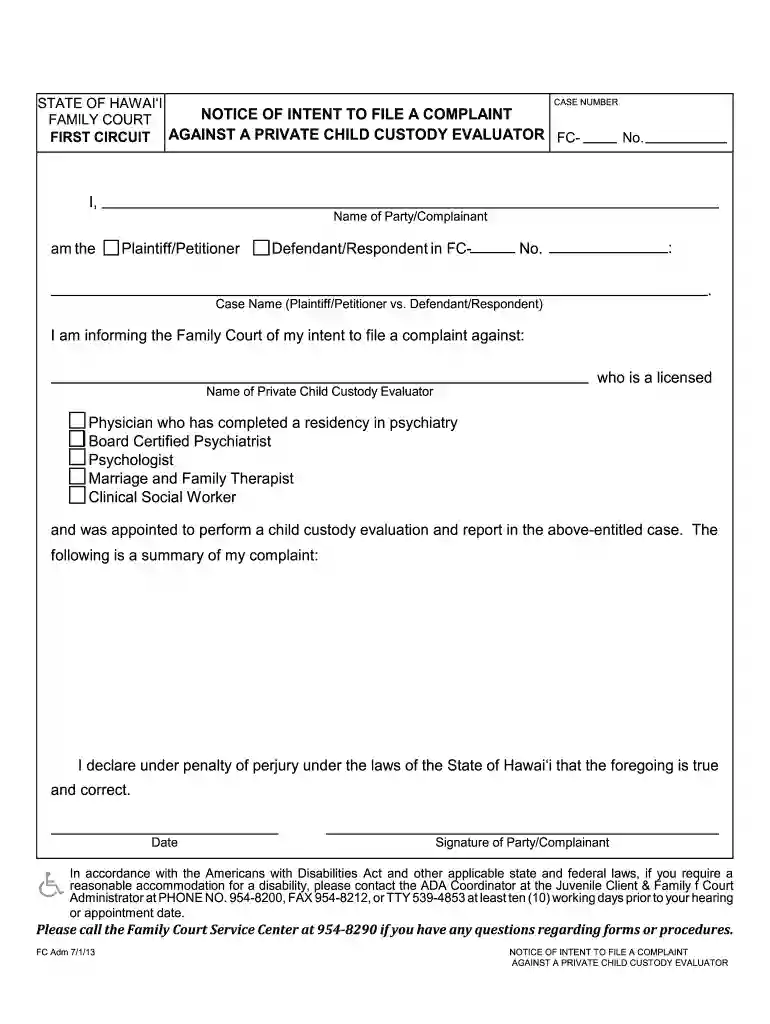
  1. Click ‘Get Form’ to open the intent complaint in the editor.
  2. Begin by entering your name in the 'Name of Party/Complainant' field. This identifies you as the individual filing the complaint.
  3. Indicate your role in the case by selecting either 'Plaintiff/Petitioner' or 'Defendant/Respondent' from the options provided.
  4. Fill in the case number and case name, ensuring accuracy to avoid any processing delays.
  5. In the section for naming the evaluator, input the 'Name of Private Child Custody Evaluator' and select their professional designation from the provided options.
  6. Summarize your complaint clearly in the designated area, providing all necessary details to support your claims.
  7. Finally, date and sign the form electronically using our platform’s signature feature to complete your submission.

Start filling out your intent complaint today for free using our platform!

See more intent complaint versions

We've got more versions of the intent complaint form. Select the right intent complaint version from the list and start editing it straight away!
Versions Form popularity Fillable & printable
2022 4.6 Satisfied (32 Votes)
2021 4.9 Satisfied (38 Votes)
2021 4.8 Satisfied (46 Votes)
2020 4.3 Satisfied (140 Votes)
2020 4.9 Satisfied (42 Votes)
2020 4.8 Satisfied (55 Votes)
2020 4.4 Satisfied (231 Votes)
2019 4.8 Satisfied (152 Votes)
2019 4.6 Satisfied (38 Votes)
2017 4.8 Satisfied (119 Votes)
2017 4.8 Satisfied (95 Votes)
2017 4 Satisfied (58 Votes)
2016 4.2 Satisfied (60 Votes)
2016 4.2 Satisfied (44 Votes)
2016 4.9 Satisfied (47 Votes)
be ready to get more

Complete this form in 5 minutes or less

Get form

Got questions?

We have answers to the most popular questions from our customers. If you can't find an answer to your question, please contact us.
Contact us
In Civil Law, a complaint is the first formal action taken to officially begin a lawsuit. This written document contains the allegations against the defense, the specific laws violated, the facts that led to the dispute, and any demands made by the plaintiff to restore justice.
Justified complaint: This is a complaint when one has a good reason for lodging a complaint. It is complaint that has good defendable basis and can easily defend with all confidence. Example is delivery of goods if faulty or damaged.
elements (of a case) The existence of a legal duty that the defendant owed to the plaintiff. The defendants breach of that duty. The plaintiffs sufferance of an injury. Proof that defendants breach caused the injury (typically defined through proximate cause)
It defines complaints, lists types of complaints (critical, major, minor), and sources of complaints (internal, external, verbal, written).
Under the federal rules, the three mandatory elements in every civil complaint are: (1) a statement as to why the court has jurisdiction over the case, (2) a short and plain statement as to why the plaintiff is entitled to relief and (3) a description of the relief sought.

Security and compliance

At DocHub, your data security is our priority. We follow HIPAA, SOC2, GDPR, and other standards, so you can work on your documents with confidence.

Learn more
ccpa2
pci-dss
gdpr-compliance
hipaa
soc-compliance

People also ask

A plaintiff starts a civil action by filing a pleading called a complaint. A complaint must state all of the plaintiffs claims against the defendant , and must also specify what remedy the plaintiff is seeking. After receiving the complaint, the defendant must respond with an answer .
Five steps to effective complaints handling Making contact. Handling customer communications effectively at the first point of contact is central to successfully resolving customer issues. Data validation and management. Case management. Redress payment. Root cause analysis.

Related links