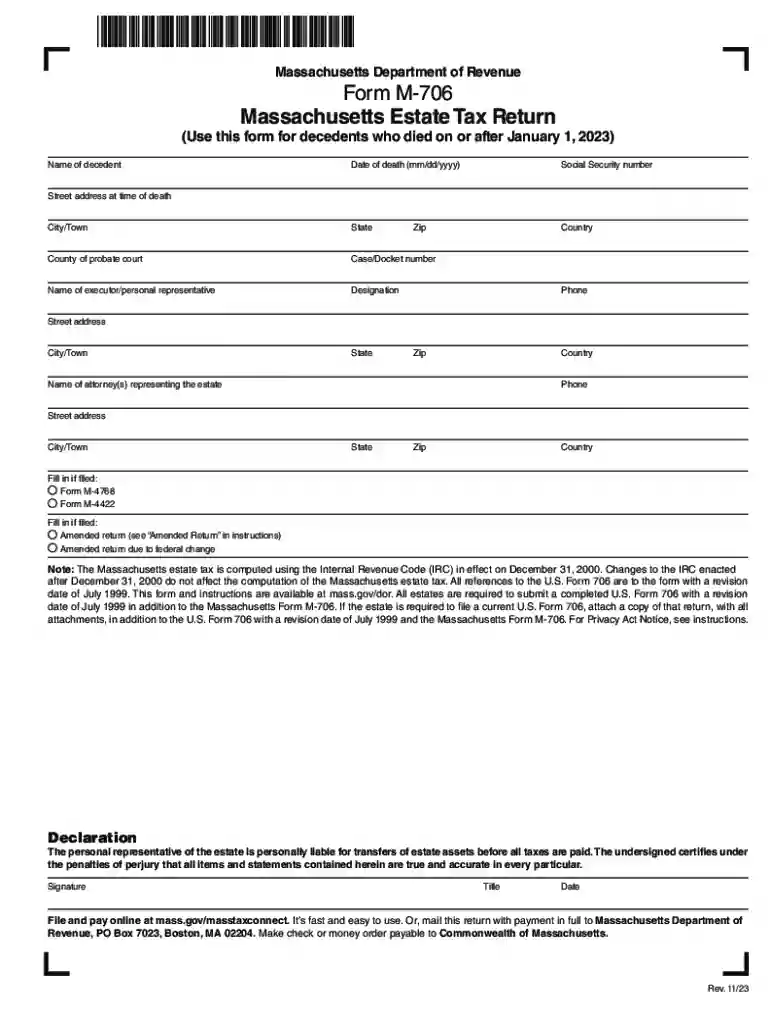
Form m 706 2026

Get Form
massachusetts estate tax form 706 Preview on Page 1

Here's how it works

01. Edit your massachusetts estate tax form 706 online
Type text, add images, blackout confidential details, add comments, highlights and more.

02. Sign it in a few clicks
Draw your signature, type it, upload its image, or use your mobile device as a signature pad.

03. Share your form with others
Send massachusetts estate tax forms via email, link, or fax. You can also download it, export it or print it out.

How to use or fill out form m 706 with our platform

Form edit decoration
9.5
Ease of Setup
DocHub User Ratings on G2
9.0
Ease of Use
DocHub User Ratings on G2
  1. Click ‘Get Form’ to open it in the editor.
  2. Begin by entering the decedent's name, date of death, and Social Security number in the designated fields.
  3. Fill in the street address, city/town, state, zip code, and country where the decedent resided at the time of death.
  4. Provide details about the executor or personal representative, including their name, contact information, and address.
  5. Indicate if any relevant forms (M-4768 or M-4422) have been filed by checking the appropriate boxes.
  6. Complete sections regarding marital status and any life insurance policies not included in the gross estate.
  7. Proceed to calculate total gross estate and allowable deductions as outlined in Parts 1 through 6 of the form.
  8. Review all entries for accuracy before signing and dating the declaration section at the end of the form.

Start using our platform today for free to simplify your form completion process!

See more form m 706 versions

We've got more versions of the form m 706 form. Select the right form m 706 version from the list and start editing it straight away!
Versions Form popularity Fillable & printable
2023 4.4 Satisfied (45 Votes)
2018 4.8 Satisfied (80 Votes)
2016 4.4 Satisfied (117 Votes)
2011 4.4 Satisfied (628 Votes)
2004 4.3 Satisfied (45 Votes)
2002 4 Satisfied (38 Votes)
be ready to get more

Complete this form in 5 minutes or less

Get form

Got questions?

We have answers to the most popular questions from our customers. If you can't find an answer to your question, please contact us.
Contact us
Federal Form 706, also known as the United States Estate (and Generation-Skipping Transfer) Tax Return, is used to report the value of a deceased persons estate and determine the amount of estate tax due, if any. A snapshot of the value of the decedents assets and liabilities is taken on the day of death.
An estate tax return (Form 706) must be filed if the gross estate of the decedent (who is a U.S. citizen or resident), increased by the decedents adjusted taxable gifts and specific gift tax exemption, is valued at more than the filing threshold for the year of the decedents death, as shown in the table below.
More In Forms and Instructions The executor of a decedents estate uses Form 706 to figure the estate tax imposed by Chapter 11 of the Internal Revenue Code. Form 706 is also used to compute the generation-skipping transfer (GST) tax imposed by Chapter 13 on direct skips.
Still, any estate in Massachusetts worth less than $2 million (death after January 1st, 2023) will not be subject to an estate tax.
Generally, you may list on Schedule M all property interests that pass from the decedent to the surviving spouse and are included in the gross estate. However, you should not list any nondeductible terminable interests (described below) on Schedule M unless you are making a QTIP election.

Security and compliance

At DocHub, your data security is our priority. We follow HIPAA, SOC2, GDPR, and other standards, so you can work on your documents with confidence.

Learn more
ccpa2
pci-dss
gdpr-compliance
hipaa
soc-compliance

People also ask

At our firm, we frequently encounter these errors that can put families at risk: Not filing Form 706 because the estate falls below the exemption threshold. Incomplete or inaccurate asset valuations that trigger IRS audits. Missing critical deadlines for filing or requesting extensions.
This code indicates that Form 706, which is used to determine the amount of the estate tax, has been accepted as filed and an examination has been concluded.
Most relatively simple estates (cash, publicly traded securities, small amounts of other easily valued assets, and no special deductions or elections, or jointly held property) do not require the filing of an estate tax return.

m706 massachusetts