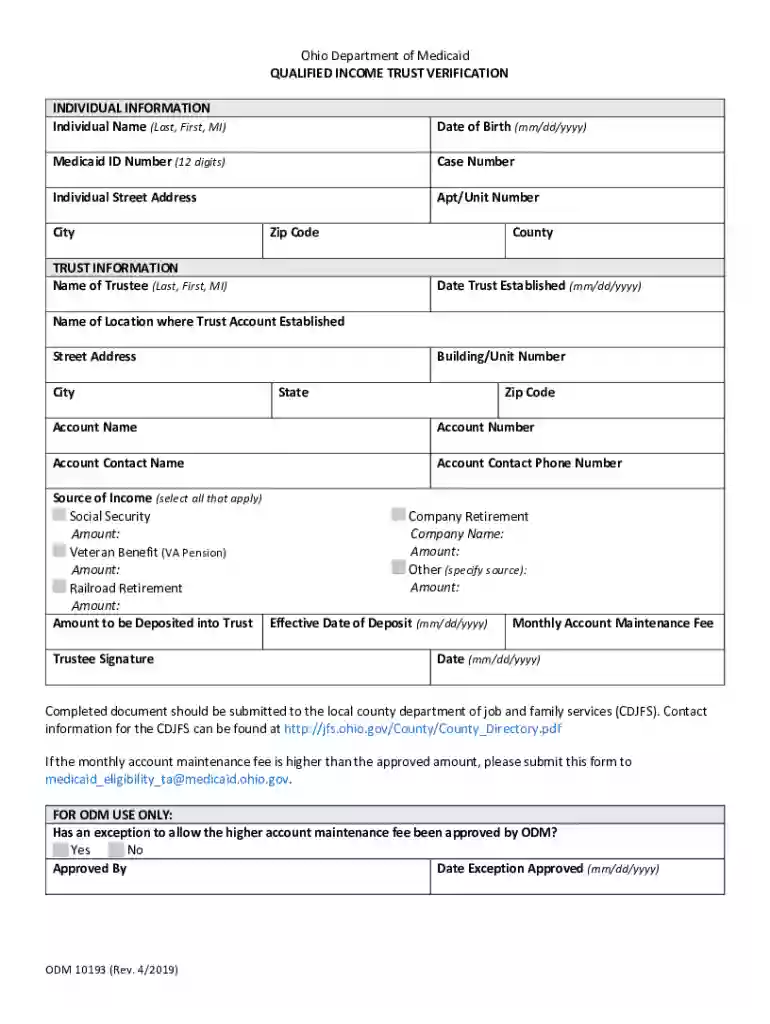
Ohio medicaid qualified income trust 2026

Get Form
qualified income trust form Preview on Page 1

Here's how it works

01. Edit your qualified income trust form online
Type text, add images, blackout confidential details, add comments, highlights and more.

02. Sign it in a few clicks
Draw your signature, type it, upload its image, or use your mobile device as a signature pad.

03. Share your form with others
Send ohio medicaid qualified income trust via email, link, or fax. You can also download it, export it or print it out.

How to use or fill out Ohio Medicaid Qualified Income Trust with our platform

Form edit decoration
9.5
Ease of Setup
DocHub User Ratings on G2
9.0
Ease of Use
DocHub User Ratings on G2
  1. Click ‘Get Form’ to open the Ohio Medicaid Qualified Income Trust in the editor.
  2. Begin by entering the individual information. Fill in the individual's name, date of birth, Medicaid ID number, and case number. Ensure accuracy as this information is crucial for identification.
  3. Next, provide the individual's street address, including any apartment or unit number, city, and zip code. This helps establish residency.
  4. Move on to the trust information section. Enter the trustee's name, county, and the date the trust was established. Include details about where the trust account is located.
  5. Fill in the account name and number along with contact details for someone managing the account. This ensures proper communication regarding the trust.
  6. Indicate sources of income by checking all applicable boxes and providing amounts for each source listed. Be thorough to avoid delays in processing.
  7. Finally, enter any monthly account maintenance fees and ensure that you sign and date the document before submission.

Start using our platform today to fill out your Ohio Medicaid Qualified Income Trust form online for free!

See more ohio medicaid qualified income trust versions

We've got more versions of the ohio medicaid qualified income trust form. Select the right ohio medicaid qualified income trust version from the list and start editing it straight away!
Versions Form popularity Fillable & printable
2019 4.8 Satisfied (102 Votes)
2016 4.1 Satisfied (22 Votes)
be ready to get more

Complete this form in 5 minutes or less

Get form

Got questions?

We have answers to the most popular questions from our customers. If you can't find an answer to your question, please contact us.
Contact us
Medicaid has strict income and asset limits, but options like irrevocable trusts, life estates, annuities and asset transfers within permissible timeframes can help shield wealth. Since Medicaid has a five-year look-back period, early planning helps avoid penalties, protect assets, and maximize available options.
A qualified income trust (QIT), also known as a Miller Trust, is an irrevocable trust specially designed to legally divert an individual or married couples income into a trust resulting in the income being excluded for purposes of determining eligibility for nursing home (institutional) Medicaid and 1915(c) home
To protect your savings, we suggest creating an asset protection plan. This plan should include a strategy for transferring your assets to your family or loved ones while still maintaining eligibility for Medicaid. One option includes creating a trust, which can shield your assets from Medicaid.
If your income is above this amount, you can deposit the excess income into a QIT to become eligible for Medicaid long-term care services (including services through PASSPORT, Assisted Living Waiver or Ohio Home Care Waiver). Money in the QIT will then be used to pay for certain expenses and allowances.
A single person may have no more than $2,000 of total assets. Most household goods and personal items are not counted. However, all bank accounts, brokerage accounts, real estate, retirement accounts, annuities, and life insurance policies (except term policies that have no cash value) are included.

Security and compliance

At DocHub, your data security is our priority. We follow HIPAA, SOC2, GDPR, and other standards, so you can work on your documents with confidence.

Learn more
ccpa2
pci-dss
gdpr-compliance
hipaa
soc-compliance
be ready to get more

Complete this form in 5 minutes or less

Get form

People also ask

Asset Transfers: The lookback period covers any asset transfers made within the five years before applying for Medicaid. If an applicant has transferred assets within this timeframe, they may face penalties or disqualification from receiving Medicaid benefits for a certain period.
A MAPT is an irrevocable trust designed to protect your assets from being counted as resources when applying for Medicaid benefits. Medicaid considers the trust assets unavailable, which doesnt count toward your eligibility limits.
This includes cash, stocks, bonds, investments, bank accounts (credit union, savings, and checking), and real estate in which one does not reside. Medicaid considers many assets to be exempt (non-countable). Exemptions include personal belongings, household furnishings, an automobile, and irrevocable burial trusts.

odm 10193