Lab 144a 2026

Get Form
lab 144a Preview on Page 1

Here's how it works

01. Edit your lab 144a online
Type text, add images, blackout confidential details, add comments, highlights and more.

02. Sign it in a few clicks
Draw your signature, type it, upload its image, or use your mobile device as a signature pad.

03. Share your form with others
Send it via email, link, or fax. You can also download it, export it or print it out.

How to use or fill out lab 144a with our platform

Form edit decoration
9.5
Ease of Setup
DocHub User Ratings on G2
9.0
Ease of Use
DocHub User Ratings on G2
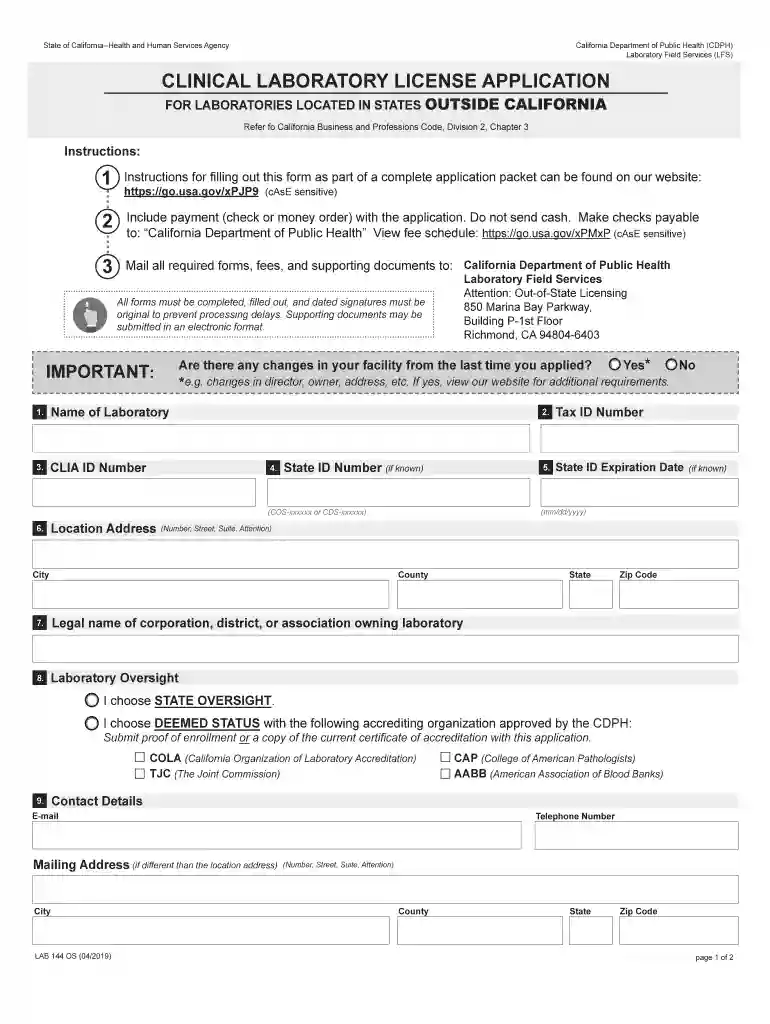
  1. Click ‘Get Form’ to open lab 144a in the editor.
  2. Begin by entering the name of your laboratory in the designated field. Ensure accuracy as this is crucial for identification.
  3. Fill in your Tax ID Number and CLIA ID Number, if applicable. These identifiers are essential for regulatory compliance.
  4. Provide the location address of your laboratory, including city, county, state, and zip code. Double-check for any typos to avoid processing delays.
  5. Indicate whether there have been any changes in your facility since your last application by selecting 'Yes' or 'No'. If 'Yes', refer to our website for additional requirements.
  6. Complete the ownership section by selecting the type of ownership and providing details about owners or partners as required.
  7. Fill out contact details including email and telephone number to ensure you can be reached regarding your application.
  8. Finally, ensure that all signatures are original and dated before submitting. Use our platform to save and send your completed form electronically if needed.

Start using our platform today to streamline your lab 144a application process for free!

See more lab 144a versions

We've got more versions of the lab 144a form. Select the right lab 144a version from the list and start editing it straight away!
Versions Form popularity Fillable & printable
2019 4.8 Satisfied (96 Votes)
2016 4.2 Satisfied (54 Votes)
be ready to get more

Complete this form in 5 minutes or less

Get form

Got questions?

We have answers to the most popular questions from our customers. If you can't find an answer to your question, please contact us.
Contact us
How to get a clinical lab certification Get an associate degree or 60 semester hours of education. Complete a NAACLS-certified technician course. Earn at least six months of clinical laboratory experience. Pass the medical laboratory technician certification test.
Clinical laboratories assist clinicians with individual patients; public health laboratories support the health officer whose patient is the community.
Waived testing may be performed at the POC or in a centralized facility. Non-waived testing is subcategorized as moderately complex and highly complex. The majority of non-waived POCT is moderately complex. The facility must be diligent regarding adherence to the manufacturers operating/testing instructions.
CLIA is the acronym for the Clinical Laboratory Improvement Amendments of 1988. This law requires any facility performing examinations of human specimens (e.g., tissue, blood, , etc.) for diagnosis, prevention, or treatment purposes to be certified by the Secretary of the Department of Health and Human Services.
By the CLIA law, waived tests are those tests that are determined by CDC or FDA to be so simple that there is little risk of error. Some testing methods for glucose and cholesterol are waived along with pregnancy tests, fecal occult blood tests, some tests, etc.

Security and compliance

At DocHub, your data security is our priority. We follow HIPAA, SOC2, GDPR, and other standards, so you can work on your documents with confidence.

Learn more
ccpa2
pci-dss
gdpr-compliance
hipaa
soc-compliance
be ready to get more

Complete this form in 5 minutes or less

Get form

People also ask

Waived tests include test systems cleared by the FDA for home use and those approved for waiver under the CLIA criteria. While CLIA requires waived tests to be simple and low-risk, they are not completely error-proof.
As defined by CLIA, waived tests are simple laboratory examinations and procedures that have an insignificant risk of an erroneous result. Examples of waived tests include: dipstick urinalysis, fecal occult blood, pregnancy tests, and blood glucose monitoring.

Related links