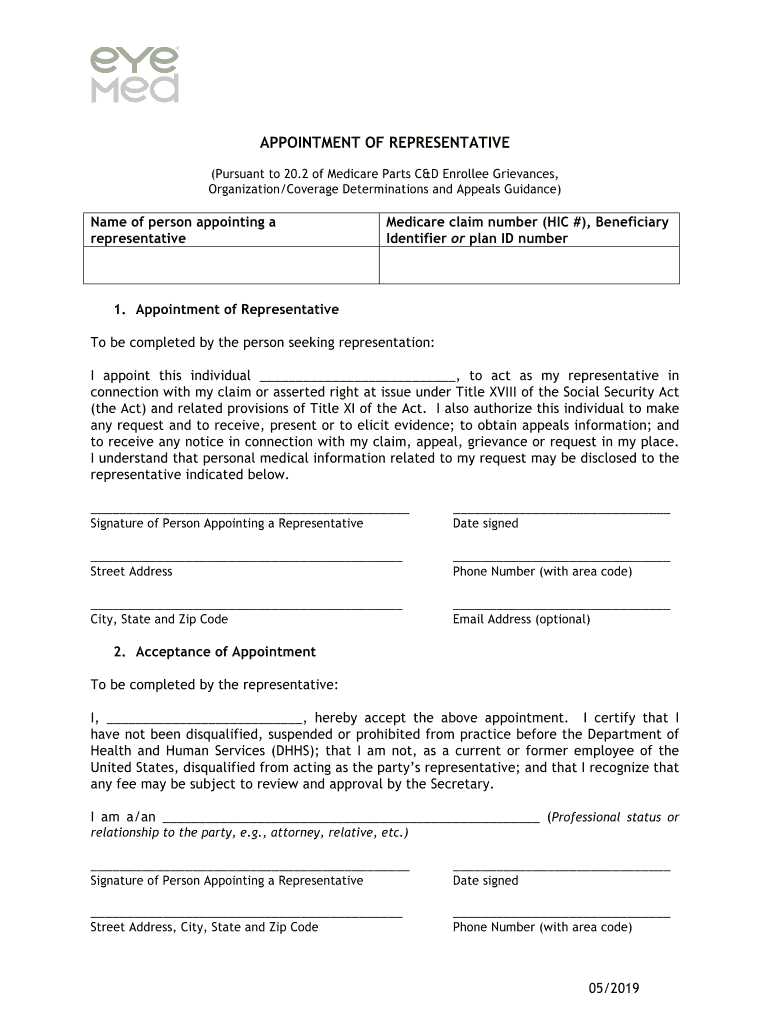
(Pursuant to 20 2026

Get Form
(Pursuant to 20 Preview on Page 1

Here's how it works

01. Edit your form online
Type text, add images, blackout confidential details, add comments, highlights and more.
02. Sign it in a few clicks
Draw your signature, type it, upload its image, or use your mobile device as a signature pad.
03. Share your form with others
Send it via email, link, or fax. You can also download it, export it or print it out.

How to Use or Fill Out the Appointment of Representative Form (Pursuant to 20)

Form edit decoration
9.5
Ease of Setup
DocHub User Ratings on G2
9.0
Ease of Use
DocHub User Ratings on G2
  1. Click ‘Get Form’ to open it in the editor.
  2. In the first section, enter the name of the person appointing a representative. This is crucial for identifying who is granting authority.
  3. Fill in your Medicare claim number, Beneficiary Identifier, or plan ID number to ensure proper identification and processing.
  4. In the 'Appointment of Representative' section, write the name of the individual you are appointing as your representative. Ensure accuracy as this person will act on your behalf.
  5. Sign and date the form where indicated. This confirms your appointment and understanding of the information being shared with your representative.
  6. Provide your street address, phone number, city, state, and zip code for contact purposes. An optional email address can also be included.
  7. The representative must complete their section by accepting the appointment and providing their professional status or relationship to you.
  8. Finally, review all entries for accuracy before submitting. Send this form to the appropriate location as specified in the instructions.

Start using our platform today to fill out your Appointment of Representative form easily and for free!

See more (Pursuant to 20 versions

We've got more versions of the (Pursuant to 20 form. Select the right (Pursuant to 20 version from the list and start editing it straight away!
Versions Form popularity Fillable & printable
2019 4.8 Satisfied (51 Votes)
be ready to get more

Complete this form in 5 minutes or less

Get form

Got questions?

We have answers to the most popular questions from our customers. If you can't find an answer to your question, please contact us.
Contact us
Rule 20 allows multiple plaintiffs or defendants to join in a single action if their claims stem from the same event and share common questions. This approach helps courts manage cases more efficiently by consolidating similar issues into one trial, reducing redundant evidence and judicial resources.
Federal Rule of Civil Procedure 20 allows for permissive joinder of parties if they assert a right to relief as plaintiffs or face a claim as defendants that arise out of the same transaction or occurrence or share a common question of law or fact.
All persons may join in one action as plaintiffs if they assert any right to relief jointly, severally, or in the alternative in respect of or arising out of the same transaction, occurrence, or series of transactions or occurrences and if any question of law or fact common to all these persons will arise in the action
Rule 20, Fed. R. Crim. P., provides for the transfer of criminal cases among districts for the limited purposes of acceptance of guilty or nolo contendere pleas and sentencing.
When an indictment is pending against a person in another district, the person may state in writing that he or she wishes to plead guilty, to waive trial and to consent to a disposition in the district in which he finds himself.

Security and compliance

At DocHub, your data security is our priority. We follow HIPAA, SOC2, GDPR, and other standards, so you can work on your documents with confidence.

Learn more
ccpa2
pci-dss
gdpr-compliance
hipaa
soc-compliance

People also ask

Rule 20 Transfers of Prisoners From the District For Plea and Sentence. Rule 20, Fed. R. Crim. P., provides for the transfer of criminal cases among districts for the limited purposes of acceptance of guilty or nolo contendere pleas and sentencing.
If someone has been sentenced in federal court and later realizes theres an error or a chance to help reduce that sentence, they may hear about something called a Rule 35 motion. This is a legal tool that can fix a clear sentencing mistake or reduce a sentence when a defendant helps the government with other cases.

Related links