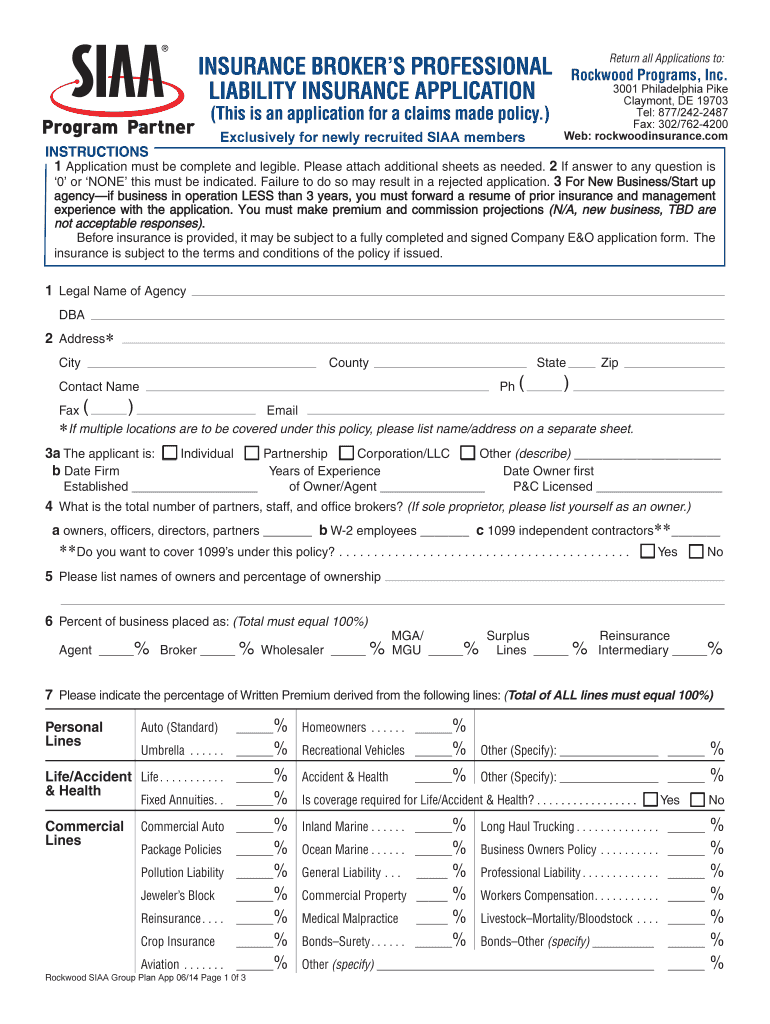
(This is an application for a claims made policy 2026

Get Form
(This is an application for a claims made policy Preview on Page 1

Here's how it works

01. Edit your form online
Type text, add images, blackout confidential details, add comments, highlights and more.
02. Sign it in a few clicks
Draw your signature, type it, upload its image, or use your mobile device as a signature pad.
03. Share your form with others
Send it via email, link, or fax. You can also download it, export it or print it out.

How to Use or Fill Out This Application for a Claims Made Policy

Form edit decoration
9.5
Ease of Setup
DocHub User Ratings on G2
9.0
Ease of Use
DocHub User Ratings on G2
  1. Click 'Get Form' to open it in the editor.
  2. Begin by entering the Legal Name of your Agency and any DBA (Doing Business As) names. Ensure all information is complete and legible.
  3. Fill in your agency's address, including city, county, state, and zip code. Provide a contact name along with phone and fax numbers.
  4. Indicate the type of applicant (Individual, Partnership, Corporation/LLC) and provide the establishment date along with years of experience.
  5. List the total number of partners, staff, and office brokers. If applicable, indicate if you want to cover 1099 independent contractors under this policy.
  6. Complete sections regarding ownership percentages and business placements. Ensure that totals equal 100% where required.
  7. Provide revenue estimates for both the last 12 months and projections for the next year. Include details about current E&O carrier limits and deductibles.
  8. Review all questions carefully, especially those regarding past claims or disciplinary actions. Provide detailed explanations on separate sheets if necessary.
  9. Finally, sign the application as an owner or authorized representative to confirm that all information is accurate before submission.

Start filling out your application today using our platform for free!

See more (This is an application for a claims made policy versions

We've got more versions of the (This is an application for a claims made policy form. Select the right (This is an application for a claims made policy version from the list and start editing it straight away!
Versions Form popularity Fillable & printable
2014 4.8 Satisfied (180 Votes)
be ready to get more

Complete this form in 5 minutes or less

Get form

Got questions?

We have answers to the most popular questions from our customers. If you can't find an answer to your question, please contact us.
Contact us
Under an occurrence policy, the occurrence of injury or damage is the trigger; liability will be covered under that policy if the injury or damage occurred during the policy period.
Unlike occurrence-based policies, which cover events that happen during the policy period, claims-made policies require both the alleged incident and the claim to occur within the policys timeframe. These policies often have a retroactive date. Claims arising from incidents before this date may not be covered.
An insurance claim is a formal request from the policyholder to their insurance company asking for payment after a covered incident, such as a hospital stay, a natural disaster, theft, and more.
What is a claims-made policy? With a claims-made policy, your coverage only kicks in when you file a claim during the policy period. As long as an insurable event happened after the policys retroactive date, your insurer should provide coverage. A claims-made policy covers claims filed while your insurance is active.
The occurrence of the loss, such as a fire, theft, or natural disaster, triggers the coverage under the policy.

Security and compliance

At DocHub, your data security is our priority. We follow HIPAA, SOC2, GDPR, and other standards, so you can work on your documents with confidence.

Learn more
ccpa2
pci-dss
gdpr-compliance
hipaa
soc-compliance

People also ask

A claims-made coverage trigger obligates an insurer to defend and/or pay a claim on an insureds behalf if the claim is first made against the insured during the period in which the policy is in force.
The Claims-Made Trigger is the effective date of the insurance policy and is typically the date that the policy was issued, renewed or amended. The Claims-Made Trigger is usually expressed as the policys retroactive date.
The occurrence form is the original contract created by the insurance industry. The claims-made form was devised later in response to long-tail claims such as asbestosis that can take 20-30 years to manifest itself. It protects the insurance company from claims reported decades after the policy has expired.

Related links