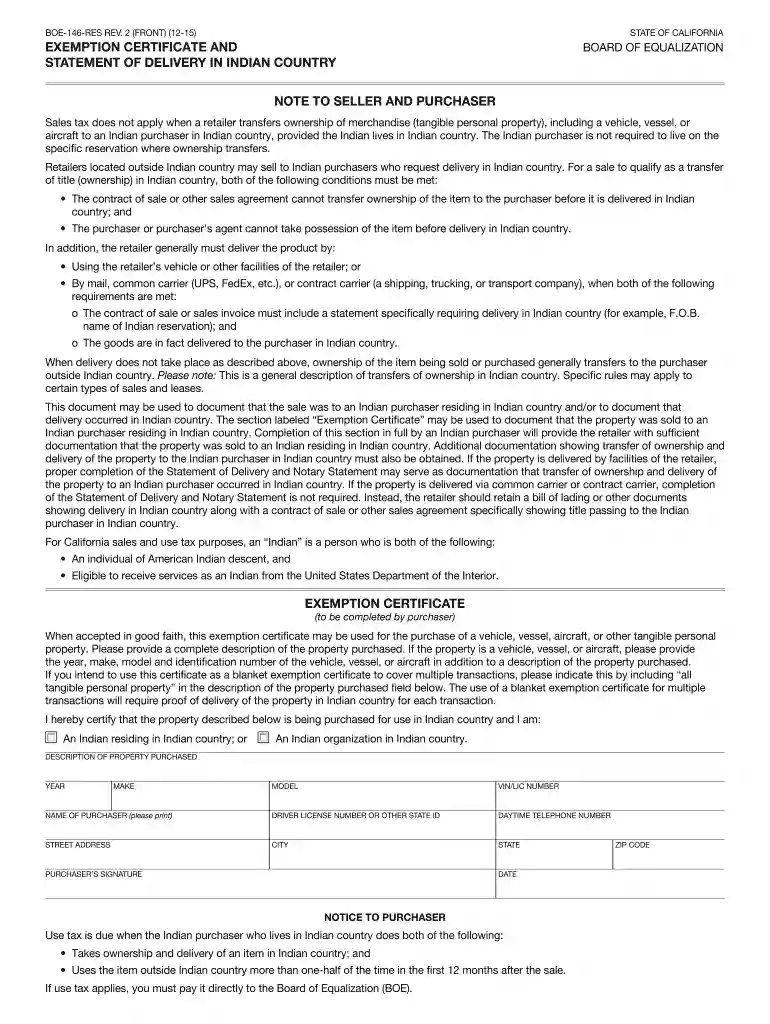
BOE-146-RES REV 2026

Get Form
boe 146 Preview on Page 1

Here's how it works

01. Edit your boe 146 online
Type text, add images, blackout confidential details, add comments, highlights and more.

02. Sign it in a few clicks
Draw your signature, type it, upload its image, or use your mobile device as a signature pad.

03. Share your form with others
Send it via email, link, or fax. You can also download it, export it or print it out.

How to use or fill out BOE-146-RES REV with our platform

Form edit decoration
9.5
Ease of Setup
DocHub User Ratings on G2
9.0
Ease of Use
DocHub User Ratings on G2
  1. Click ‘Get Form’ to open the BOE-146-RES REV in the editor.
  2. Begin by completing the 'Exemption Certificate' section. Provide a detailed description of the property purchased, including year, make, model, and identification number if applicable.
  3. Fill in your personal information as the purchaser: name, driver license number or state ID, daytime telephone number, street address, city, state, and zip code.
  4. Sign and date the form at the bottom of the 'Exemption Certificate' section to certify that you are an Indian residing in Indian country or an Indian organization.
  5. Next, move to the 'Statement of Delivery' section. If you are delivering the property yourself, complete this section with details about the merchandise and delivery date.
  6. If applicable, complete the Notary Statement by providing necessary details and obtaining a notary public's signature.

Start using our platform today for free to streamline your form completion process!

See more BOE-146-RES REV versions

We've got more versions of the BOE-146-RES REV form. Select the right BOE-146-RES REV version from the list and start editing it straight away!
Versions Form popularity Fillable & printable
2020 4.9 Satisfied (48 Votes)
2019 4.3 Satisfied (71 Votes)
2017 4.4 Satisfied (167 Votes)
2015 4.3 Satisfied (86 Votes)
be ready to get more

Complete this form in 5 minutes or less

Get form

Got questions?

We have answers to the most popular questions from our customers. If you can't find an answer to your question, please contact us.
Contact us
The sale of a vehicle or vessel by an off-reservation retailer is generally not subject to tax when the vehicle or vessel is purchased by a Native American who resides on a reservation, and delivery is made to the purchaser on a reservation and the ownership transfers on the reservation to the Native American.
California Resale Certificate Form CDTFA-230. The California Resale Certificate (CDTFA-230) is used by sellers to certify their intent to resell purchased items. This form allows businesses to purchase tangible personal property without paying sales tax upfront.
Who Does Not Have to Pay Taxes? You generally dont have to pay taxes if your income is less than the standard deduction or the total of your itemized deductions, if you have a certain number of dependents, if you work abroad and are below the required thresholds, or if youre a qualifying non-profit organization.
Tribal s are a significant revenue stream for a number of tribes. Tribal s are likewise free from U.S. taxes. However, for the right to operate, tribal s sometimes pay gaming exclusivity fees based on profits.
All Indians are subject to federal income taxes. As sovereign entities, tribal governments have the power to levy taxes on reservation lands. Some tribes do and some dont. As a result, Indians and non-Indians may or may not pay sales taxes on goods and services purchased on the reservation depending on the tribe.

Security and compliance

At DocHub, your data security is our priority. We follow HIPAA, SOC2, GDPR, and other standards, so you can work on your documents with confidence.

Learn more
ccpa2
pci-dss
gdpr-compliance
hipaa
soc-compliance
be ready to get more

Complete this form in 5 minutes or less

Get form

People also ask

Do Indians pay taxes? All Indians are subject to federal income taxes. As sovereign entities, tribal governments have the power to levy taxes on reservation lands. Some tribes do and some dont.
Citizens, individual Indians may enjoy exemptions that derive plainly from treaties or agreements with the Indian tribes concerned, or some act of Congress dealing with their affairs.

Related links