



Food Establishment Restaurant InspectionsTooele County 2026

Get Form
Food Establishment Restaurant InspectionsTooele County Preview on Page 1

Here's how it works

01. Edit your form online
Type text, add images, blackout confidential details, add comments, highlights and more.

02. Sign it in a few clicks
Draw your signature, type it, upload its image, or use your mobile device as a signature pad.

03. Share your form with others
Send it via email, link, or fax. You can also download it, export it or print it out.

How to use or fill out Food Establishment Restaurant Inspections Tooele County with our platform

Form edit decoration
9.5
Ease of Setup
DocHub User Ratings on G2
9.0
Ease of Use
DocHub User Ratings on G2
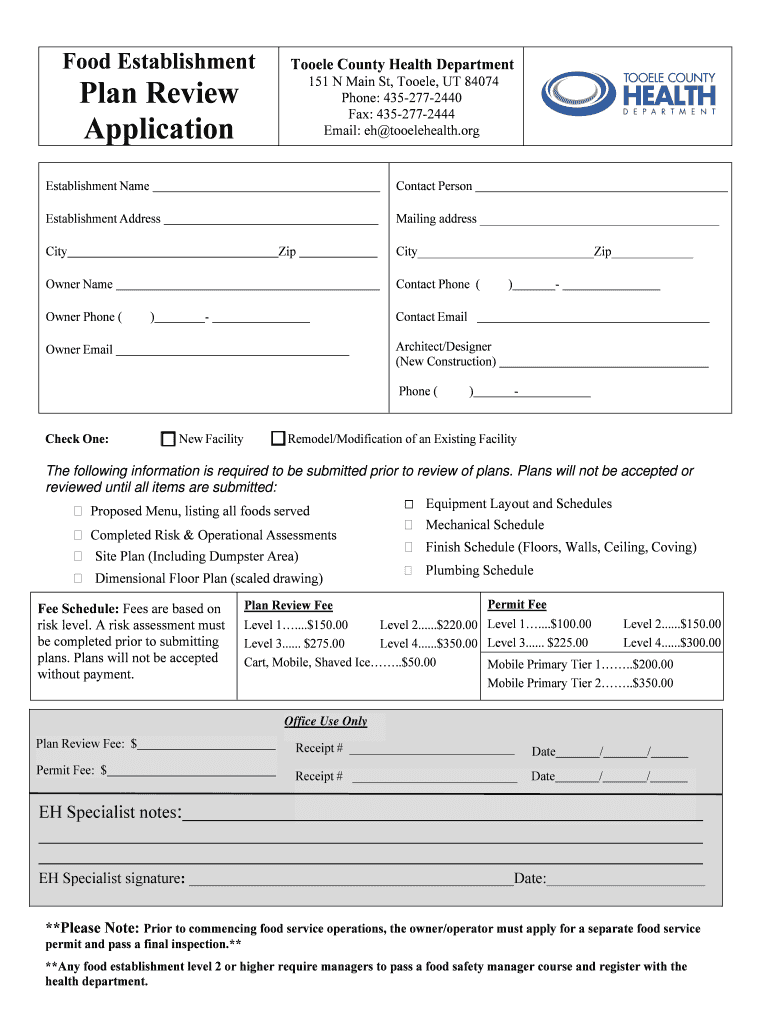
  1. Click ‘Get Form’ to open the Food Establishment Restaurant Inspections form in the editor.
  2. Begin by entering the 'Establishment Name' and 'Contact Person' details. Ensure accuracy as this information is crucial for identification.
  3. Fill in the 'Establishment Address' and 'Mailing Address'. Double-check that all address fields are complete, including city and zip code.
  4. Select whether your application is for a 'New Facility' or a 'Remodel/Modification of an Existing Facility' by checking the appropriate box.
  5. Complete the required sections regarding equipment layout, proposed menu, and risk assessments. Attach any necessary documents directly within our platform for convenience.
  6. Review the fee schedule carefully and ensure you include payment details before submission. This step is essential as plans will not be accepted without payment.
  7. Finally, sign and date the document at the bottom to certify that all information provided is correct before submitting it through our platform.

Start using our platform today to streamline your Food Establishment Restaurant Inspections process for free!

See more Food Establishment Restaurant InspectionsTooele County versions

We've got more versions of the Food Establishment Restaurant InspectionsTooele County form. Select the right Food Establishment Restaurant InspectionsTooele County version from the list and start editing it straight away!
Versions Form popularity Fillable & printable
2019 4.8 Satisfied (26 Votes)
be ready to get more

Complete this form in 5 minutes or less

Get form

Got questions?

We have answers to the most popular questions from our customers. If you can't find an answer to your question, please contact us.
Contact us
Health departments that use letter grades generally assign restaurants an A, B, or C grade. These letters typically mean: A: The restaurant has minimal to no food safety rule violations. B: The restaurant has minor food safety rule violations that need to be corrected.
Inspections focus on food safety practices and determining compliance with the health and safety code requirements for safe food temperatures, safe food handling, employee hygiene, an adequate supply of water and hot water, and the business is maintained clean and free of vermin.
11 Most Common Safety Incidents in Restaurant Industry Slips, Trips and Falls. Slips, trips, and falls are prevalent in the fast-paced restaurant environment. Cuts and Lacerations. Burns and Scalds. Chemical Exposure. Fire Hazards. Foodborne Illnesses. Ergonomic Injuries. Electrical Hazards.
One of the most common practices inspectors will look for is proper food storage because cross-contamination, one of the leading causes of foodborne illness, can occur when pathogens on raw foods transfer through contact to ready-to-eat foods.
What are the most common types of injuries in restaurants? Injuries from objects. Slips, trips, and falls. Burns. Overexertion injuries. Chemicals/cleaners. Electrical. Cold temperatures.

Security and compliance

At DocHub, your data security is our priority. We follow HIPAA, SOC2, GDPR, and other standards, so you can work on your documents with confidence.

Learn more
ccpa2
pci-dss
gdpr-compliance
hipaa
soc-compliance
be ready to get more

Complete this form in 5 minutes or less

Get form

People also ask

Restaurants are inspected on a risk based schedule that can range between one and four times per year. Almost all establishments get at least two inspections per year. Follow up visits are required for critical item violations.
Here are a few things we frequently see: Inefficient layout or overuse of add-on prices for menu item variations. Waiting too late to adjust or adjusting too fast to inventory price fluctuations.
Poor food quality is one of the most common complaints in restaurants. Examples of this include dishes lacking flavor, food served at the wrong temperature, menus that dont accommodate dietary restrictions and general mix-ups caused by servers mishearing and failing to confirm orders.

Related links