




01. Edit your uk medical records online
Type text, add images, blackout confidential details, add comments, highlights and more.

Type text, add images, blackout confidential details, add comments, highlights and more.

Draw your signature, type it, upload its image, or use your mobile device as a signature pad.

Send uk healthcare medical records via email, link, or fax. You can also download it, export it or print it out.
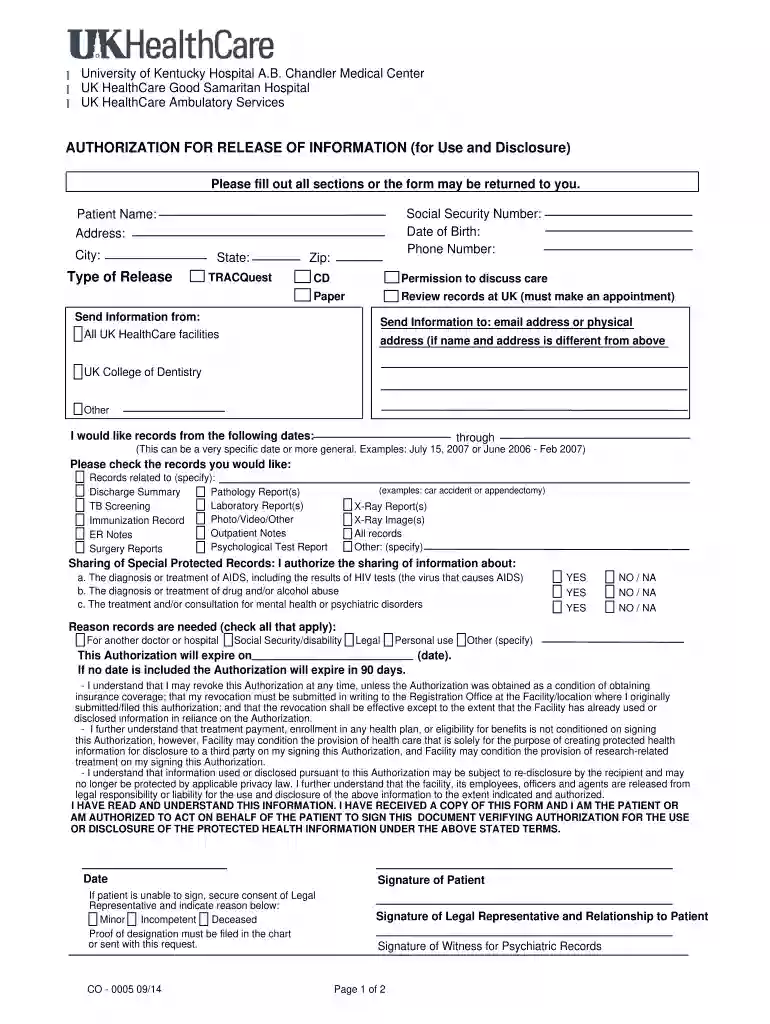
The UK medical records release form is a legal document that authorizes the sharing of an individual's personal health information from healthcare providers to third parties. This form is essential for patients who wish to access or transfer their medical records, whether it's for personal use, ongoing medical treatment, or insurance purposes. The document details the specific information being released, the parties involved in the release, and the timeframe for which the authorization is valid. By completing this form, individuals grant permission to healthcare organizations to disclose their sensitive medical data.
The use of the release form is governed by various regulations, including the Data Protection Act and the Health Insurance Portability and Accountability Act (HIPAA) in the United States. Understanding these legal frameworks is crucial as they protect patient rights while facilitating necessary access to medical data.
Several critical sections must be included in a standard UK medical records release form to ensure it is legally compliant and user-friendly:
Patient Information: This section includes the patient's full name, date of birth, address, and contact information. This is essential for accurately identifying the individual requesting the records.
Authorized Recipient: The form must specify who is allowed to receive the medical records. This could be an individual, organization, or healthcare provider. Providing precise details helps ensure that records are shared appropriately.
Scope of Information Released: This section outlines the specific medical records being released, such as lab results, treatment histories, or billing information. Clarity here prevents ambiguity regarding what data is included.
Reason for Release: This is a critical component that often requires the patient to state the reason for the request, whether it be for personal health management, legal purposes, or insurance claims.
Expiration Date of Authorization: Indicating when the release will no longer be valid is critical for compliance with privacy laws. This gives a clear timeframe for how long the authorization remains in effect.
Signature and Date: The patient's signature, along with the date, finalizes the form, ensuring that the authorization is legitimate and voluntarily granted.
Completing the UK medical records release form involves several systematic steps to ensure all information is provided accurately and in compliance with legal standards:
Gather Necessary Information: Collect all relevant personal details including name, date of birth, and contact information, as well as the contact details of the authorized recipient.
Clearly Define the Information to be Released: Specify the types of medical records needed, such as doctor notes, test results, or hospital discharge summaries.
State the Purpose of the Request: Indicate the reason for accessing these records. Be concise but clear in providing the context for the request.
Determine the Validity Period: Decide how long the authorization should remain valid. This is usually set for a specific duration or until the completion of a certain task.
Review the Form for Accuracy: Before submission, double-check all entered information for completeness and correctness to avoid processing delays.
Sign and Date the Form: Ensure that the form is signed and dated by the individual granting authorization, confirming the request's legitimacy.
Submit the Form: Send the completed release form to the appropriate healthcare provider or organization. This can often be done via email, mail, or in-person delivery.
Understanding the terminology associated with the UK medical records release form can help individuals navigate the process more effectively. Here are some key terms:
HIPAA Compliance: Refers to adherence to regulations that protect patient confidentiality and govern how medical information is handled.
Data Protection Act: Legislation that outlines data protection requirements in the UK, ensuring individuals' rights and how their personal information can be used.
Informed Consent: A legal term indicating that a patient has been fully informed about the risks and benefits of releasing their medical records and agrees to share them.
Authorization: A formal agreement by the patient permitting their medical records to be shared with specified parties.
Retrieval Process: The procedure followed by healthcare providers to locate and release requested medical records.
Utilizing a UK medical records release form can take various forms, depending on an individual's circumstances. Here are some practical examples:
Transferring Care: A patient moving to a new healthcare provider might request the release of their medical records to ensure continuity of care. This could include sharing treatment histories, medication lists, and previous diagnoses.
Insurance Claims: Individuals filing for insurance claims often need to provide corroborative medical evidence. A release form can facilitate access to necessary records for the claims process, supporting the patient's case with detailed medical histories.
Legal Purposes: In cases of personal injury litigation, a lawyer may require access to the patient’s medical records as evidence. The patient would use the release form to authorize this access legally.
Family Member Requests: A family member seeking health information to assist with caregiving responsibilities may require a release form. This ensures that the family member can make informed decisions regarding the patient's health and wellbeing.
Research Studies: Participants in clinical studies or medical trials might need to authorize access to their medical records to help researchers gather data pertaining to the study, contributing to advancements in healthcare.
By understanding the function and details of the UK medical records release form, patients can ensure that their health information is handled appropriately and efficiently across various contexts.
We've got more versions of the uk medical records form. Select the right uk medical records version from the list and start editing it straight away!
At DocHub, your data security is our priority. We follow HIPAA, SOC2, GDPR, and other standards, so you can work on your documents with confidence.
You may request your records by filling out an authorization form in person at our new off-campus location, 2333 Alumni Park Plaza, Suite 110, Lexington, KYRead more
You have the right to obtain a copy of your medical records. The law requires contains certain criteria included on this form. This form must be released.Read more
Our team will guide you through the next steps, including reviewing your medical records. You can apply directly through our online pre-screening form.Read more


