




01. Edit your outcome rating scale pdf online
Type text, add images, blackout confidential details, add comments, highlights and more.

Type text, add images, blackout confidential details, add comments, highlights and more.

Draw your signature, type it, upload its image, or use your mobile device as a signature pad.

Send outcome rating scale template via email, link, or fax. You can also download it, export it or print it out.
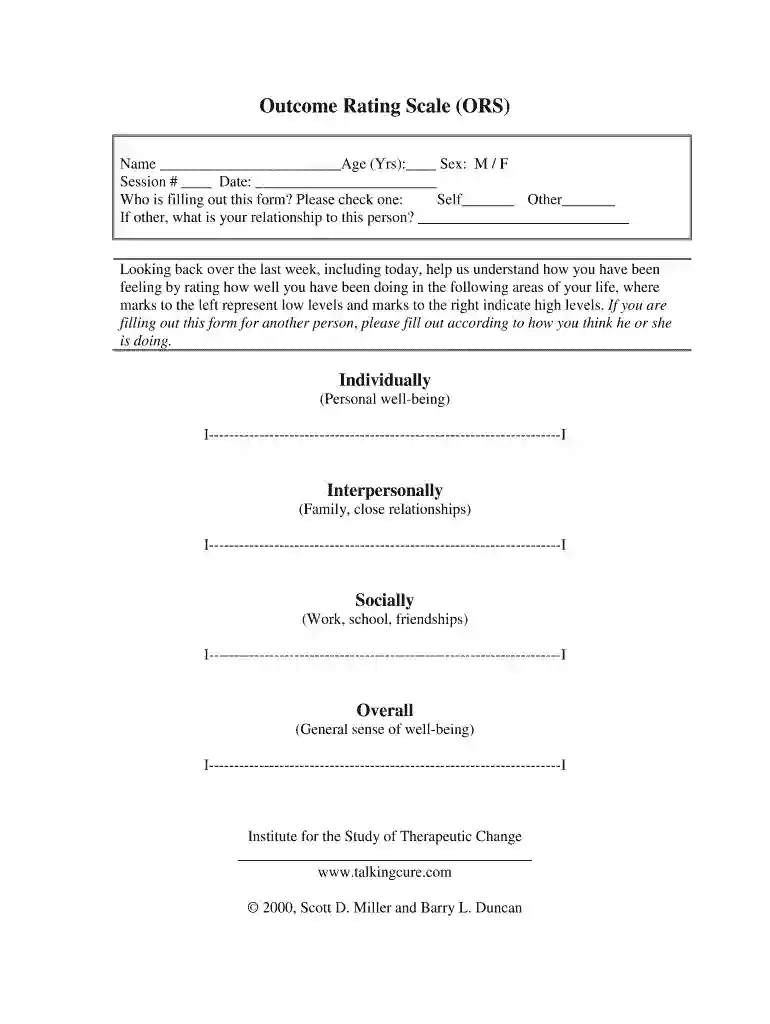
The outcome rating scale is a valuable tool designed to assess an individual's overall well-being across various dimensions, including personal, interpersonal, social, and a general sense of well-being. It typically consists of a series of questions or prompts that allow respondents to reflect on their feelings and experiences over a specified period, often the past week. The responses are usually quantified in a manner that permits easy interpretation and analysis by healthcare providers or professionals.
These scales are particularly useful in therapeutic settings, where monitoring progress and adjusting treatment plans are essential for effective care. By using an outcome rating scale, practitioners can gain insights into clients' perspectives and provide more targeted interventions.
Using the outcome rating scale involves several steps that ensure accurate completion and interpretation.
By actively engaging clients in this process, healthcare providers can foster a collaborative environment that promotes well-being and enhances therapeutic outcomes.
The outcome rating scale comprises several critical components that facilitate its use and effectiveness:
These elements work together to ensure the outcome rating scale serves as a reliable measure of well-being for individuals over time.
The outcome rating scale is employed by professionals across various fields, most notably:
These diverse applications highlight the scale’s versatility and the collective aim of enhancing individuals’ quality of life through targeted assessments.
The outcome rating scale can be used in various practical scenarios, aiding professionals in assessing and improving well-being. Here are a few examples:
These examples illustrate the outcome rating scale's role in facilitating meaningful discussions and supporting improvements in well-being.
At DocHub, your data security is our priority. We follow HIPAA, SOC2, GDPR, and other standards, so you can work on your documents with confidence.
Introducing the Outcome Rating Scale. August 28, 2023. Information. Transcript
Mar 10, 2015 Looking back over the last week, including today, help us understand how you have been feeling by rating how well you have been doing in theRead more
Motor Response. Obeys commands for movement 6 points. Purposeful movement to painful stimulus 5 points. Withdraws in response to pain 4 points.Read more


