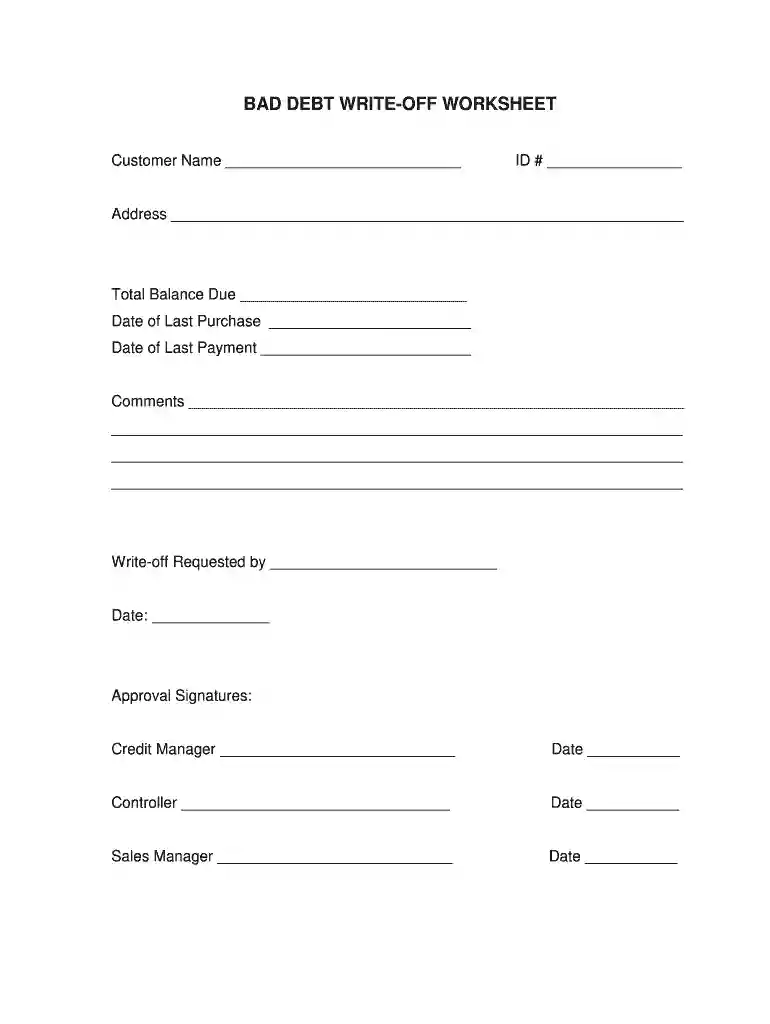
Debt write off worksheet 2026

Get Form
bad debt write off approval letter format Preview on Page 1

Here's how it works

01. Edit your bad debt write off approval letter format online
Type text, add images, blackout confidential details, add comments, highlights and more.

02. Sign it in a few clicks
Draw your signature, type it, upload its image, or use your mobile device as a signature pad.

03. Share your form with others
Send write off letter sample via email, link, or fax. You can also download it, export it or print it out.

How to use or fill out debt write off worksheet with our platform

Form edit decoration
9.5
Ease of Setup
DocHub User Ratings on G2
9.0
Ease of Use
DocHub User Ratings on G2
  1. Click ‘Get Form’ to open the debt write off worksheet in the editor.
  2. Begin by entering the Customer Name in the designated field. This identifies the individual or entity associated with the debt.
  3. Next, input the ID number in the provided space. This unique identifier helps track the account effectively.
  4. Fill in the Address section to ensure accurate communication regarding the write-off process.
  5. Enter the Total Balance Due, which reflects the amount that is being considered for write-off.
  6. Record the Date of Last Purchase and Date of Last Payment to provide context for your request.
  7. Use the Comments section for any additional notes or explanations relevant to your request.
  8. Complete the Write-off Requested by field with your name and date to formalize your request.
  9. Finally, ensure that all required Approval Signatures are obtained from relevant managers before finalizing.

Start using our platform today to streamline your document editing and make filling out forms easier than ever!

be ready to get more

Complete this form in 5 minutes or less

Get form

Got questions?

We have answers to the most popular questions from our customers. If you can't find an answer to your question, please contact us.
Contact us
While both allowance and direct write-off methods are used to write off bad debt in the accounting books of a company, the former is considered to be more accurate. This is because the allowance method follows the matching principle and complies with accounting standards such as GAAP.
The IRS ultimately determines whether you qualify for debt forgiveness. However, the agency generally considers taxpayers who meet these criteria: a total tax debt balance of $50,000 or less. a total income below $100,000 for individuals (or $200,000 for married couples)
A bad debt write-off is the process of removing an uncollectible debt from a businesss accounting records. This accounting method acknowledges the loss incurred when a debtor fails to repay a debt.
You debit Bad Debts and credit AFDA based on ur estimate. This will offset your A/R on the balance sheet. When you determine that its actually uncollectible and needs to be written off, you debit AFDA and credit A/R. In your example, AFDA was recorded but then they decided to reverse it because it was eventually paid.
Record the journal entry by debiting bad debt expense and crediting allowance for doubtful accounts. When you decide to write off an account, debit allowance for doubtful accounts and credit the corresponding receivables account.

Security and compliance

At DocHub, your data security is our priority. We follow HIPAA, SOC2, GDPR, and other standards, so you can work on your documents with confidence.

Learn more
ccpa2
pci-dss
gdpr-compliance
hipaa
soc-compliance

People also ask

A bad debt deduction must be taken in the year it becomes worthless and can be deducted from short-term capital gains, long-term capital gains, and other income up to $3,000. Any remaining balance can be carried over to subsequent years.
To be deductible, a debt must be a bona fide loan with an expectation of repayment and may include interest and a promissory note. The debt must be 100% worthless before it can be deducted. Documented efforts to collect the debt must be made, such as letters, invoices, and phone calls.
You will write off a part of the receivables as bad debt and post a bad debt journal entry by debiting the bad debt expense and crediting the accounts receivable. Here, bad debt expense is treated as a direct loss from the uncollectible accounts that go straight against revenues, reducing the net income.

write off proposal format