PLAN OF CAREANAPHYLAXIS PLAN OF CARE - DSBN 2025

Get Form
PLAN OF CAREANAPHYLAXIS PLAN OF CARE - DSBN Preview on Page 1

Here's how it works

01. Edit your form online
Type text, add images, blackout confidential details, add comments, highlights and more.
02. Sign it in a few clicks
Draw your signature, type it, upload its image, or use your mobile device as a signature pad.
03. Share your form with others
Send it via email, link, or fax. You can also download it, export it or print it out.

How to use or fill out PLAN OF CARE — ANAPHYLAXIS PLAN OF CARE - DSBN

Form edit decoration
9.5
Ease of Setup
DocHub User Ratings on G2
9.0
Ease of Use
DocHub User Ratings on G2
  1. Click ‘Get Form’ to open it in the editor.
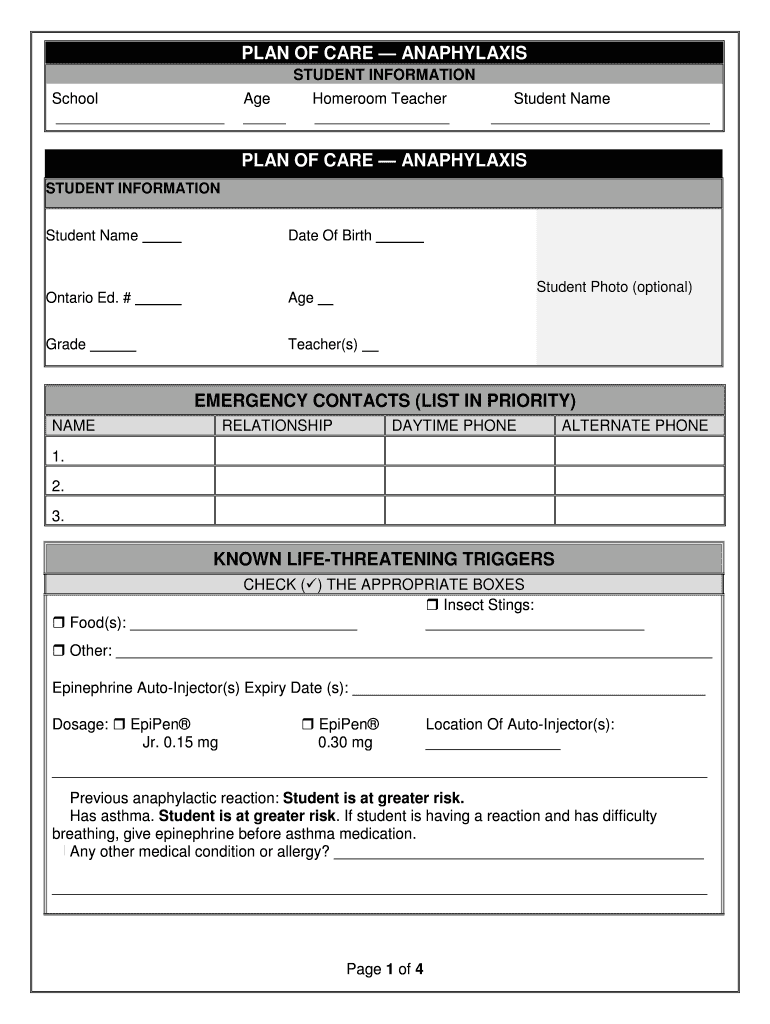
  2. Begin by filling out the 'STUDENT INFORMATION' section. Enter the school name, age, homeroom teacher, and student name. Optionally, you can add a student photo.
  3. In the 'EMERGENCY CONTACTS' section, list contacts in priority order along with their relationship to the student and phone numbers.
  4. Identify known life-threatening triggers by checking the appropriate boxes for insect stings, food allergies, or other triggers. Specify details as needed.
  5. Complete the 'DAILY/ROUTINE ANAPHYLAXIS MANAGEMENT' section by listing food allergens to avoid and safety measures for both food and insect stings.
  6. Follow with the 'EMERGENCY PROCEDURES' section detailing steps to take during an anaphylactic reaction. Ensure clarity on administering epinephrine and contacting emergency services.
  7. Optionally fill out the 'HEALTHCARE PROVIDER INFORMATION' if applicable, including provider details and any special instructions regarding medications.
  8. Finally, complete the 'AUTHORIZATION/PLAN REVIEW' section by obtaining necessary signatures from parents/guardians and school officials.

Start using our platform today to easily fill out your PLAN OF CARE — ANAPHYLAXIS form for free!

be ready to get more

Complete this form in 5 minutes or less

Get form

Got questions?

We have answers to the most popular questions from our customers. If you can't find an answer to your question, please contact us.
Contact us
Acute management of anaphylaxis involves removal of the trigger; early administration of intramuscular epinephrine; supportive care for the patients airway, breathing, and circulation; and a period of observation for potential biphasic reactions.
Call 911 or emergency medical help. Use an epinephrine autoinjector, if available, by pressing it into the persons thigh. Make sure the person is lying down and elevate the legs. Check the persons pulse and breathing and, if necessary, administer cardiopulmonary resuscitation (CPR) or other first-aid measures.
Adrenaline is the first line treatment for anaphylaxis and acts to reduce airway mucosal oedema, induce bronchodilation, induce vasoconstriction and increase strength of cardiac contraction.
Use one adrenaline auto-injector and then call 999, ask for an ambulance, and state anaphylaxis, even if symptoms are improving. Lie flat with the legs raised in order to maintain blood flow. If the person has breathing difficulties, they should sit up to make breathing easier.
How should I manage a person with anaphylaxis with or without angio-oedema? Treat as a medical emergency. Assess the person. Place the person in a comfortable position take into account the following factors: Give intramuscular (IM) adrenaline 1:1000 as per age-related guidelines. Remove the trigger if possible.

People also ask

The Management of Anaphylaxis Assess, call for help, position patient safely, administer adrenaline, be prepared to commence age appropriate CPR, administer oxygen, record vital signs every 5-10 minutes, admit patient to hospital.
Purpose. This plan seeks to outline: The procedures by which the School will provide information to all staff (including volunteers and casual relief staff), students and parents about Anaphylaxis and the Schools Anaphylaxis Policy.

Related links