




Here's how it works

01. Edit your form online
Type text, add images, blackout confidential details, add comments, highlights and more.

02. Sign it in a few clicks
Draw your signature, type it, upload its image, or use your mobile device as a signature pad.

03. Share your form with others
Send it via email, link, or fax. You can also download it, export it or print it out.
How to use or fill out Change of Scope Application: Pain Medicine with our platform

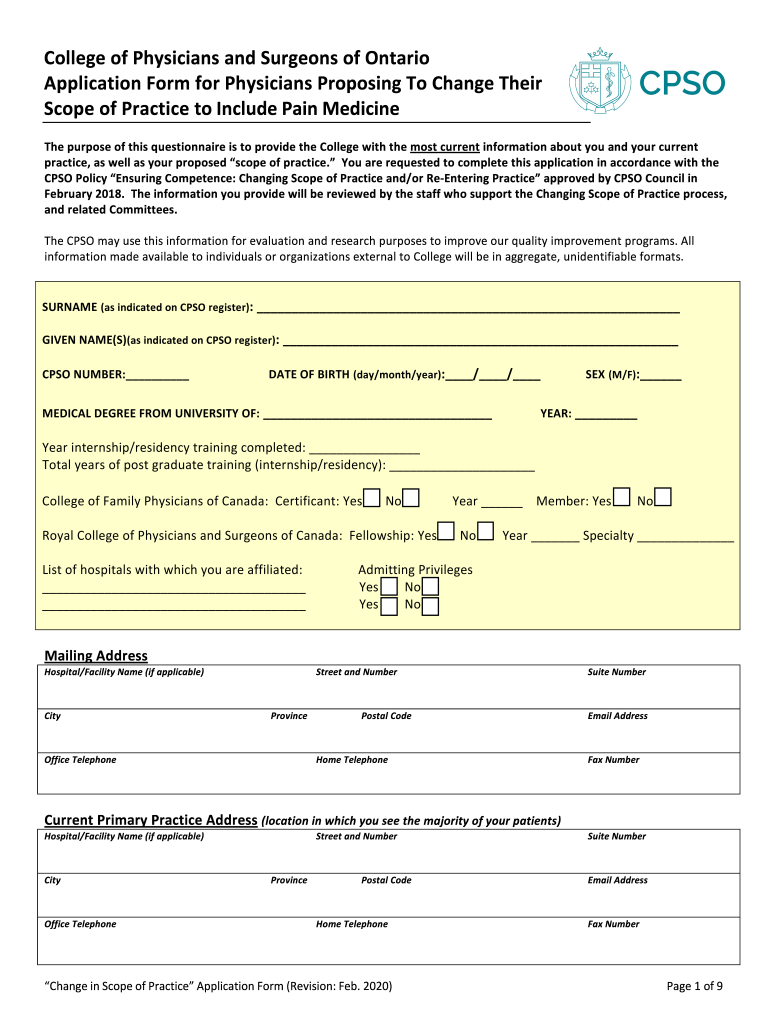
- Click ‘Get Form’ to open the Change of Scope Application: Pain Medicine in the editor.
- Begin by filling out your personal information, including your surname, given names, CPSO number, and date of birth. Ensure accuracy as this information is crucial for processing your application.
- In Part I, specify your proposed practice location. If it differs from your current address, provide the new details clearly.
- Complete Part II by detailing your current and proposed practice structure. Indicate the personnel you work with and how many patients you see weekly in both settings.
- For Part III, outline any continuing professional development activities you've undertaken that relate to pain medicine. This helps demonstrate your commitment to maintaining competence.
- In Part IV, list potential clinical supervisors who will oversee your practice changes. Their approval is necessary before proceeding.
- Review all sections for completeness and accuracy before submitting the application via email to cosre@cpso.on.ca.
Start using our platform today to streamline your application process for free!
Fill out Change of Scope Application: Pain Medicine online
It's free
It's free
See more Change of Scope Application: Pain Medicine versions
We've got more versions of the Change of Scope Application: Pain Medicine form. Select the right Change of Scope Application: Pain Medicine version from the list and start editing it straight away!
| Versions | Form popularity | Fillable & printable |
|---|---|---|
| 2020 | 4.9 Satisfied (28 Votes) |
Got questions?
We have answers to the most popular questions from our customers. If you can't find an answer to your question, please contact us.
Contact us
Can you do pain management from family medicine?
The American Board of Medical Specialties (ABMS) currently offers Pain Medicine certification for multiple specialties including Anesthesiology, Physical Medicine and Rehabilitation (PMR), Neurology, Psychiatry, Family Medicine, Emergency Medicine, and Radiology.
Does step 3 score matter for pain fellowship?
Most fellowships will not care about about your Step 3/Level 3 score except that you passed. In fact, the more competitive fellowships often look more highly on your Step 1 and 2 scores. Take whichever you think will be easier / cheaper.
How competitive is a pain medicine fellowship?
Pain is arguably the most competitive anesthesiology fellowship, though match rates are still 70-80% (can check the match reports). However, there are a very wide range of fellowships, and I think their quality varies more than anesthesiology residency programs.
How much do pain management fellows make?
What are Top 10 Highest Paying Cities for Pain Fellowship Trained Anesthesiologist Jobs CityAnnual SalaryMonthly Pay San Francisco, CA $463,275 $38,606 Santa Clara, CA $461,806 $38,483 Sunnyvale, CA $461,497 $38,458 Livermore, CA $461,236 $38,4366 more rows
What is the difference between pain medicine and interventional pain medicine?
For example, your primary care physician may prescribe an over-the-counter medication to help ease your pain for a short duration of time, while your interventional pain management physician will often perform a procedure that can block the pain or permanently correct the problem that is causing your pain.
Security and compliance
At DocHub, your data security is our priority. We follow HIPAA, SOC2, GDPR, and other standards, so you can work on your documents with confidence.
Learn more


People also ask
What is the pain medicine fellowship excellence award?
The Pain Medicine Fellowship Excellence Award recognizes Pain Medicine Fellowship Programs that provide exceptional learning experiences to their fellows, preparing them to deliver the highest standard of care to patients with pain.