Indiana db020w nr non resident 2026

Get Form
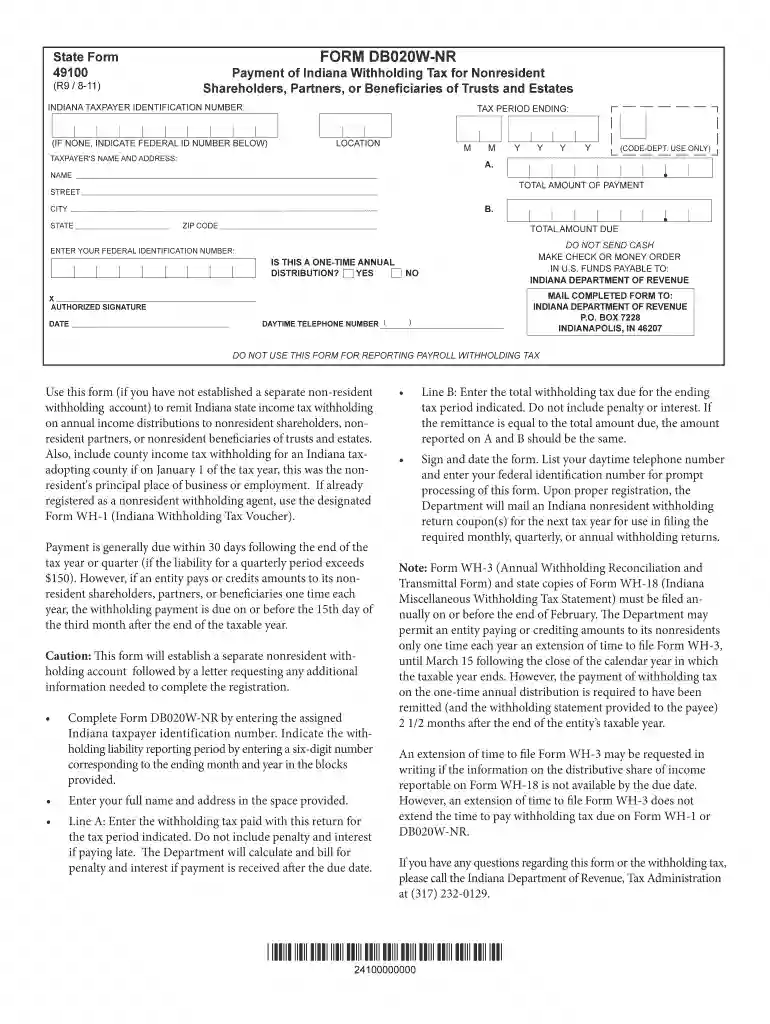
db020w nr Preview on Page 1

Here's how it works

01. Edit your db020w nr online
Type text, add images, blackout confidential details, add comments, highlights and more.

02. Sign it in a few clicks
Draw your signature, type it, upload its image, or use your mobile device as a signature pad.

03. Share your form with others
Send db020wnr tax non resident via email, link, or fax. You can also download it, export it or print it out.

How to use or fill out Indiana DB020W NR Non-Resident with Our Platform

Form edit decoration
9.5
Ease of Setup
DocHub User Ratings on G2
9.0
Ease of Use
DocHub User Ratings on G2
  1. Click ‘Get Form’ to open the Indiana DB020W NR in the editor.
  2. Begin by entering your Indiana taxpayer identification number in the designated field. This is crucial for processing your payment accurately.
  3. Indicate the tax period ending by entering a six-digit number that corresponds to the month and year.
  4. Fill in your full name and address in the provided fields to ensure proper identification.
  5. On Line A, enter the amount of withholding tax you are paying for this return. Remember not to include any penalties or interest.
  6. On Line B, input the total withholding tax due for the indicated period, ensuring it matches Line A if applicable.
  7. Sign and date the form, then provide your daytime telephone number and federal identification number for efficient processing.

Start filling out your Indiana DB020W NR form online for free today!

See more indiana db020w nr non resident versions

We've got more versions of the indiana db020w nr non resident form. Select the right indiana db020w nr non resident version from the list and start editing it straight away!
Versions Form popularity Fillable & printable
2011 4.9 Satisfied (461 Votes)
2004 4 Satisfied (21 Votes)
be ready to get more

Complete this form in 5 minutes or less

Get form

Got questions?

We have answers to the most popular questions from our customers. If you can't find an answer to your question, please contact us.
Contact us
Individual nonresidents and part-year residents are taxed at a flat state tax rate of 3.23%, plus any applicable county tax. Indiana no longer gives the option for nonresident individuals to opt-out of filing composite returns; it is now required.
Generally, if you were a resident of another state (or country) at any time during the year and had income from Indiana (except certain interest, dividends or pension income), you must file a tax return with Indiana. Read more about your residency status and choosing the right form to file.
Part-Year Residents and Full-Year Nonresidents If you were a part-year resident and received income while you lived in Indiana, you must file your Indiana income taxes. If you were a full-year nonresident of Indiana, but received any income from Indiana sources, you must file your Indiana income taxes.
You are a full-year Indiana resident if you maintain your legal residence in Indiana from Jan. 1 through Dec. 31. You do not have to be physically present in Indiana the entire year to be considered a full-year resident.
You must file Form 1040-NR, U.S. Nonresident Alien Income Tax Return only if you have income that is subject to tax, such as wages, tips, scholarship and fellowship grants, dividends, etc. Refer to Foreign students, scholars, teachers, researchers and exchange visitors for more information.

Security and compliance

At DocHub, your data security is our priority. We follow HIPAA, SOC2, GDPR, and other standards, so you can work on your documents with confidence.

Learn more
ccpa2
pci-dss
gdpr-compliance
hipaa
soc-compliance

People also ask

Generally, NRIs are not mandated to file ITRs solely based on their non-resident status. However, their obligation to file hinges on their total income generated in India during a specific financial year. The Income Tax Act 1961 dictates the income threshold that triggers mandatory ITR filing for NRIs.
If you were an Indiana resident during the tax year and had income from Kentucky, Michigan, Ohio, Pennsylvania or Wisconsin, you are covered by a reciprocal agreement. This agreement applies only to wages, salaries, tips and commissions. The income needs to be included on the Indiana return and tax paid to Indiana.
In addition, a person subject to local income tax for a county is subject to tax at the same rate, regardless of whether the individual is a resident or nonresident taxpayer.

db020w nr withholding non resident