TT Instructions for Form 400 ITR and 440 EMO 2026

Get Form
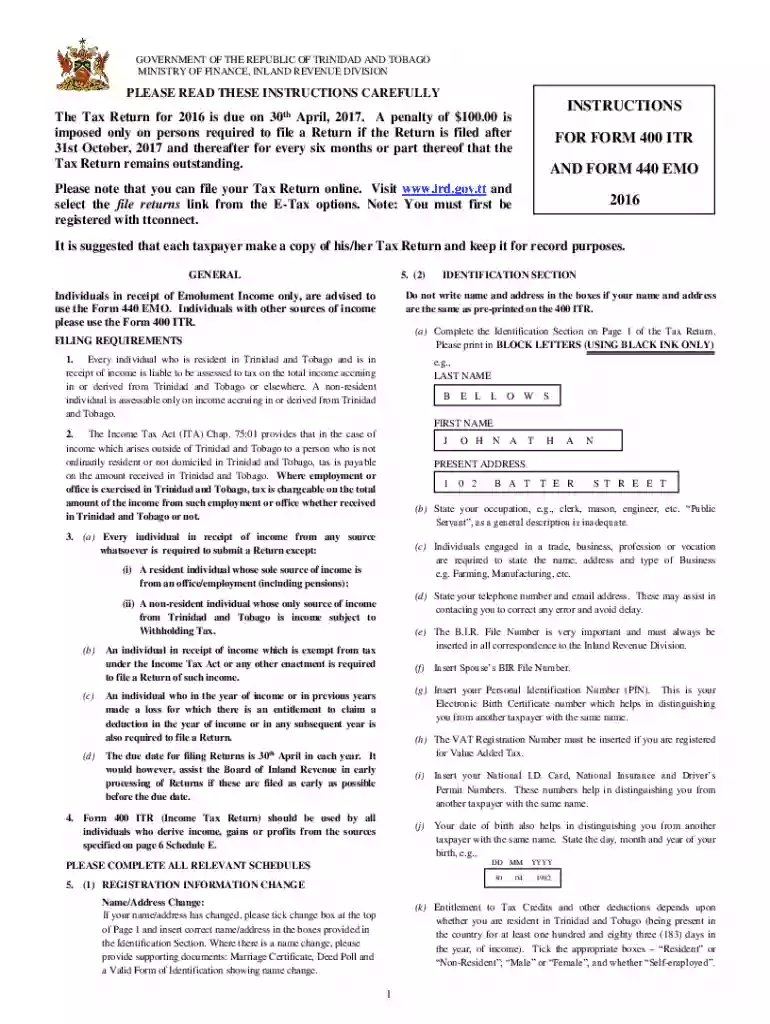
TT Instructions for Form 400 ITR and 440 EMO Preview on Page 1

Here's how it works

01. Edit your form online
Type text, add images, blackout confidential details, add comments, highlights and more.

02. Sign it in a few clicks
Draw your signature, type it, upload its image, or use your mobile device as a signature pad.

03. Share your form with others
Send it via email, link, or fax. You can also download it, export it or print it out.

How to use or fill out TT Instructions for Form 400 ITR and 440 EMO with our platform

Form edit decoration
9.5
Ease of Setup
DocHub User Ratings on G2
9.0
Ease of Use
DocHub User Ratings on G2
  1. Click ‘Get Form’ to open the TT Instructions for Form 400 ITR and 440 EMO in the editor.
  2. Begin with the Identification Section on Page 1. If your name and address are pre-printed, do not fill them in. Otherwise, print your details in BLOCK LETTERS using black ink.
  3. Complete all relevant fields regarding your income sources. For individuals with Emolument Income only, use Form 440 EMO; others should use Form 400 ITR.
  4. Fill out your occupation, contact information, and BIR File Number accurately to avoid processing delays.
  5. Proceed to complete the General Declaration on Page 2. Ensure you sign it; failure to do so may delay processing.
  6. Review all entries for accuracy before submitting. Use our platform's features to save a copy of your completed form for your records.

Start filling out your tax return online for free today using our platform!

See more TT Instructions for Form 400 ITR and 440 EMO versions

We've got more versions of the TT Instructions for Form 400 ITR and 440 EMO form. Select the right TT Instructions for Form 400 ITR and 440 EMO version from the list and start editing it straight away!
Versions Form popularity Fillable & printable
2016 4.9 Satisfied (52 Votes)
2013 4 Satisfied (23 Votes)
be ready to get more

Complete this form in 5 minutes or less

Get form

Got questions?

We have answers to the most popular questions from our customers. If you can't find an answer to your question, please contact us.
Contact us
ITR-1 is not allowed if you are a Non-Resident or Resident but Not Ordinarily Resident (RNOR). NRIs must file ITR-2 or ITR-3 depending on their income sources.
You will be redirected to the Income Tax Return Page. Enter the required details. You will find your Permanent Account Number (PAN) auto-filled in the form. Select the mode of Filing. Click on Continue. Select the status. Select the appropriate ITR form. Summary of tax computation.
You can file ITR 2 if you have capital gains, more than one house property, or your income has exceeded Rs.50 Lakhs . Which ITR form to file for salaried emloyees? ITR-1: If the individual has total annual income is less that Rs.50 Lakhs and is deriving income from only one house property, ITR-1 can be filed.
Form ITR 2 can be used by an individual and Hindu Undivided Family who is not eligible to file ​​ITR-1 Sahaj​ and not having income from profit and gains of business or profession and also not having income from Profits and gains of business or profession in the nature of interest, salary, bonus,
Form ITR-1, also known as ITR-1 (SAHAJ) is one of the ITR forms that is best suited for salaried individuals. This form is for taxpayers having salary income, one house property, agricultural income not exceeding Rs. 5000, income from other sources, and long-term capital gains u/s 112A not exceeding Rs. 1.25 lakhs.

Security and compliance

At DocHub, your data security is our priority. We follow HIPAA, SOC2, GDPR, and other standards, so you can work on your documents with confidence.

Learn more
ccpa2
pci-dss
gdpr-compliance
hipaa
soc-compliance

People also ask

How to File ITR Online - ITR Filing Online Process Step 1: Calculate Income and Tax. Step 2: TDS Certificates and Form 26AS. Step 3: Select the Suitable Income Tax Form. Step 4: Download ITR utility from Income Tax Portal. Step 5: Fill Out the Downloaded File. Step 6: Validate the Information Entered.
ITR 1 is filed for individuals who earn income under the head Salaries, and if your total income is below Rs. 50 Lakhs. You can file ITR 2 if you have capital gains, more than one house property, or your income has exceeded Rs. 50 Lakhs .

Related links