







Understanding the Barthel Index
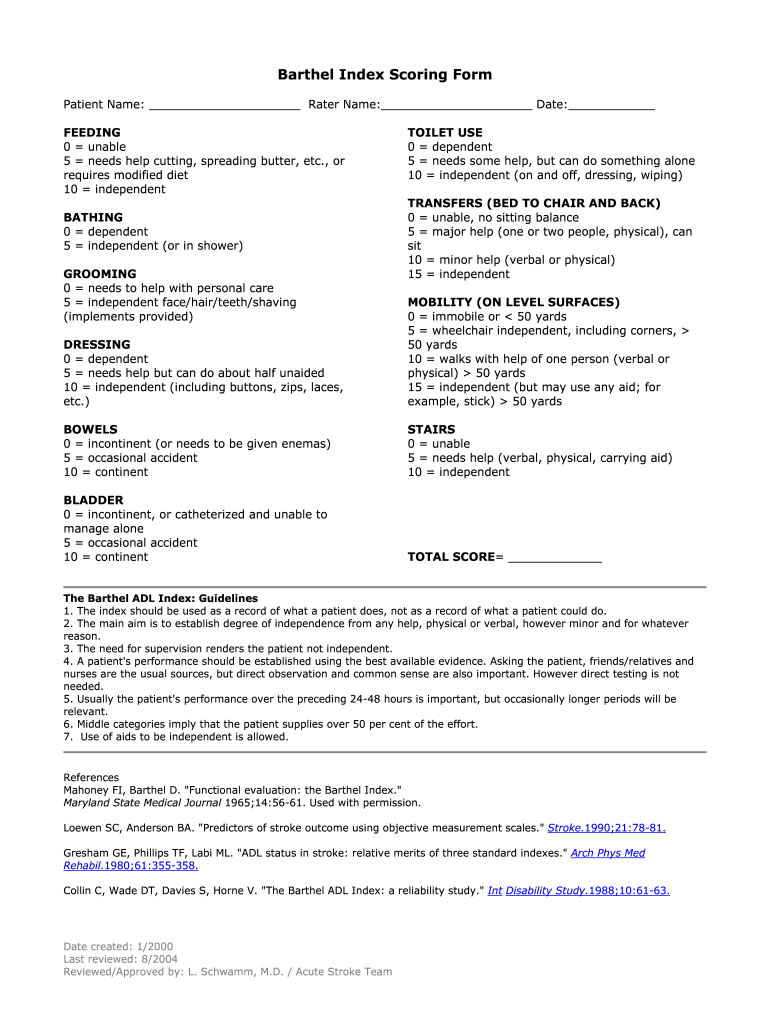
The Barthel Index is a widely used tool for assessing a patient’s level of independence in executing activities of daily living (ADLs). These activities include essential tasks such as feeding, bathing, grooming, transferring, dressing, mobility, bowel and bladder control, and stair navigation. Each activity is assigned a score based on the assistance required, which can range from zero, indicating complete dependence, to ten or more, indicating full independence in that activity.
Detailed Scoring System of the Barthel Index
To accurately score the Barthel Index, each activity is valued differently depending on its complexity and the impact it has on daily living. Here is how the scoring typically breaks down:
- Feeding: Four levels of care ranging from totally dependent to completely independent, with scores from zero to ten.
- Bathing: Similar to feeding, encompassing assistance required.
- Grooming: Scored by the extent of help needed to manage personal hygiene.
- Toilet Use: Evaluates the ability to access and use the restroom independently.
- Transfers: Involves assessing assistance needed to move from one location to another.
- Dressing: Focused on the capability to dress without supervision.
- Mobility: Measures how far a patient can walk independently.
- Bowel and Bladder Control: Assesses incontinence and management.
- Stair Navigation: Scores based on the ability to navigate stairs.
This structured scoring system allows for a thorough assessment, providing healthcare professionals with a clear metric for patient capabilities.
Importance of Accurate Assessment
Evaluating actual performance, rather than potential capability, is crucial for valid results. This focus on observed performance offers a clearer picture of a patient's functional abilities, which can guide treatment and rehabilitation strategies. It's important for healthcare providers to work collaboratively with patients to ensure accurate scoring, considering both their physical and cognitive abilities.
Barthel Index Interpretation and Use in Clinical Settings
In practice, the Barthel Index score can be interpreted to stratify care needs. A higher score indicates greater independence and may influence discharge planning, rehabilitation intensity, and overall care objectives. An example interpretation might include:
- Scores from 0 to 20: Indicates severe dependence; patients may require full-time assistance.
- Scores of 21 to 60: Suggests moderate dependence; patients may benefit from rehabilitation services.
- Scores from 61 to 100: Indicates increasing independence, potentially being suitable for home care or minimal assistance.
Modified Barthel Index Variants
The Modified Barthel Index is a variation that allows for a more nuanced evaluation by adjusting the scoring parameters or including additional activities. For instance, the modified version may incorporate more detailed metrics, such as distinct tasks within dressing or bathing, leading to scores that can be more reflective of patient needs.
Practical Considerations for Using the Barthel Index
When utilizing the Barthel Index in various clinical settings, professionals should consider the following:
- Training and Familiarity: Personnel administering the assessment should be trained in using the form, as subjective interpretations can vary.
- Patient Context: Factors such as cognitive status, age, and prior level of functioning should be considered when interpreting scores.
- Documentation: Proper documentation is essential for tracking progress over time and making informed decisions about care plans.
By integrating these considerations, practitioners can ensure efficient, effective assessments that genuinely reflect their patients’ needs.




