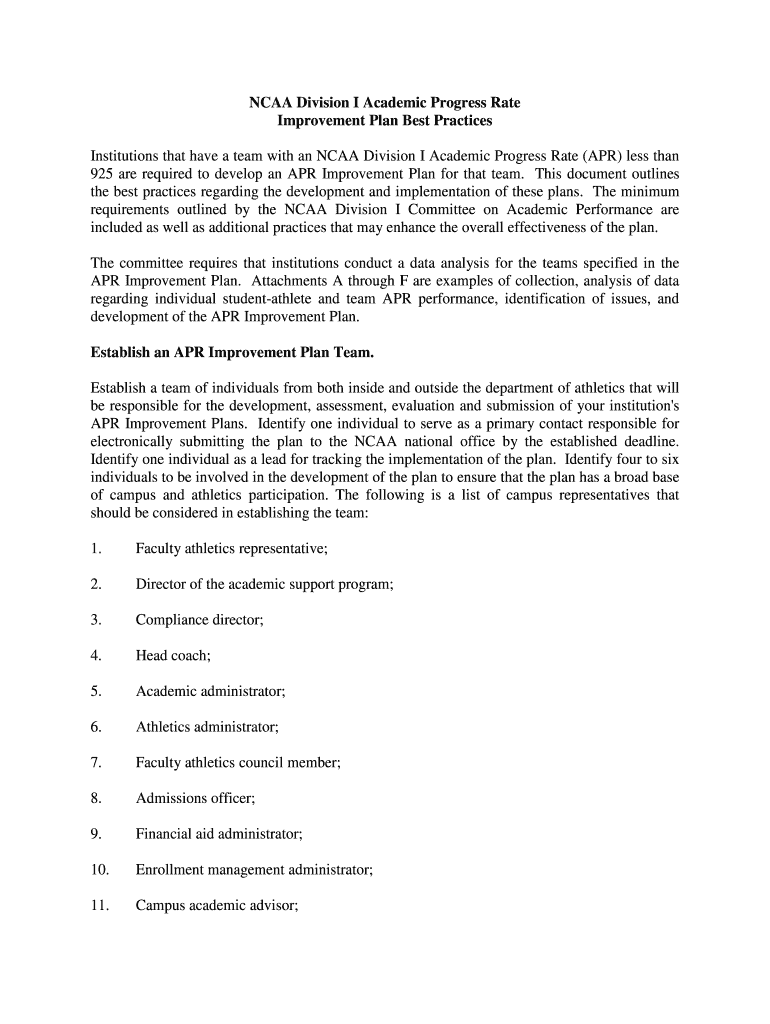
Ncaa improvement plan division 1 2026

Get Form
best practise Preview on Page 1

Here's how it works

01. Edit your best practise online
Type text, add images, blackout confidential details, add comments, highlights and more.
02. Sign it in a few clicks
Draw your signature, type it, upload its image, or use your mobile device as a signature pad.
03. Share your form with others
Send ncaa improvement plan division 1 via email, link, or fax. You can also download it, export it or print it out.

How to use or fill out NCAA Improvement Plan Division 1 with DocHub

Form edit decoration
9.5
Ease of Setup
DocHub User Ratings on G2
9.0
Ease of Use
DocHub User Ratings on G2
  1. Click ‘Get Form’ to open the NCAA Improvement Plan in our editor.
  2. Begin by establishing your APR Improvement Plan Team. Identify key individuals from various departments, ensuring a broad base of participation.
  3. Conduct a thorough analysis of your team's APR data. Use the provided sections to document specific issues impacting performance, such as eligibility and retention trends.
  4. Summarize observations from your data analysis and identify primary issues affecting the APR. Group teams with similar challenges for targeted strategies.
  5. Set measurable goals based on identified issues. Ensure these goals are specific, measurable, agreed upon, realistic, and timely (SMART).
  6. Outline detailed steps to achieve each goal. Assign responsibilities to team members and establish a timeline for completion.
  7. Review and approve the plan with necessary stakeholders before submission. Utilize our platform's features for easy collaboration and document sharing.

Start using our platform today to streamline your NCAA Improvement Plan process for free!

See more ncaa improvement plan division 1 versions

We've got more versions of the ncaa improvement plan division 1 form. Select the right ncaa improvement plan division 1 version from the list and start editing it straight away!
Versions Form popularity Fillable & printable
2010 4.8 Satisfied (145 Votes)
be ready to get more

Complete this form in 5 minutes or less

Get form

Got questions?

We have answers to the most popular questions from our customers. If you can't find an answer to your question, please contact us.
Contact us
The central purpose of the NCAA Division I Committee for Legislative Relief is to review requests to waive the normal application of the legislation while considering the purpose or intent of the legislation, the involvement and the overall well-being of the student-athlete and any competitive or recruiting advantages
To remain eligible in Division I, student-athletes must complete 40 percent of the coursework required for a degree by the end of their second year in college. They must complete 60 percent by the end of their third year and 80 percent by the end of their fourth year.
Back Pay for Student-Athletes: College athletic departments and the NCAA will pay $2.8 billion in back pay to student-athletes who competed in the NCAA from 2016 through June 6, 2025 (the date of the settlement approval).
Feigning Injuries: To combat the practice of feigning injuries, the rules committee passed a rule that if a player presents as injured after the ball is spotted by officials, that team will be charged a Team Timeout or a delay penalty if all timeouts have been used.
Understanding the New NCAA Scholarship and Roster Limits In the new model, NCAA DI schools that opt into the House Settlement are permitted to offer a scholarship to each player on a sports roster up to the new roster limits. With the move, roughly 790 new scholarships are available across the 40-plus NCAA sports.

Security and compliance

At DocHub, your data security is our priority. We follow HIPAA, SOC2, GDPR, and other standards, so you can work on your documents with confidence.

Learn more
ccpa2
pci-dss
gdpr-compliance
hipaa
soc-compliance
be ready to get more

Complete this form in 5 minutes or less

Get form

People also ask

Updated on Sep 8, 2025. The NCAA has officially approved changes to team roster sizes and scholarship limits that are reshaping college sports right now. These updates open new doors for some high school graduates to compete at the next level, while narrowing opportunities for others.
Complete 10 of your 16 NCAA-approved core-course credits, including seven in English, math or science, before the start of your seventh semester. Once you begin your seventh semester, any course needed to meet the 10/7 requirement cannot be replaced or repeated. 4. Earn a minimum 2.3 core-course GPA.
The world of college sports enters historic new territory after Judge Claudia Wilken granted final approval to the $2.8 billion settlement of the federal class-action antitrust lawsuit House v. NCAA on June 6, 2025.

plan 1 academic progress rate