



Illinois bulk sales law 2026

Get Form
bulk sales notice Preview on Page 1

Here's how it works

01. Edit your bulk sales notice online
Type text, add images, blackout confidential details, add comments, highlights and more.

02. Sign it in a few clicks
Draw your signature, type it, upload its image, or use your mobile device as a signature pad.

03. Share your form with others
Send it via email, link, or fax. You can also download it, export it or print it out.

How to use or fill out Illinois Bulk Sales Law with our platform

Form edit decoration
9.5
Ease of Setup
DocHub User Ratings on G2
9.0
Ease of Use
DocHub User Ratings on G2
  1. Click ‘Get Form’ to open it in the editor.
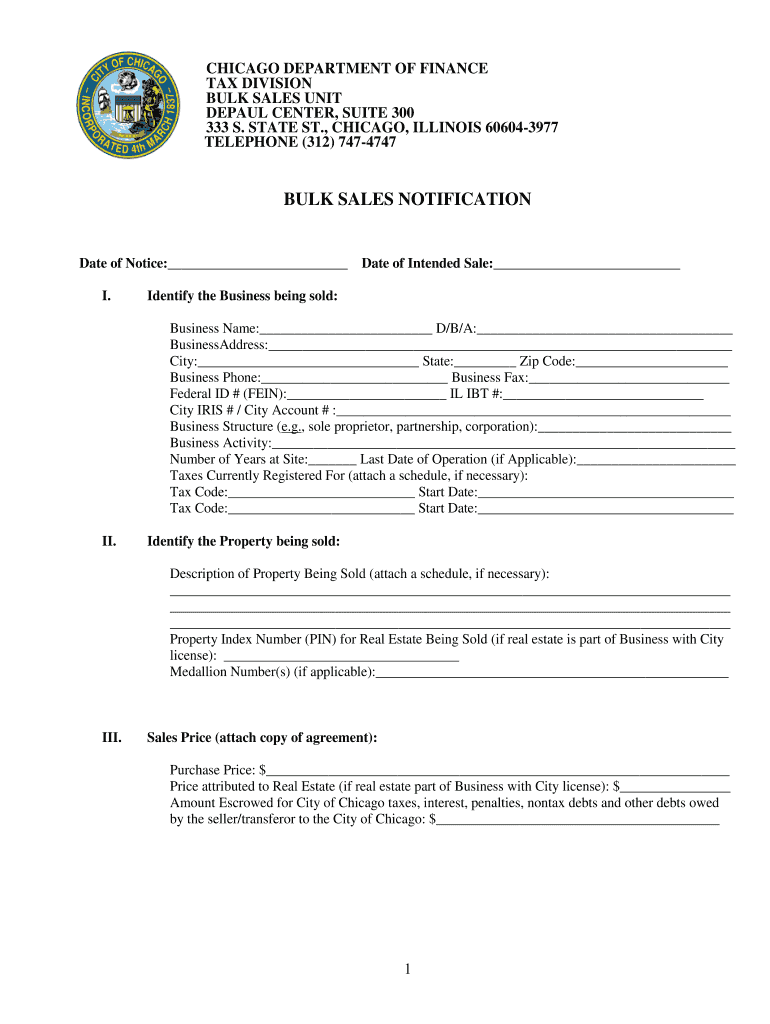
  2. Begin by entering the 'Date of Notice' and 'Date of Intended Sale' at the top of the form. This establishes the timeline for your transaction.
  3. In Section I, identify the business being sold. Fill in the 'Business Name', 'D/B/A', and complete the address fields including city, state, and zip code. Ensure you provide accurate contact information such as phone and fax numbers.
  4. Continue with federal identification numbers and business structure details. Specify how long the business has operated at its current location and any relevant tax registrations.
  5. Section II requires a description of the property being sold. If applicable, attach additional schedules for detailed descriptions.
  6. In Section III, indicate the sales price and any amounts escrowed for taxes or debts owed to the City of Chicago.
  7. Complete Sections IV and V with detailed information about both transferor/seller and transferee/buyer, ensuring all fields are filled accurately.

Start using our platform today to streamline your document editing process for free!

be ready to get more

Complete this form in 5 minutes or less

Get form

Got questions?

We have answers to the most popular questions from our customers. If you can't find an answer to your question, please contact us.
Contact us
The Illinois Procurement Code (30 ILCS 500/20) states the applicable source selection and contract formation requirements. This policy is applicable to all purchases subject to the Illinois Procurement Code that are below the small purchase/competitive procurement limit of $100,000.
Information for exclusively charitable, religious, or educational organizations; governmental bodies; and certain other tax-exempt organizations. Qualified organizations, as determined by the Illinois Department of Revenue (IDOR), are exempt from paying sales taxes in Illinois.
Economic nexus thresholds under state sales tax laws AlabamaSales dollar amount: $250,000 Arizona Sales dollar amount: $100,000 Arkansas Sales dollar amount: $100,000 California Sales dollar amount: $500,00047 more rows Jul 10, 2024
As an e-commerce seller, you will need to collect sales tax in Illinois if you have: Gross receipts of $100,000 or more or 200 or more transactions in Illinois (economic nexus) Physical presence in Illinois (physical nexus).
The tax remittance thresholds are: $100,000 or more in cumulative gross receipts from sales of tangible personal property to purchasers in Illinois; or. 200 or more separate transactions for the sale of tangible personal property to purchasers in Illinois.

Security and compliance

At DocHub, your data security is our priority. We follow HIPAA, SOC2, GDPR, and other standards, so you can work on your documents with confidence.

Learn more
ccpa2
pci-dss
gdpr-compliance
hipaa
soc-compliance
be ready to get more

Complete this form in 5 minutes or less

Get form

People also ask

While most states have repealed their bulk sales statutes, in some states across the U.S., such as California, Delaware, Illinois, New Jersey and Pennsylvania, the practice of bulk sales compliance remains alive and well.
When a bulk sale occurs, the purchaser or transferee must file (and the seller or transferor may file) Form CBS-1, Notice of Sale, Purchase, or Transfer of Business Assets, to report the sale or transfer of assets to the Illinois Department of Revenue (IDOR).
In Illinois, various Bulk Sales Acts impose an obligation on purchasers of a business or a major portion of the assets of a business, which can include the transfer of real estate, for certain unpaid taxes and even debts for which the seller of such property was responsible.

Related links