




01. Edit your parent consent letter online
Type text, add images, blackout confidential details, add comments, highlights and more.

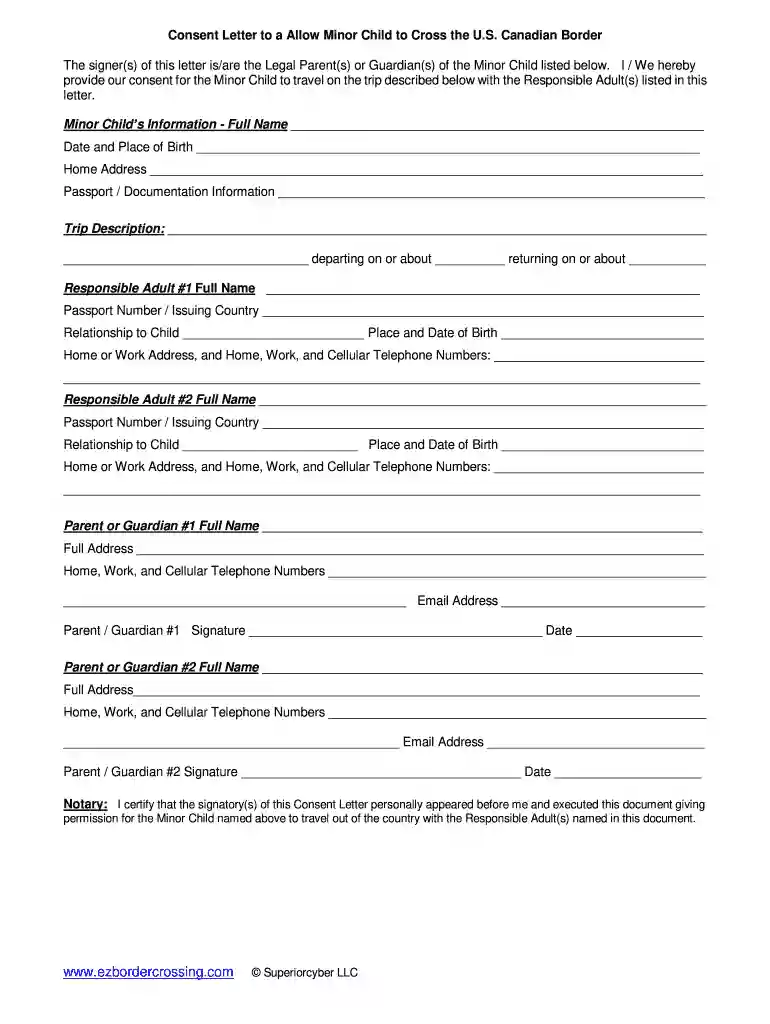
Type text, add images, blackout confidential details, add comments, highlights and more.

Draw your signature, type it, upload its image, or use your mobile device as a signature pad.

Send cbp parental consent letter sample via email, link, or fax. You can also download it, export it or print it out.
The CBP parental consent letter sample serves as an essential document for permitting a minor to travel across U.S. borders with nominated adults. This letter is recommended by U.S. Customs and Border Protection to help facilitate a smoother border crossing. It functions as legal proof that the child's parents or guardians consent to this travel arrangement.
A well-structured parental consent letter typically includes the following key components:
These elements ensure that the letter is comprehensive and ready to be presented at border control points.
When utilizing the CBP parental consent letter sample, it is vital to follow specific guidelines to ensure accuracy and completeness:
Fill In Accurate Information: Include the correct details for each section, especially the child’s information and guardian's contact details. Mistakes in this area can lead to delays or complications at the border.
Sign and Date: Ensure that all parents or guardians sign and date the letter appropriately. Lack of signatures could render the document ineffective for its intended purpose.
Include Notarization: For further validation, consider having the consent letter notarized. This step can enhance trustworthiness when presented to border authorities.
Carry Copies: When traveling, both parties (the child and the guardians) should carry printed copies of the consent letter to ensure availability when required by border officials.
Completing a CBP parental consent letter involves a straightforward process:
Draft the Letter: Use a template or draft your own letter following the key elements outlined above.
Gather Required Information: Ensure you have all the necessary details of the minor and guardians ready for inclusion in the document.
Review for Accuracy: Double-check all information provided to prevent any potential issues during border crossing.
Sign the Document: Have all parents or guardians sign the document.
Consider Notarization: If deemed necessary, visit a notary to have the document officially notarized.
Print Copies: Make several copies of the final signed document for travel.
Here are specific scenarios where a CBP parental consent letter sample is vital:
Travel with Grandparents: When a child is traveling with grandparents, parents must provide written consent, ensuring border agents that the grandparents have permission to take the child across the border.
School Field Trips: If a school organizes a trip abroad involving minors, the school may require parental consent letters from each child's guardians to ensure all necessary permissions are documented.
Separated or Divorced Parents: In cases where parents are separated or divorced, a consent letter can clarify who is authorized to travel with the child, reducing potential legal complications.
The CBP parental consent letter operates within a framework of legal requirements that guardians should be mindful of:
Legal Authority: Only legal guardians or parents have the authority to issue consent. This aspect must be clear, especially in cases of joint custody.
Compliance and Validity: The document should comply with all local and federal laws governing child travel consent. Border control may require additional verification, such as identification or custody agreements.
The letter does not guarantee entry into the destination country but facilitates the travel process. Understanding these legal nuances ensures that guardians are well-prepared before any travel.
At DocHub, your data security is our priority. We follow HIPAA, SOC2, GDPR, and other standards, so you can work on your documents with confidence.
Table of Contents. Sample letter from state court to immigration enforcement officials, in Non-Criminal, Family,. Juvenile, Civil Courts and Cases
Follow the same guidelines as for ICE and USCIS representatives as discussed in subsections (a) and. (b) when completing this caption for a CBP representative.Read more
Nov 13, 2025 International travel documents for children. See what documents a child needs to travel to or from the U.S. alone or with a parent or relative.Read more


