




01. Edit your example of completed aoc e 506 online
Type text, add images, blackout confidential details, add comments, highlights and more.

Type text, add images, blackout confidential details, add comments, highlights and more.

Draw your signature, type it, upload its image, or use your mobile device as a signature pad.

Send aoc e 506 part iv continuation via email, link, or fax. You can also download it, export it or print it out.
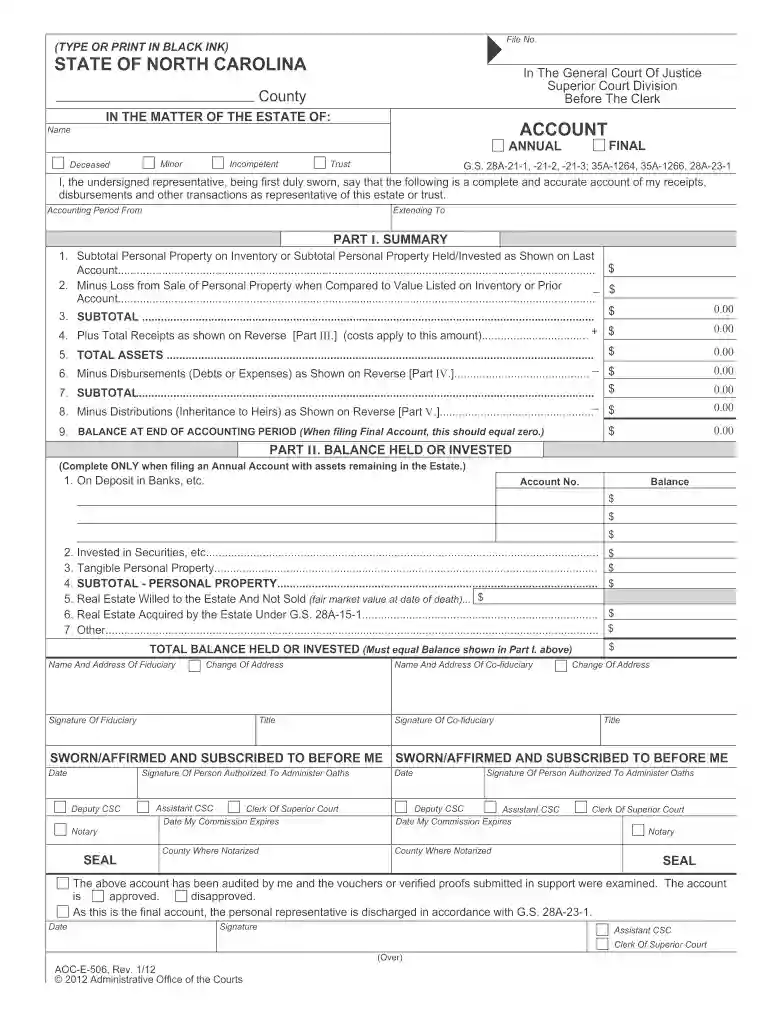
The AOC-E 506 form is a legal document commonly used in North Carolina for estate accounting. Specifically, it facilitates the reporting of financial activities related to an estate or trust. Its primary purpose is to provide a structured framework for fiduciaries to disclose income, expenses, and distributions to heirs, ensuring compliance with state laws governing estate management.
Key components often include:
When completing the AOC-E 506, precision is key to accurately reflecting the estate’s financial status.
Filling out the AOC-E 506 form involves several important steps to ensure accuracy and compliance. Follow these guidelines for successful completion:
Gather Documentation: Collect all relevant financial records, including bank statements, receipts, and documentation related to any assets and liabilities. This will provide the necessary information to fill out the form correctly.
Complete Basic Information: Enter essential details in the top section, such as the estate's name, the fiduciary's information, and relevant dates. Ensure spelling and numbers are accurate to avoid delays in processing.
Input Financial Figures:
Record Receipts and Disbursements: Document all financial transactions. Use precise dates and amounts to maintain a clear record of the estate’s monetary inflow and outflow.
Distributions: Clearly indicate amounts distributed to heirs along with their names and the corresponding date of distribution.
Review and Sign: Double-check all entries for accuracy. The fiduciary must sign the form to validate it before submission.
Completing the AOC-E 506 with accuracy ensures compliance with legal requirements in North Carolina, which can prevent possible legal complications.
Understanding the key elements of the AOC-E 506 form is essential for effective completion. The following components should be carefully considered:
These key elements contribute to a comprehensive presentation of the estate’s financial activities.
Certain pitfalls can hinder the process of filling out the AOC-E 506. It is important to be aware of these common mistakes:
Staying attentive to these areas can prevent issues that may arise post-submission.
Reviewing examples of completed AOC-E 506 forms can serve as a beneficial reference. Here are some hypothetical scenarios:
Example 1: An estate valued at $300,000, with liabilities of $50,000, presents clear income of $10,000 and distributions to heirs totaling $40,000. The completed form reflects these figures across the designated sections, providing an accurate financial portrayal.
Example 2: In a case where the estate includes real property valued at $200,000 alongside a bank account with $50,000, the fiduciary correctly lists and totals these assets while also documenting a $20,000 distribution to one heir, ensuring records are detailed and specific.
These examples demonstrate the importance of clarity in reporting estate financials, ensuring accuracy and compliance with state requirements.
Compliance with IRS guidelines is essential when handling estate documents. Important considerations include:
Tax Implications: Understanding that distributions to heirs may have tax consequences is vital. Beneficiaries might be liable for taxes on the portion of the estate they receive.
Filing Deadlines: Being aware of applicable deadlines for estate tax filings prevents potential penalties. The IRS typically requires a timely submission post-death of the estate owner.
Following these guidelines can help ensure that all legal requirements are met, paving the way for a smooth estate settlement process.
We've got more versions of the example of completed aoc e 506 form. Select the right example of completed aoc e 506 version from the list and start editing it straight away!
At DocHub, your data security is our priority. We follow HIPAA, SOC2, GDPR, and other standards, so you can work on your documents with confidence.
Aug 22, 2016 Typically, the clerk uses AOC form SP-202, which is the Order on Petition for Adjudication of. Incompetence. The appeal of the order onRead more
Acoustic parameter adjustment to match your speakers and listening environment. Automatic settings for speaker acoustic parameters.Read more
An original and one copy of a completed AOC Cover Sheet (Form #1) shall accompany the filing with the Clerk of Superior Court of any complaint, motion, answer,Read more


