Direct deposit agreement account 2026

Get Form
worker direct deposit Preview on Page 1

Here's how it works

01. Edit your worker direct deposit online
Type text, add images, blackout confidential details, add comments, highlights and more.

02. Sign it in a few clicks
Draw your signature, type it, upload its image, or use your mobile device as a signature pad.

03. Share your form with others
Send it via email, link, or fax. You can also download it, export it or print it out.

How to use or fill out direct deposit agreement account with our platform

Form edit decoration
9.5
Ease of Setup
DocHub User Ratings on G2
9.0
Ease of Use
DocHub User Ratings on G2
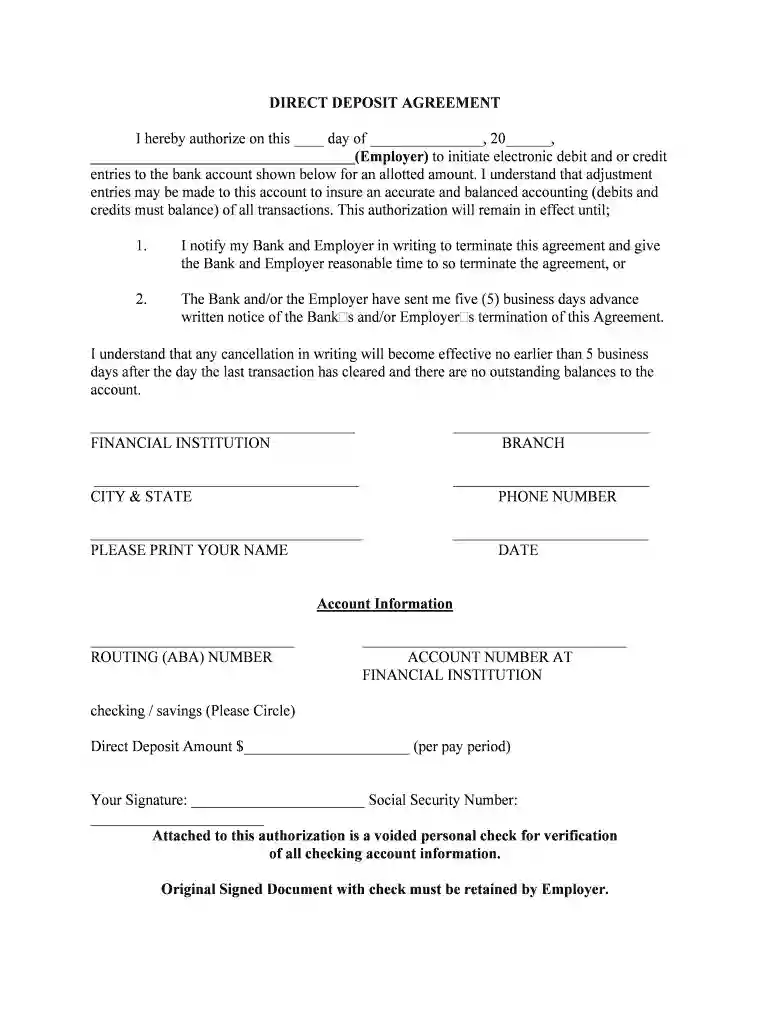
  1. Click ‘Get Form’ to open the direct deposit agreement account in the editor.
  2. Begin by entering the date at the top of the form. This is crucial for establishing when the authorization takes effect.
  3. Fill in your employer's name in the designated space, ensuring accuracy for proper processing.
  4. Provide your financial institution's details, including branch, city & state, and phone number. This information is essential for verification.
  5. Enter your routing (ABA) number and account number clearly. Indicate whether it’s a checking or savings account by circling your choice.
  6. Specify the direct deposit amount per pay period. Ensure this aligns with your expected earnings.
  7. Sign the document and include your Social Security Number for identification purposes.
  8. Attach a voided personal check to verify your account information before submitting it to your employer.

Start using our platform today to easily complete and manage your direct deposit agreement!

See more direct deposit agreement account versions

We've got more versions of the direct deposit agreement account form. Select the right direct deposit agreement account version from the list and start editing it straight away!
Versions Form popularity Fillable & printable
2020 4.8 Satisfied (101 Votes)
be ready to get more

Complete this form in 5 minutes or less

Get form

Got questions?

We have answers to the most popular questions from our customers. If you can't find an answer to your question, please contact us.
Contact us
Direct Deposit is a safe, fast, and easy way to automatically receive your payments deposited into your personal bank account. Make purchases, pay your bills, or get cash as soon as your benefits are deposited. Its fast and easy to enroll. All you need is your checking or savings account information.
Account Information : For a direct deposit, you typically need to provide your banks name, your account number, and the banks routing number. Bank Policies Employer Requirements Access to Funds
Clearly define the rights and responsibilities of each party, including their rights to the deposit amount, the interest earned, and any penalties for late or nonpayment. Make sure the agreement is written in plain language and that both parties understand the terms and conditions.
Savings, Current, Salary, Fixed Deposit, and Recurring Deposit Accounts cater to different financial needs, offering flexibility and tailored benefits.
In the Deposit Type drop down, select whether the deposit is based on a set amount, a percentage of your net pay, or if it is to be the Balance of Net Pay account. Note: A Balance of Net Pay account is required, if you only have one (1) account, it should have a deposit type of Balance of Net Pay.

Security and compliance

At DocHub, your data security is our priority. We follow HIPAA, SOC2, GDPR, and other standards, so you can work on your documents with confidence.

Learn more
ccpa2
pci-dss
gdpr-compliance
hipaa
soc-compliance
be ready to get more

Complete this form in 5 minutes or less

Get form

People also ask

Direct deposit authorization forms authorize employers to send money directly into an individuals bank account.
The DailyPay account (DPA) is a unique bank account that replaces an employees existing direct deposit account within the payroll system, so that DailyPay can handle all reconciliation of advanced earned pay without requiring you, the employer, to make any changes to your payroll process.

Related links