Kidney Clinical Research & Epidemiology - NIDDK - NIH 2026

Get Form
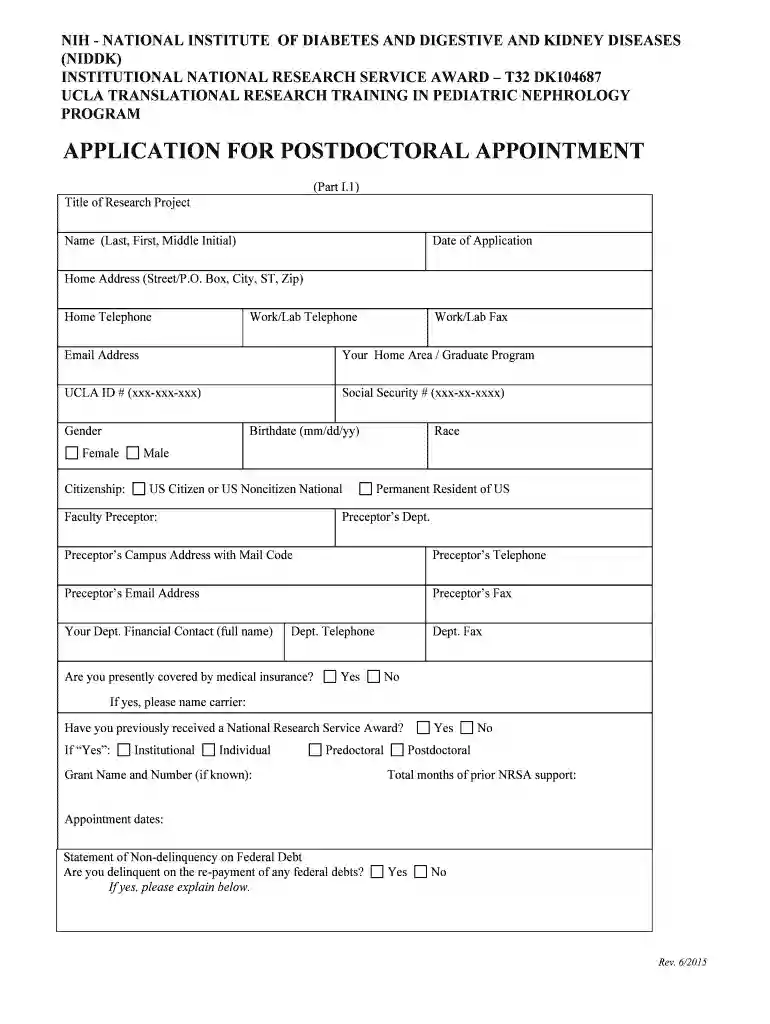
Kidney Clinical Research & Epidemiology - NIDDK - NIH Preview on Page 1

Here's how it works

01. Edit your form online
Type text, add images, blackout confidential details, add comments, highlights and more.

02. Sign it in a few clicks
Draw your signature, type it, upload its image, or use your mobile device as a signature pad.

03. Share your form with others
Send it via email, link, or fax. You can also download it, export it or print it out.

How to use or fill out Kidney Clinical Research & Epidemiology - NIDDK - NIH with Our Platform

Form edit decoration
9.5
Ease of Setup
DocHub User Ratings on G2
9.0
Ease of Use
DocHub User Ratings on G2
  1. Click ‘Get Form’ to open the Kidney Clinical Research & Epidemiology - NIDDK - NIH document in the editor.
  2. Begin with Part I by filling out the Application for Appointment form. Enter your title of research project, name, and date of application in the designated fields.
  3. Complete your home address, telephone numbers, email address, and UCLA ID #. Ensure all personal information is accurate for seamless communication.
  4. In Part II, provide details about your research project. This section requires a two-page explanation signed by both you and your preceptor.
  5. For Part III, gather necessary documents such as a Letter of Nomination from your preceptor and their NIH Biosketch or CV. Make sure these are attached before submission.
  6. Review all sections for completeness and accuracy. Use our platform's tools to highlight any areas that need attention or additional information.

Start using our platform today to streamline your application process for free!

See more Kidney Clinical Research & Epidemiology - NIDDK - NIH versions

We've got more versions of the Kidney Clinical Research & Epidemiology - NIDDK - NIH form. Select the right Kidney Clinical Research & Epidemiology - NIDDK - NIH version from the list and start editing it straight away!
Versions Form popularity Fillable & printable
2015 4.9 Satisfied (23 Votes)
be ready to get more

Complete this form in 5 minutes or less

Get form

Got questions?

We have answers to the most popular questions from our customers. If you can't find an answer to your question, please contact us.
Contact us
The reliability of the NIDDK-QA, as measured by test-retest correlation (Pearson coefficients: 0.82-0.99, P
KidneyCure, the ASN Foundation, funds clinical and basic research, and provides grant support to members at various points in their careers, while ASN provides travel support to trainees to attend Kidney Week.
The National Institute of Diabetes and Digestive and Kidney Diseases (NIDDK), of the National Institutes of Health, is a Federal Government research agency funded by Congressional appropriations. However, NIDDK is also authorized by the U.S. Congress to accept donations and bequests to support its mission.
Funding applications undergo a peer review process by outside scientific experts, typically in a study section organized by NIHs Center for Scientific Review (CSR) link or NIDDK. For information about which types of applications are reviewed by NIH and NIDDK, view NIDDKs Grant Review page.
Quick Reference on UACR GFR. Kidney Failure. Diabetic Kidney Disease. IgA Nephropathy.

Security and compliance

At DocHub, your data security is our priority. We follow HIPAA, SOC2, GDPR, and other standards, so you can work on your documents with confidence.

Learn more
ccpa2
pci-dss
gdpr-compliance
hipaa
soc-compliance
be ready to get more

Complete this form in 5 minutes or less

Get form

People also ask

You should keep applying for K awards, but remember K99 is extremely competitive, median success rate is ~25%, institutes like NCI and NIDDK are like 17%, some institutes get ~5 apps and maybe fund half or none depending on the year.
The National Institutes of Health (NIH) supports biomedical and behavioral research domestically and abroad, conducts research in its own laboratories and clinics, trains research scientists, and develops and disseminates credible, science-based health information to the public.

Related links