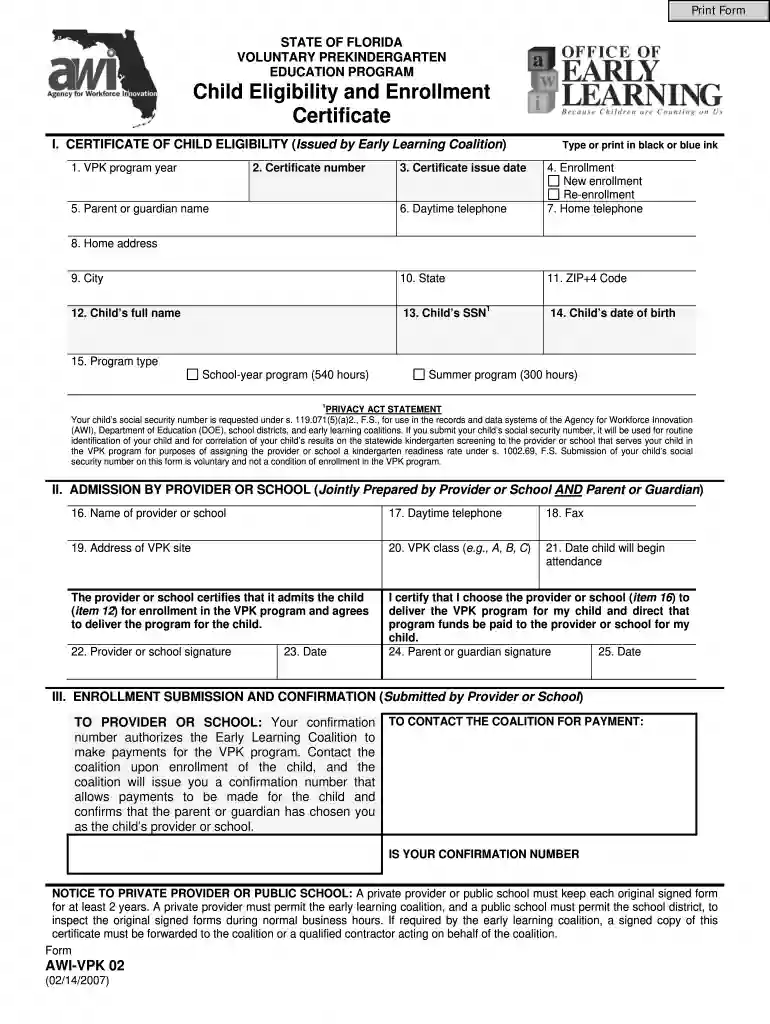
Child Eligibility and Enrollment 2025

Get Form
Child Eligibility and Enrollment Preview on Page 1

Here's how it works

01. Edit your form online
Type text, add images, blackout confidential details, add comments, highlights and more.

02. Sign it in a few clicks
Draw your signature, type it, upload its image, or use your mobile device as a signature pad.

03. Share your form with others
Send it via email, link, or fax. You can also download it, export it or print it out.

How to use or fill out Child Eligibility and Enrollment with our platform

Form edit decoration
9.5
Ease of Setup
DocHub User Ratings on G2
9.0
Ease of Use
DocHub User Ratings on G2
  1. Click ‘Get Form’ to open the Child Eligibility and Enrollment document in the editor.
  2. Begin by filling in the 'VPK program year' and 'Certificate number' fields at the top of the form. Ensure you enter this information accurately as it is crucial for processing.
  3. Next, indicate whether this is a new enrollment or re-enrollment by selecting the appropriate option in section I.
  4. Provide your contact details, including daytime and home telephone numbers, along with your home address. This information helps maintain communication regarding your child's enrollment.
  5. Fill in your child's full name, Social Security Number (optional), and date of birth. Be mindful of privacy considerations when entering sensitive information.
  6. Select the program type—either 'School-year program' or 'Summer program'—to specify which VPK option you are enrolling your child in.
  7. In section II, input the name and contact details of the provider or school where your child will attend. This includes their address and class designation.
  8. Finally, ensure that both you and the provider sign and date the form to confirm enrollment before submission.

Start using our platform today to easily complete your Child Eligibility and Enrollment form for free!

See more Child Eligibility and Enrollment versions

We've got more versions of the Child Eligibility and Enrollment form. Select the right Child Eligibility and Enrollment version from the list and start editing it straight away!
Versions Form popularity Fillable & printable
2007 4.8 Satisfied (183 Votes)
2005 4 Satisfied (57 Votes)
be ready to get more

Complete this form in 5 minutes or less

Get form

Got questions?

We have answers to the most popular questions from our customers. If you can't find an answer to your question, please contact us.
Contact us
If you get health insurance through your job, through Medicare or through the Affordable Care Act (ACA) marketplace, you will have an open enrollment period.
You qualify for a Special Enrollment Period if youve had certain life events, including losing health coverage, moving, getting married, having a baby, or adopting a child. Depending on your Special Enrollment Period type, you usually have 60 days before or 60 days following the event to enroll in a plan.
The EE Rule protects children from being forced into periods of uninsurance by eliminating CHIP waiting periods that delay uninsured eligible kids from enrolling in coverage. Waiting periods force children to go uninsured for as long as three months before they can get coverage.
The Access Rule requires states to institute and manage a grievance (complaint) process for people who receive services through Medicaid fee-for-service (FFS). The requirement complements the requirements already in place in managed care programs.
Financial eligibility, or income eligibility, is based on Modified Adjusted Gross Income (MAGI). MAGI is used to determine financial eligibility for Medicaid, CHIP, and premium tax credits and cost sharing reductions available through the health insurance marketplace.

People also ask

For most states, the Medicaid income limit is $2,901 per month for a single applicant and $5,802 per month for married applicants, typically set at 300% of the Federal Benefit Rate (FBR).
Answer: States have different income eligibility rules, but in most states, children up to age 19 with family income up to $80,000 per year (for a family of four; income levels vary by state) may qualify for Medicaid or the CHIP. In many states, family income can be even higher and children can still qualify.
The Insurance Eligibility clause defines the criteria that individuals or entities must meet to qualify for coverage under an insurance policy. Typically, this clause outlines requirements such as age limits, residency status, employment conditions, or other specific qualifications necessary for participation.

Related links