Chronic Wasting Disease (CWD) - Kansas Department of Agriculture 2026

Get Form
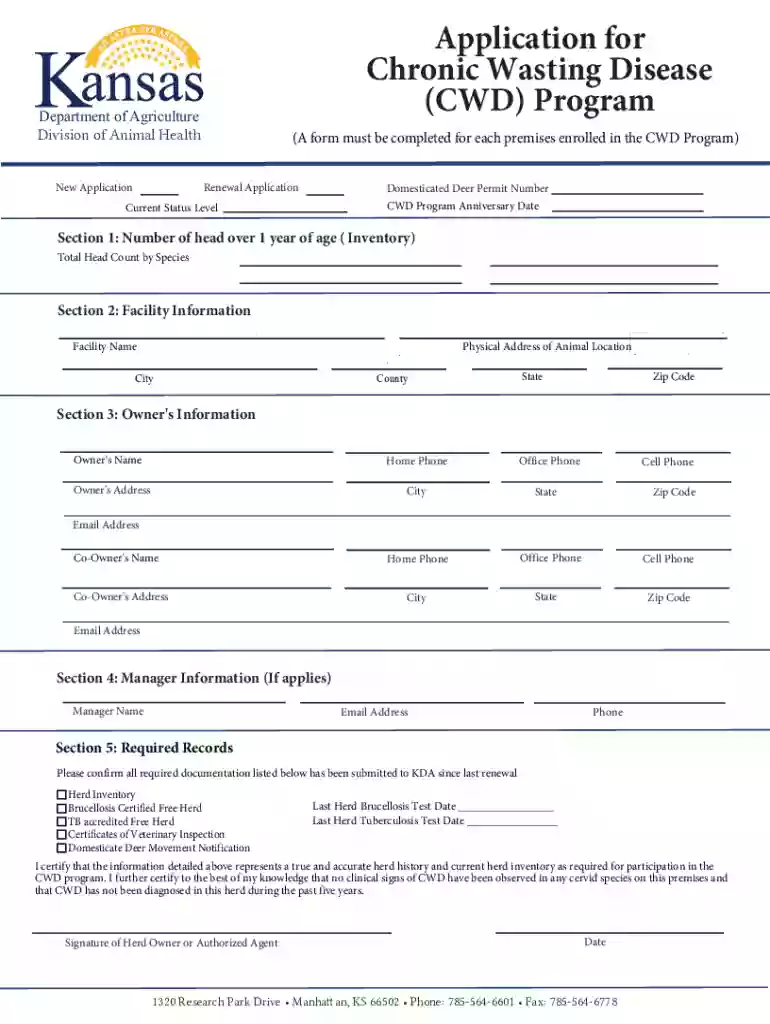
Chronic Wasting Disease (CWD) - Kansas Department of Agriculture Preview on Page 1

Here's how it works

01. Edit your form online
Type text, add images, blackout confidential details, add comments, highlights and more.

02. Sign it in a few clicks
Draw your signature, type it, upload its image, or use your mobile device as a signature pad.

03. Share your form with others
Send it via email, link, or fax. You can also download it, export it or print it out.

How to use or fill out Chronic Wasting Disease (CWD) - Kansas Department of Agriculture with our platform

Form edit decoration
9.5
Ease of Setup
DocHub User Ratings on G2
9.0
Ease of Use
DocHub User Ratings on G2
  1. Click ‘Get Form’ to open it in the editor.
  2. Begin with Section 1, where you will input the total head count by species for animals over one year of age. Ensure accuracy as this information is crucial for your application.
  3. Proceed to Section 2 and fill in the facility information. Provide the physical address, facility name, city, county, state, and zip code where your animals are located.
  4. In Section 3, enter the owner's information. This includes the owner's name, home phone number, address details, office phone number, cell phone number, state, zip code, and email address. If applicable, also include co-owner's details.
  5. If there is a manager involved in your operation, complete Section 4 with their name, email address, and phone number.
  6. In Section 5, confirm that all required records have been submitted since your last renewal. This includes herd inventory and various health certifications. Fill in the dates for the last herd brucellosis and tuberculosis tests.
  7. Finally, certify that all provided information is accurate by signing and dating at the bottom of the form.

Start using our platform today to streamline your CWD application process for free!

See more Chronic Wasting Disease (CWD) - Kansas Department of Agriculture versions

We've got more versions of the Chronic Wasting Disease (CWD) - Kansas Department of Agriculture form. Select the right Chronic Wasting Disease (CWD) - Kansas Department of Agriculture version from the list and start editing it straight away!
Versions Form popularity Fillable & printable
2019 4.8 Satisfied (148 Votes)
be ready to get more

Complete this form in 5 minutes or less

Get form

Got questions?

We have answers to the most popular questions from our customers. If you can't find an answer to your question, please contact us.
Contact us
Chronic Wasting Disease in Kansas was first identified in farmed bull elk in Harper County in 2001. As of June 30, 2024, CWD has been detected in two farmed elk, 1 farm mule deer, and 1,075 wild deer.
Health officials with the Centers for Disease Control and Prevention (CDC) show CWD is present in 49 counties in Kansas, the majority being in the western half of the state.
There is no known cure. CWD, like all transmissible spongiform encephalopathies, is not treatable and ultimately fatal. This makes it a real, and undeniable threat to animal and herd health. To date, scientists have documented that CWD can have negative population effects in elk, mule deer, and white-tailed deer.
Key points. Chronic wasting disease affects deer, elk and similar animals in the United States and a few other countries. The disease hasnt been shown to infect people. However, it might be a risk to people if they have contact with or eat meat from animals infected with CWD.
No CWD infections in people have ever been reported. And its not known if people can even get infected with CWD. However, CWD is related to another prion disease in animals that does infect people. So, it is considered a theoretical risk to people.

Security and compliance

At DocHub, your data security is our priority. We follow HIPAA, SOC2, GDPR, and other standards, so you can work on your documents with confidence.

Learn more
ccpa2
pci-dss
gdpr-compliance
hipaa
soc-compliance
be ready to get more

Complete this form in 5 minutes or less

Get form

People also ask

Mule deer are restricted to the western one-third of the state, primarily on the High Plains, Smoky Hills, and Red Hills regions. As you travel west to east, mule deer are less abundant, and whitetail numbers increase.
KDWP recommends that every captive cervid operator enroll in the voluntary CWD monitoring program administered by the Kansas Department of Agriculture, Animal Health Division.

Related links