California involuntary 2026

Get Form
california patient Preview on Page 1

Here's how it works

01. Edit your california patient online
Type text, add images, blackout confidential details, add comments, highlights and more.
02. Sign it in a few clicks
Draw your signature, type it, upload its image, or use your mobile device as a signature pad.
03. Share your form with others
Send patient form via email, link, or fax. You can also download it, export it or print it out.

How to use or fill out California Involuntary with our platform

Form edit decoration
9.5
Ease of Setup
DocHub User Ratings on G2
9.0
Ease of Use
DocHub User Ratings on G2
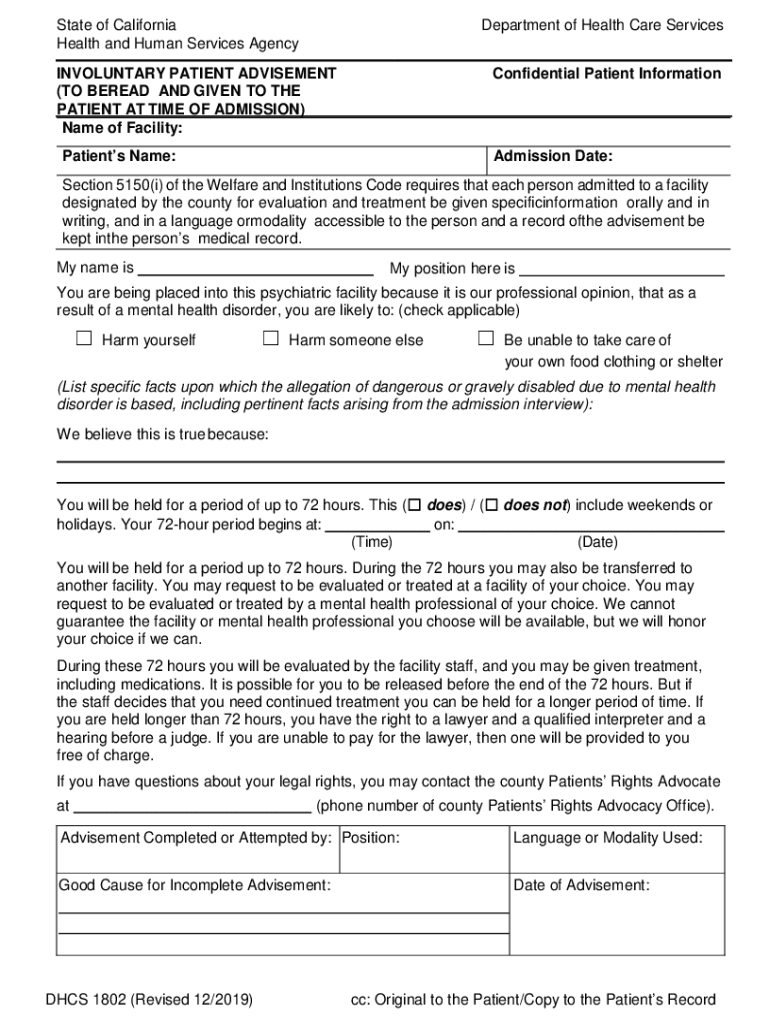
  1. Click ‘Get Form’ to open the California Involuntary Patient Advisement document in the editor.
  2. Begin by entering the 'Name of Facility' at the top of the form. This identifies where the patient is being admitted.
  3. Fill in the 'Patient’s Name' and 'Admission Date' fields to ensure accurate record-keeping.
  4. In the section regarding potential harm, check all applicable boxes that describe why the patient is being admitted. This is crucial for legal documentation.
  5. Provide specific facts supporting the admission decision in the designated area. This should include details from the admission interview.
  6. Indicate whether weekends or holidays are included in the 72-hour hold period by checking the appropriate box.
  7. Complete sections regarding advisement completion, including your name, position, and any language used during advisement.

Start using our platform today to easily fill out your California Involuntary forms for free!

See more california involuntary versions

We've got more versions of the california involuntary form. Select the right california involuntary version from the list and start editing it straight away!
Versions Form popularity Fillable & printable
2019 4.8 Satisfied (48 Votes)
2014 4.4 Satisfied (33 Votes)
be ready to get more

Complete this form in 5 minutes or less

Get form

Got questions?

We have answers to the most popular questions from our customers. If you can't find an answer to your question, please contact us.
Contact us
Involuntary treatment is typically applied under the following conditions: The individual has a severe mental illness. They are assessed as being at significant risk of harming themselves or others. No less restrictive treatment options are available.
In reference to law, involuntary is used to indicate a lack of control or intent. For example: Involuntary acts includes reflexes, convulsions, or other acts which are not consciously controlled by the mind or which a person has no control. In criminal law , involuntary actions may absolve the actor of liability.
California law allows police officers and certain mental health professionals to take you into custody if they believe that, because of your mental illness, you are likely to cause or suffer specific kinds of harm. This is often referred to as a 5150 hold, named after the regulation that authorizes it.
5150 is the number of the section of the Welfare and Institutions Code, which allows an adult who is experiencing a mental health crisis to be involuntarily detained for a 72- hour psychiatric hospitalization when evaluated to be a danger to others, or to himself or herself, or gravely disabled.
Involuntary Patients. What does it mean to be an involuntary patient? An involuntary patient is a person who is detained in a hospital without their consent and cannot leave without permission.

Security and compliance

At DocHub, your data security is our priority. We follow HIPAA, SOC2, GDPR, and other standards, so you can work on your documents with confidence.

Learn more
ccpa2
pci-dss
gdpr-compliance
hipaa
soc-compliance

People also ask

Civil commitment is a legal process that allows for involuntary psychiatric treatment of individuals who are a danger to themselves or others or are unable to provide for their needs due to mental illness.

california dhcs form