




Here's how it works

01. Edit your motion to dismiss juvenile georgia online
Type text, add images, blackout confidential details, add comments, highlights and more.

02. Sign it in a few clicks
Draw your signature, type it, upload its image, or use your mobile device as a signature pad.

03. Share your form with others
Send georgia motion juvenile via email, link, or fax. You can also download it, export it or print it out.
How to use or fill out Georgia Motion Juvenile with Our Platform

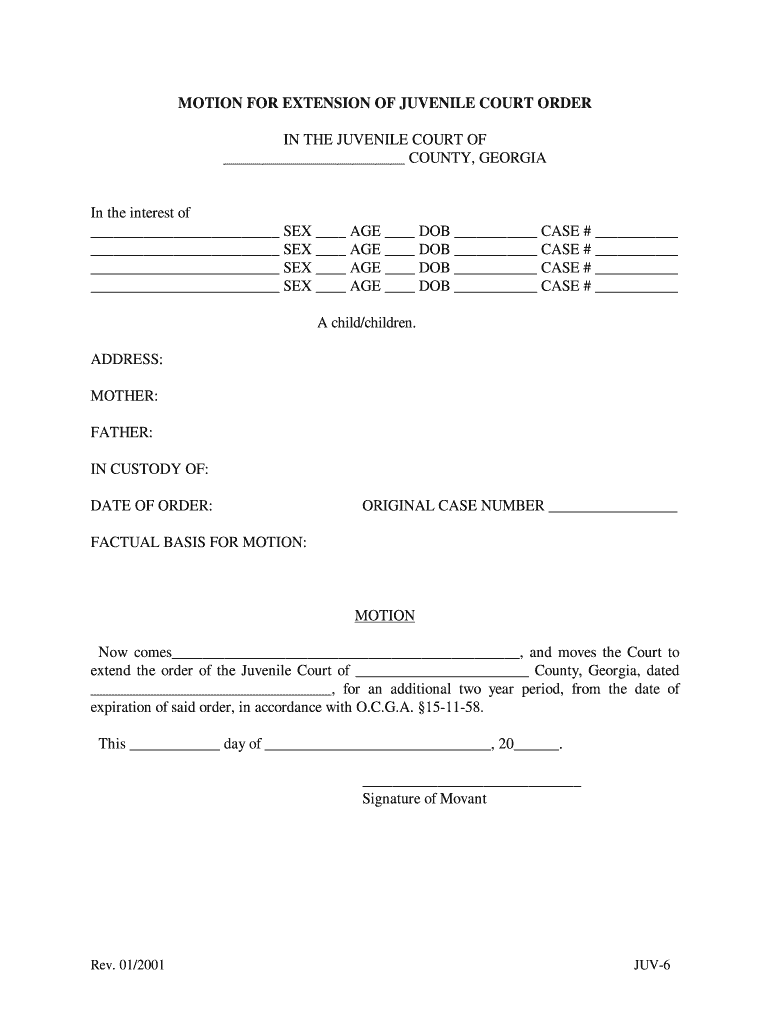
- Click ‘Get Form’ to open the Georgia Motion Juvenile in the editor.
- Begin by filling in the county name at the top of the form, ensuring it matches your jurisdiction.
- In the 'In the interest of' section, enter the names, sex, age, and date of birth for each child involved in the case. Make sure all details are accurate.
- Provide the address where you can be reached under 'ADDRESS'.
- Fill in the names of both parents or guardians under 'MOTHER' and 'FATHER'.
- Indicate who currently has custody of the child/children in the 'IN CUSTODY OF' section.
- Enter the date of the original order and its case number in their respective fields.
- In 'FACTUAL BASIS FOR MOTION', clearly state your reasons for requesting an extension.
- Sign and date at the bottom as 'Movant' to finalize your motion.
- Review all sections for completeness before submitting your motion for a hearing date.
Start using our platform today to fill out your Georgia Motion Juvenile form online for free!
Fill out georgia motion juvenile online
It's free
It's free
See more georgia motion juvenile versions
We've got more versions of the georgia motion juvenile form. Select the right georgia motion juvenile version from the list and start editing it straight away!
| Versions | Form popularity | Fillable & printable |
|---|---|---|
| 2001 | 4.8 Satisfied (119 Votes) |
Got questions?
We have answers to the most popular questions from our customers. If you can't find an answer to your question, please contact us.
Contact us
What is the most common type of case disposition in juvenile court?
Probation is the most frequent disposition for all juvenile arrests because: It is limitless: unlike training schools or private providers, probation departments cannot limit or control their intake.
What happens when a juvenile goes to court in Georgia?
In Georgia, all Juvenile Court cases are decided only by a Judge, there are no juries in Juvenile Court. Once the child is adjudicated (found guilty) on the delinquent act, that is when they will meet with their Community Supervision Officer and go over the conditions of their sentence.
What are the 5 steps in the juvenile justice system?
Heres what to expect as you navigate through the various stages of juvenile court proceedings. 1) Investigation. 2) Diversion. 3) First Appearance. 4) Arraignment. 5) Pre-Trial Hearing (also known as Pretrial Conference or a Case Setting Hearing) 6) Fact Finding Hearing (also known as an adjudication hearing or trial)
What are the three types of Juvenile Court hearings?
Juvenile courts hear three types of cases: (1) delinquency; (2) child protection; and (3) status offenses.
Is a juvenile anyone under the age of 17 in Georgia?
The Georgia court system draws the line between adulthood and juveniles for the sake of criminal consequences at 17 years of age. Offenders under 17 will generally receive consequences appropriate to their age, while adult offenders may receive more severe penalties.
Security and compliance
At DocHub, your data security is our priority. We follow HIPAA, SOC2, GDPR, and other standards, so you can work on your documents with confidence.
Learn more


People also ask
What are the three basic components of the juvenile justice system?
The major components of the juvenile justice system are also featured, including law enforcement, prosecution and the courts, and corrections.
What are the three types of juveniles?
Youth who are accused of committing crimes fall into three categories: Juvenile Delinquent, Juvenile Offender, and Adolescent Offender. A Juvenile Delinquent is a child over 12, but under 18 years of age, who commits an act that would be a crime if it had been committed by an adult.
What are the 4 types of juvenile delinquency?
There are four main types of juvenile delinquency individual, group-supported, organized and situational. Individual delinquency refers to one child committing an act on his or her own, with the argument that the delinquency is caused by family problems.


