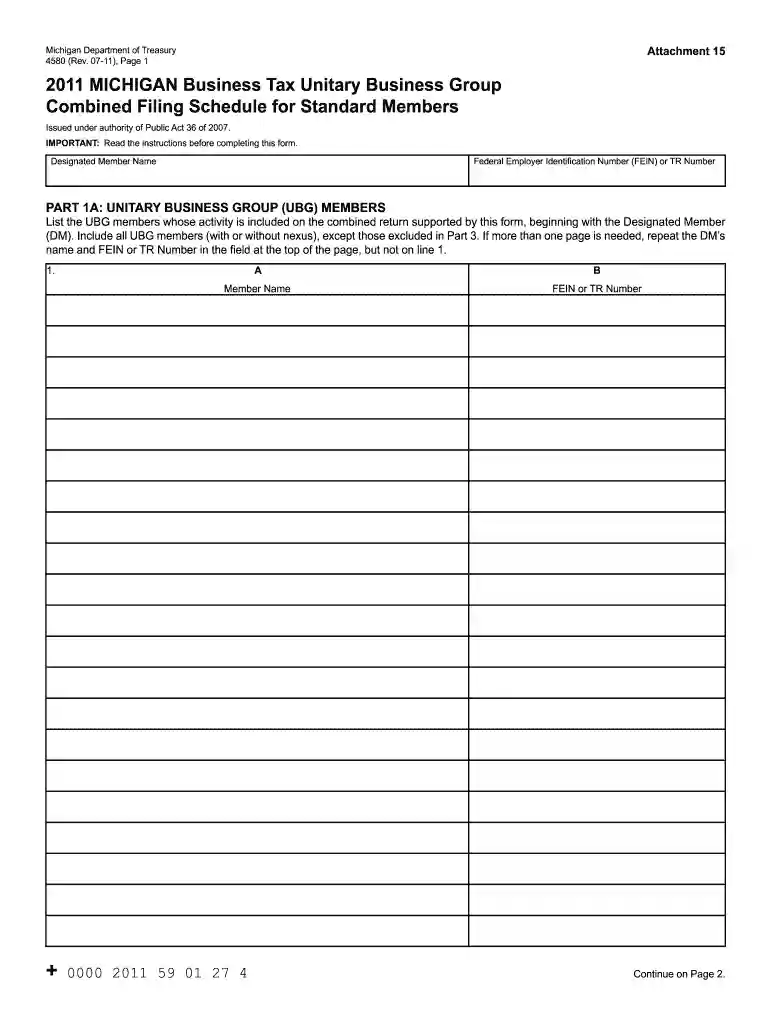
2011 michigan unitary 4580 form Preview on Page 1

2011 michigan unitary 4580 form-2026

Here's how it works

  • 01. Edit your form online

    Type text, add images, blackout confidential details, add comments, highlights and more.

  • 02. Sign it in a few clicks

    Draw your signature, type it, upload its image, or use your mobile device as a signature pad.

  • 03. Share your form with others

    Send it via email, link, or fax. You can also download it, export it or print it out.

How to use or fill out 2011 Michigan Unitary 4580 form with our platform

Form edit decoration
9.5
Ease of Setup
DocHub User Ratings on G2
9.0
Ease of Use
DocHub User Ratings on G2
  1. Click ‘Get Form’ to open the 2011 Michigan Unitary 4580 form in the editor.
  2. Begin by entering the Designated Member Name and Federal Employer Identification Number (FEIN) at the top of the form.
  3. In Part 1A, list all members of the Unitary Business Group (UBG) starting with the Designated Member. Ensure to include their corresponding FEIN or TR numbers.
  4. Proceed to Part 1B for each member listed in Part 1A. Fill out details such as Member Name, Organization Type, and Address.
  5. In Part 2A, enter data for each member's business activity. This includes Gross Receipts, Inventory, and any deductions applicable.
  6. Complete Part 2B by summarizing business activities for all members and ensuring intercompany transactions are eliminated where necessary.
  7. Finally, review all entries for accuracy before saving or exporting your completed form directly from our platform.

Start using our platform today to simplify your document editing and form completion process for free!

See more 2011 michigan unitary 4580 form versions

We've got more versions of the 2011 michigan unitary 4580 form form. Select the right 2011 michigan unitary 4580 form version from the list and start editing it straight away!

VersionsForm popularityFillable & printable
20234.4 Satisfied (35 Votes)
20224.1 Satisfied (57 Votes)
20214.6 Satisfied (82 Votes)
20204.4 Satisfied (182 Votes)
20194.3 Satisfied (60 Votes)
20174.2 Satisfied (85 Votes)
20144.3 Satisfied (119 Votes)
20134.4 Satisfied (60 Votes)
20114 Satisfied (46 Votes)

be ready to get more

Complete this form in 5 minutes or less

Got questions?

We have answers to the most popular questions from our customers. If you can't find an answer to your question, please contact us.

The CIT return has to be filed by the last day of the fourth month post the end of the taxpayers tax year. It is important to note that the CIT Michigan Corporation taxes isnt required to be filed by any taxpayer reporting less than $350,000 in apportioned or allocated gross receipts.
Single-member LLC (sole proprietorship): Must file a tax return if it has any income, regardless of profit, and/or if it has deductible expenses. Multi-member LLC: Must file a tax return if it has any income or deductible expenses.
Pass-Through LLCs (default status): Do not pay Michigan business taxes directly. Instead, the owner reports business income on their personal state return (Form MI-1040). Corporation-Elected LLCs: Must pay Michigan Corporate Income Tax (CIT) at a flat 6% rate and file Form 4891.
Your LLC must file an IRS Form 1065 and a Michigan Partnership Return (filed with the city). LLC taxed as a Corporation: Yes. Your LLC must file tax returns with the IRS and the Michigan Department of Revenue to pay your Michigan income tax. Check with your accountant to make sure you file all the correct documents.
In Michigan, a UBG with standard members must file Form 4567. A Designated Member (DM) must file the return on behalf of the standard members of the group. In a parent- subsidiary controlled group, the controlling member must serve as DM if it has nexus with Michigan.

Security and compliance

At DocHub, your data security is our priority. We follow HIPAA, SOC2, GDPR, and other standards, so you can work on your documents with confidence.

Related links

indiana handbook of taxes, revenues, and appropriations

Jun 9, 2024 From 2007 to 2011, the property and payroll factors will be phased out, with single-sales-factor apportionment beginning in tax year 2011.Read more

Learn more
If you believe that this page should be taken down, please follow our DMCA take down process here