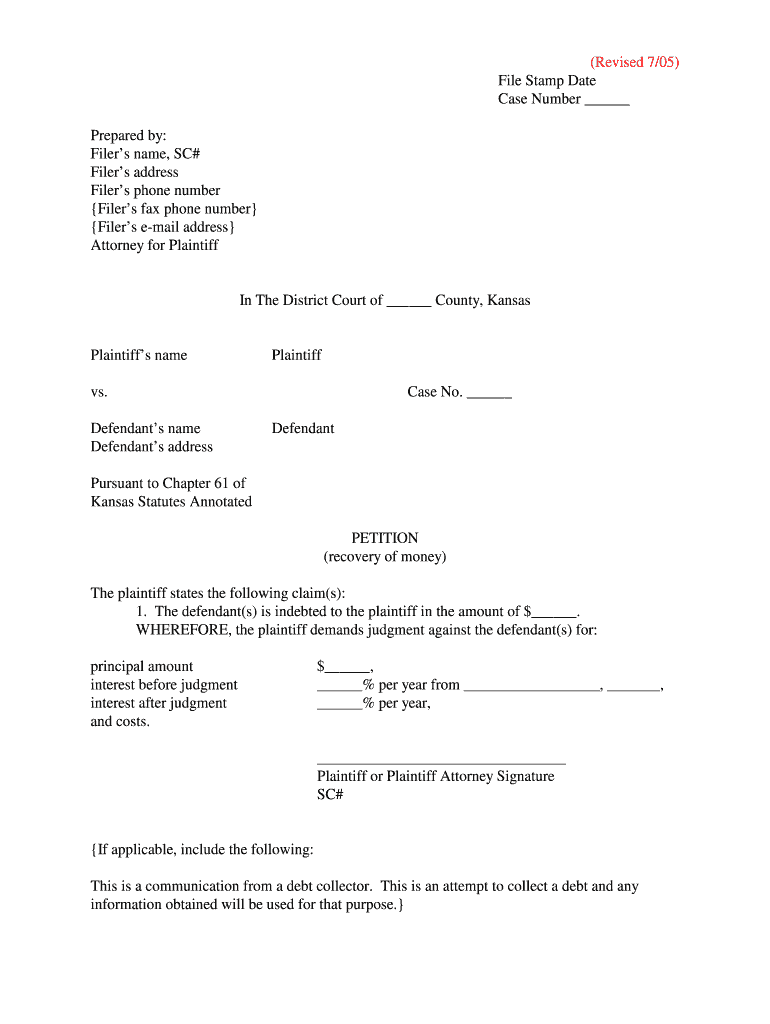
U:kscourtscouncilch61 petition recovermoney wpd - kansasjudicialcouncil 2026

Get Form
U:kscourtscouncilch61 petition recovermoney wpd - kansasjudicialcouncil Preview on Page 1

Here's how it works

01. Edit your form online
Type text, add images, blackout confidential details, add comments, highlights and more.
02. Sign it in a few clicks
Draw your signature, type it, upload its image, or use your mobile device as a signature pad.
03. Share your form with others
Send it via email, link, or fax. You can also download it, export it or print it out.

How to use or fill out U:kscourtscouncilch61 petition recovermoney wpd - kansasjudicialcouncil with our platform

Form edit decoration
9.5
Ease of Setup
DocHub User Ratings on G2
9.0
Ease of Use
DocHub User Ratings on G2
  1. Click ‘Get Form’ to open it in the editor.
  2. Begin by entering the case number at the top of the form. This is essential for identifying your case within the court system.
  3. Fill in your name, address, phone number, and email address in the designated fields. If you are an attorney, include your SC# as well.
  4. In the section labeled 'Plaintiff', enter the name of the plaintiff and their details. Similarly, provide the defendant's name and address in the corresponding fields.
  5. State your claim by specifying the amount owed by the defendant in the appropriate field. Include any applicable interest rates and dates as required.
  6. Finally, sign and date the document at the bottom. Ensure all information is accurate before submitting.

Start using our platform today to easily complete your petition for free!

See more U:kscourtscouncilch61 petition recovermoney wpd - kansasjudicialcouncil versions

We've got more versions of the U:kscourtscouncilch61 petition recovermoney wpd - kansasjudicialcouncil form. Select the right U:kscourtscouncilch61 petition recovermoney wpd - kansasjudicialcouncil version from the list and start editing it straight away!
Versions Form popularity Fillable & printable
2005 4.8 Satisfied (151 Votes)
be ready to get more

Complete this form in 5 minutes or less

Get form

Got questions?

We have answers to the most popular questions from our customers. If you can't find an answer to your question, please contact us.
Contact us
The Steps of the Probate Process Filing a Petition with the Court. The process begins with filing a petition in probate court. Validating the Will. Inventorying the Estate. Addressing Debts and Taxes. Distributing Assets to Beneficiaries. Closing the Estate.
If you would like to access an official record, please file a Kansas Open Records Act (KORA) request online or in person with the appropriate department or agency. More details on how to file a KORA request can be found at .
The Kansas Judicial Council is an independent agency in the judicial branch. The statutorily created council has ten members, eight of which are appointed by the chief justice. The council works to improve the administration of justice in Kansas by continuously studying the judicial system and related areas of law.
No creditor shall have any claim against or lien upon the property of a decedent other than liens existing at the date of the decedents death, unless a petition is filed for the probate of the decedents will pursuant to K.S.A.
File your petition with the clerk of the court office in your county. Answer all questions on forms with specific information. Include dates, times, and a clear description of events.

Security and compliance

At DocHub, your data security is our priority. We follow HIPAA, SOC2, GDPR, and other standards, so you can work on your documents with confidence.

Learn more

People also ask

(a) Any person may exhibit a demand against the estate of a decedent by filing a petition for its allowance in the proper district court. Such demand shall be deemed duly exhibited from the date of the filing of the petition. The petition shall contain a statement of all offsets to which the estate is entitled.
A medical provider or COMCARE may file a petition in the District Court alleging a patient is in need of care and treatment due to a mental illness. The involuntary commitment process is a civil action and is not a criminal action.