Iowa affidavit exempt 2026

Get Form
iowa affidavit exempt Preview on Page 1

Here's how it works

01. Edit your iowa affidavit exempt online
Type text, add images, blackout confidential details, add comments, highlights and more.
02. Sign it in a few clicks
Draw your signature, type it, upload its image, or use your mobile device as a signature pad.
03. Share your form with others
Send it via email, link, or fax. You can also download it, export it or print it out.

How to use or fill out Iowa Affidavit Exempt with DocHub

Form edit decoration
9.5
Ease of Setup
DocHub User Ratings on G2
9.0
Ease of Use
DocHub User Ratings on G2
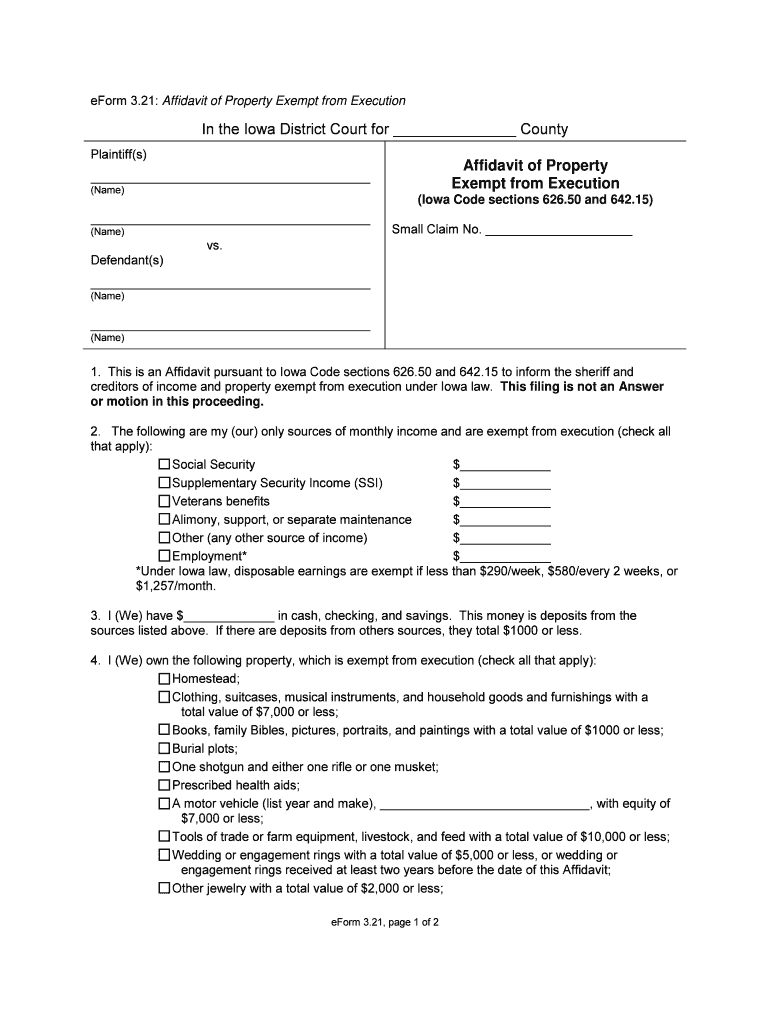
  1. Click ‘Get Form’ to open the Iowa Affidavit Exempt in our editor.
  2. Begin by filling in the county name where the affidavit is being filed, along with the names of the plaintiff(s) and defendant(s).
  3. In Section 2, check all applicable sources of monthly income that are exempt from execution. Enter the amounts next to each source.
  4. Proceed to Section 3 and input your total cash, checking, and savings amounts. Ensure these funds are derived from the listed exempt sources.
  5. In Section 4, check all types of property you own that are exempt from execution. Provide details for any motor vehicle you wish to list.
  6. Complete Sections 5 and 6 regarding electronic filing and certification. Make sure to sign and date the document appropriately.

Start using our platform today for free to streamline your document editing and signing process!

be ready to get more

Complete this form in 5 minutes or less

Get form

Got questions?

We have answers to the most popular questions from our customers. If you can't find an answer to your question, please contact us.
Contact us
Exempt property Certain property is exempt from execution, meaning a debt collector cannot take it. Exemptions are listed in Iowa Code section 627.6. Exemptions include things like wedding rings, burial plots, and one motor vehicle (not to exceed $7,000 in value).
You can claim exemption from withholding only if both the following situations apply: For the prior year, you had a right to a refund of all federal income tax withheld because you had no tax liability. For the current year, you expect a refund of all federal income tax withheld because you expect to have no liability.
In Iowa, it is not necessary to have a notary public witness the signature, but it is fine if it is witnessed and signed by a notary public. It is best if the affidavit also has the case caption at the top of the first page.
In addition to the homestead tax credit, eligible claimants who are 65 years of age or older on or before January 1 of the assessment year are now eligible for a homestead tax exemption. For the assessment year beginning on January 1, 2023, the exemption is for $3,250 of taxable value.
Exemption for persons under age 65 A married couple or a head of household with taxable income of $13,500 or less. A single person with taxable income of $9,000 or less. A single person with taxable income of less than $5,000 who is claimed as a dependent on someone elses Iowa return.

Security and compliance

At DocHub, your data security is our priority. We follow HIPAA, SOC2, GDPR, and other standards, so you can work on your documents with confidence.

Learn more
ccpa2
pci-dss
gdpr-compliance
hipaa
soc-compliance
be ready to get more

Complete this form in 5 minutes or less

Get form

People also ask

Any property owner in the State of Iowa who lives in the property can receive a homestead tax credit. To be eligible, a homeowner must occupy the homestead any 6 months out of the year, but must reside there on July 1.
Tax-exempt customers Some customers are exempt from paying sales tax under Iowa law. Examples include government agencies, some nonprofit organizations, and merchants purchasing goods for resale. Sellers are required to collect a valid exemption or resale certificate from buyers to validate each exempt transaction.
Exempt employees are those who are never entitled to overtime under any circumstances, regardless of how much they work. Nonexempt employees are those who are always entitled to overtime when they work more than forty hours in a week.

Related links