Indiana Small Claims Rules - IN Indiana Supreme Court public access case search - MyCaseIndiana Smal 2026

Get Form
mycaseindiana gov Preview on Page 1

Here's how it works

01. Edit your mycaseindiana gov online
Type text, add images, blackout confidential details, add comments, highlights and more.

02. Sign it in a few clicks
Draw your signature, type it, upload its image, or use your mobile device as a signature pad.

03. Share your form with others
Send it via email, link, or fax. You can also download it, export it or print it out.

How to use or fill out Indiana Small Claims Rules - IN Indiana Supreme Court public access case search - MyCaseIndiana Smal with our platform

Form edit decoration
9.5
Ease of Setup
DocHub User Ratings on G2
9.0
Ease of Use
DocHub User Ratings on G2
  1. Click ‘Get Form’ to open it in the editor.
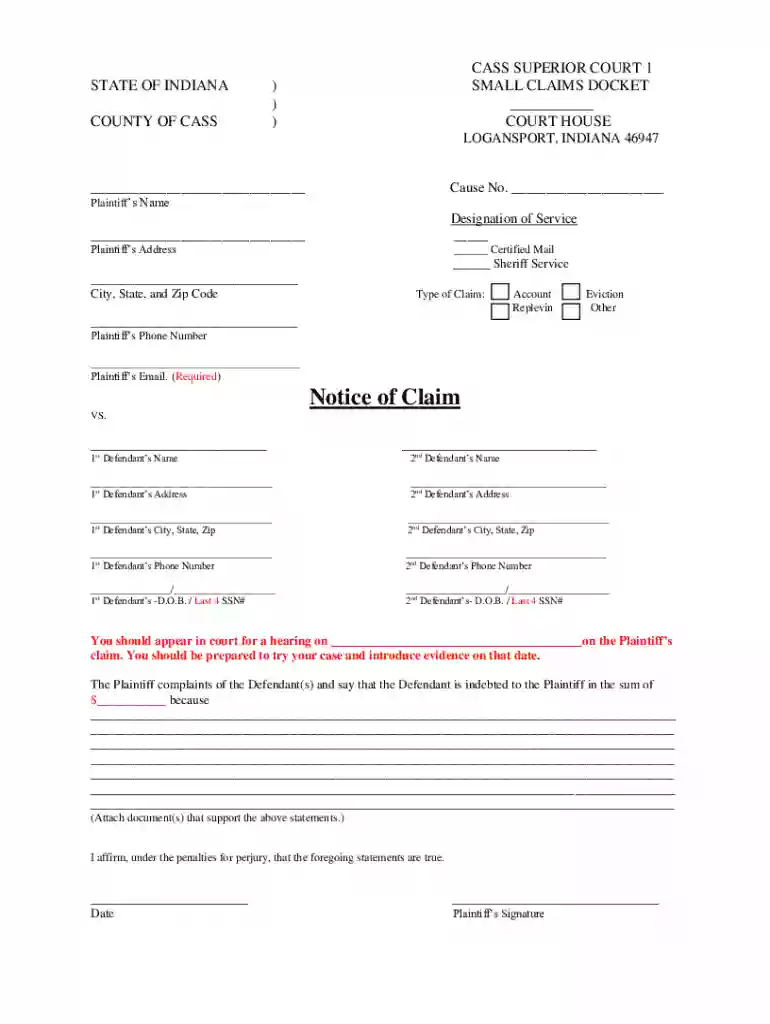
  2. Begin by entering the Cause Number at the top of the form. This is essential for identifying your case.
  3. Fill in the Plaintiff’s Name and Address, ensuring all details are accurate. Select your preferred method of service: Certified Mail or Sheriff Service.
  4. Indicate the Type of Claim by checking the appropriate box (Account, Replevin, Eviction, Other) and provide your contact information including phone number and email.
  5. Enter the names and addresses of all defendants involved in the claim. Make sure to include their phone numbers and relevant identification details like D.O.B. and last four digits of SSN.
  6. In the section for Notice of Claim, clearly state the amount owed and provide a detailed explanation of why you believe this amount is due.
  7. Finally, affirm that your statements are true by signing and dating the document before submission.

Start using our platform today to streamline your document editing process for free!

See more Indiana Small Claims Rules - IN Indiana Supreme Court public access case search - MyCaseIndiana Smal versions

We've got more versions of the Indiana Small Claims Rules - IN Indiana Supreme Court public access case search - MyCaseIndiana Smal form. Select the right Indiana Small Claims Rules - IN Indiana Supreme Court public access case search - MyCaseIndiana Smal version from the list and start editing it straight away!
Versions Form popularity Fillable & printable
2021 4.9 Satisfied (42 Votes)
2018 4.2 Satisfied (41 Votes)
be ready to get more

Complete this form in 5 minutes or less

Get form

Got questions?

We have answers to the most popular questions from our customers. If you can't find an answer to your question, please contact us.
Contact us
This hearing occurs shortly after a person is arrested on a federal warrant or indictment. The primary purpose of a Rule 5 hearing is to inform the defendant of the charges against them, ensure they understand their rights, and determine if they will be released or detained pending further proceedings.
Indiana is one of the few states that allows the public to search its civil and criminal court records for free. MyCase is an online database of records from civil and criminal cases within the Indiana court system.
Access to Court Records Rule 5 defines confidential information and access rules for the public information in records. All confidential information that is e- filed must be filed as a confidential document. All confidential information paper filings must be filed on green paper.
Access to Public Records Act 5-14-3-1 et seq. Exempt: Trade secrets; university research; and certain educational and medical records. Discretionary exemptions include: Personnel files; diaries; journals; and personal notes.
Ind. Access to Court Records Rule 5 defines confidential information and access rules for the public information in records. All confidential information that is e- filed must be filed as a confidential document. All confidential information paper filings must be filed on green paper.

Security and compliance

At DocHub, your data security is our priority. We follow HIPAA, SOC2, GDPR, and other standards, so you can work on your documents with confidence.

Learn more

People also ask

The right of access applies to certain judicial documents filed in connection with litigation. To determine whether a document qualifies as such, the Second Circuit uses the experience and logic test articulated by the Supreme Court in Press-Enterprise Co. v. Superior Court, 478 U.S. 1, 9 (1986).
Small Claims Rule 8 allows a person to appear at trial and, if he or she chooses, represent himself or herself and avoid the cost of hiring an attorney.

Related links