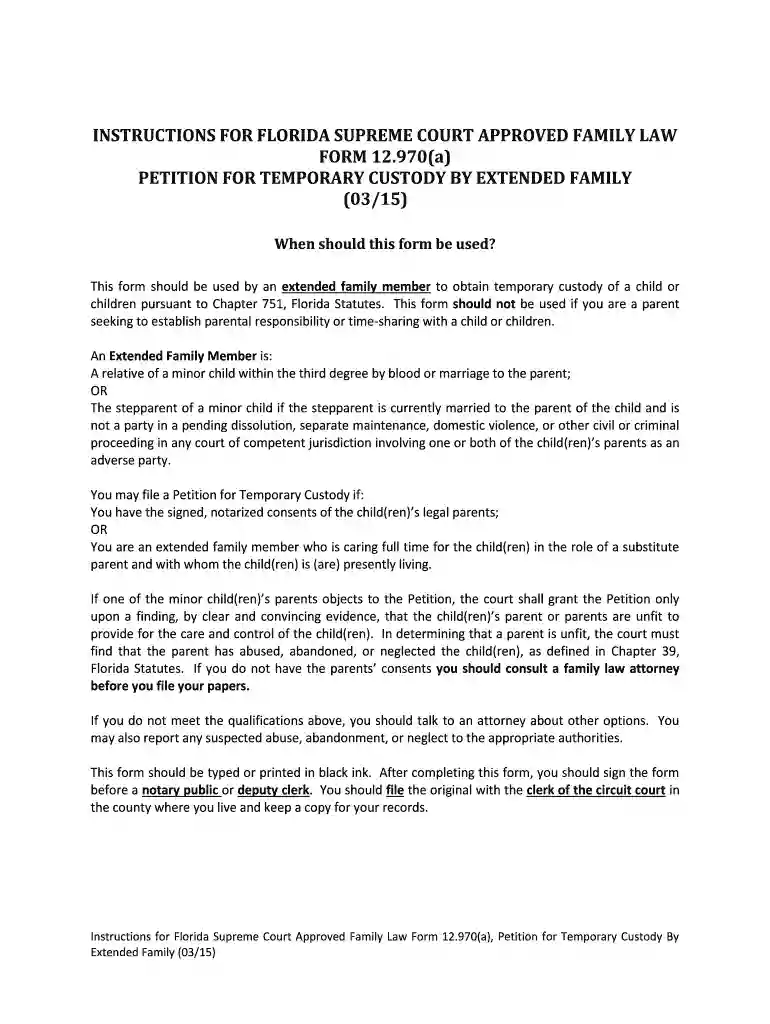
970(a) - flcourts 2026

Get Form
970(a) - flcourts Preview on Page 1

Here's how it works

01. Edit your form online
Type text, add images, blackout confidential details, add comments, highlights and more.

02. Sign it in a few clicks
Draw your signature, type it, upload its image, or use your mobile device as a signature pad.

03. Share your form with others
Send it via email, link, or fax. You can also download it, export it or print it out.

How to use or fill out 970(a) - flcourts with our platform

Form edit decoration
9.5
Ease of Setup
DocHub User Ratings on G2
9.0
Ease of Use
DocHub User Ratings on G2
  1. Click ‘Get Form’ to open the 970(a) - flcourts document in the editor.
  2. Begin by entering your full legal name as the Petitioner at the top of the form. Ensure all information is accurate.
  3. Fill in the details of the minor child(ren) for whom you are seeking temporary custody, including their names and dates of birth.
  4. Indicate your relationship to the child(ren) and select whether you have notarized consent from both parents or if you are acting as a substitute parent.
  5. Complete the Uniform Child Custody Jurisdiction and Enforcement Act Affidavit section, ensuring it is signed under oath before submission.
  6. Review all sections for completeness, especially regarding any orders of protection or child support that may apply.
  7. Once completed, sign the form before a notary public or deputy clerk, then file it electronically with your local circuit court.

Start using our platform today to fill out your 970(a) - flcourts form online for free!

See more 970(a) - flcourts versions

We've got more versions of the 970(a) - flcourts form. Select the right 970(a) - flcourts version from the list and start editing it straight away!
Versions Form popularity Fillable & printable
2018 4.8 Satisfied (57 Votes)
2015 4.4 Satisfied (233 Votes)
2015 4.4 Satisfied (71 Votes)
2011 4.3 Satisfied (159 Votes)
be ready to get more

Complete this form in 5 minutes or less

Get form

Got questions?

We have answers to the most popular questions from our customers. If you can't find an answer to your question, please contact us.
Contact us
What Happens After You File for Emergency Custody? When you file for emergency custody in California: You submit your ex parte motion and supporting declaration, outlining the immediate threat to your child. The court will often review the documents within 2448 hours.
(6) At any time, either or both of the childs parents may petition the court to modify or terminate the order granting temporary custody. (a) The court may modify an order granting temporary custody if the parties consent or if modification is in the best interest of the child.
In Florida, you can apply for emergency custody in two ways: with an ex-parte motion or by notifying the other parent. In an ex-parte motion, the judge decides on the petition before the other parent is notified. Ex-parte motions are rare and used only for the most serious cases.
Emergency custody cases move fast by design. In many situations, the judge will hold a hearing and issue a decision within 24 to 48 hours of the motion being filed.
A temporary custody order in Florida can last indefinitely. It usually has no specified end date. It generally lasts until another custody-related order replaces it. Temporary custody recognizes that sometimes a child is cared for by an extended family member who isnt their parent.

Security and compliance

At DocHub, your data security is our priority. We follow HIPAA, SOC2, GDPR, and other standards, so you can work on your documents with confidence.

Learn more
ccpa2
pci-dss
gdpr-compliance
hipaa
soc-compliance
be ready to get more

Complete this form in 5 minutes or less

Get form

People also ask

Instructions for Emergency Child Custody First, you must fill out these four separate forms: Form #FL-300, Order to Show Cause. Form #FL-305, Temporary Orders. Form #FL-310, Application for Order and Supporting Declaration.
How to Get Temporary Guardianship Without Going to Court in Florida: In many instances, this can be achieved through a power of attorney agreement negotiated between the parents and the designated guardian.

Related links