




01. Edit your form 1999 online
Type text, add images, blackout confidential details, add comments, highlights and more.

Type text, add images, blackout confidential details, add comments, highlights and more.

Draw your signature, type it, upload its image, or use your mobile device as a signature pad.

Send 1999 w 4 via email, link, or fax. You can also download it, export it or print it out.
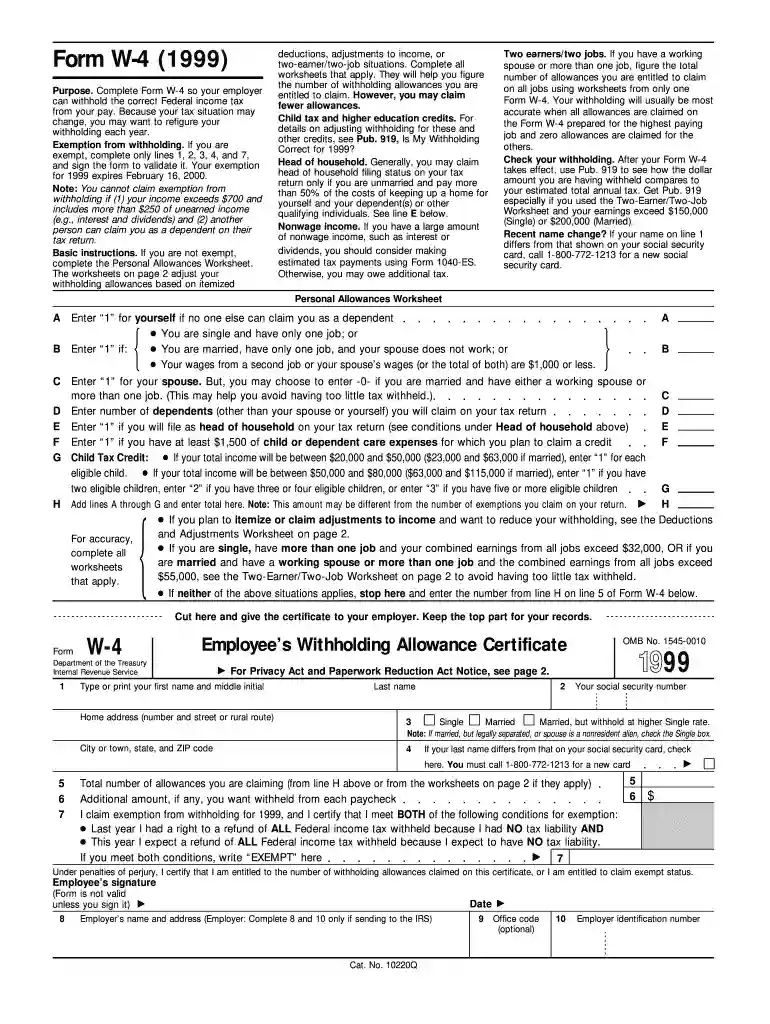
The 1999 W-4 form is a tax document used by employees in the United States to inform their employers of the correct amount of federal income tax to withhold from their paychecks. This withholding ensures that employees do not owe excessive taxes at the end of the tax year and helps avoid underpayment penalties. The W-4 form includes sections for claiming exemptions, calculating withholding allowances based on personal circumstances, and adjusting for non-wage income. It serves as an essential tool for both employees and employers to manage tax withholding efficiently.
Using the 1999 W-4 form involves several steps to ensure accurate federal income tax withholding:
Filling out the 1999 W-4 form requires attention to detail to ensure each section is accurately completed:
Understanding the terminology on the W-4 form is crucial for accurate completion:
The essential components of the 1999 W-4 form include:
The IRS provides comprehensive guidelines for the completion and submission of the W-4 form. These include instructions on:
The W-4 form should be submitted by new employees before the first paycheck to ensure correct withholding from the start. Current employees may submit a new form anytime during the year, especially when their tax situation changes (e.g., marriage, divorce, birth of a child). It's advisable to review and, if necessary, update the W-4 form annually to reflect all changes in financial or personal circumstances, with a focus on the start of the new tax year.
When completing the 1999 W-4 form, having the following documents on hand can help:
Real-world scenarios describe how different individuals might use the form to tailor their withholding:
These examples highlight the flexibility of the W-4 form in managing tax obligations based on individual circumstances.
We've got more versions of the form 1999 form. Select the right form 1999 version from the list and start editing it straight away!
| Versions | Form popularity | Fillable & printable |
|---|---|---|
| 2025 | 4.5 Satisfied (26 Votes) | |
| 2024 | 4.2 Satisfied (40 Votes) | |
| 2023 | 4.3 Satisfied (21 Votes) | |
| 2022 | 4 Satisfied (53 Votes) | |
| 2021 | 4.9 Satisfied (53 Votes) | |
| 2020 | 4.2 Satisfied (93 Votes) | |
| 2019 | 4.4 Satisfied (617 Votes) | |
| 2018 | 4.4 Satisfied (332 Votes) | |
| 2017 | 4 Satisfied (47 Votes) | |
| 2017 | 4.4 Satisfied (334 Votes) | |
| 2016 | 4.4 Satisfied (484 Votes) | |
| 2015 | 4 Satisfied (51 Votes) | |
| 2014 | 4.2 Satisfied (41 Votes) | |
| 2013 | 4 Satisfied (29 Votes) | |
| 2012 | 4.4 Satisfied (38 Votes) |
At DocHub, your data security is our priority. We follow HIPAA, SOC2, GDPR, and other standards, so you can work on your documents with confidence.
Jan 23, 2018 An em- ployee must file a new Form W-4 by February 15 each year to continue the exemption. Part 2. Tax on Unearned. Income of Certain Children.Read more
If you receive any government payment shown below, you may use Form W-4V to ask the payer to withhold Federal income tax.Read more
Purpose. Complete Form W-4 so your employer can withhold the correct Federal income tax from your pay. Because your tax situation may.Read more


