
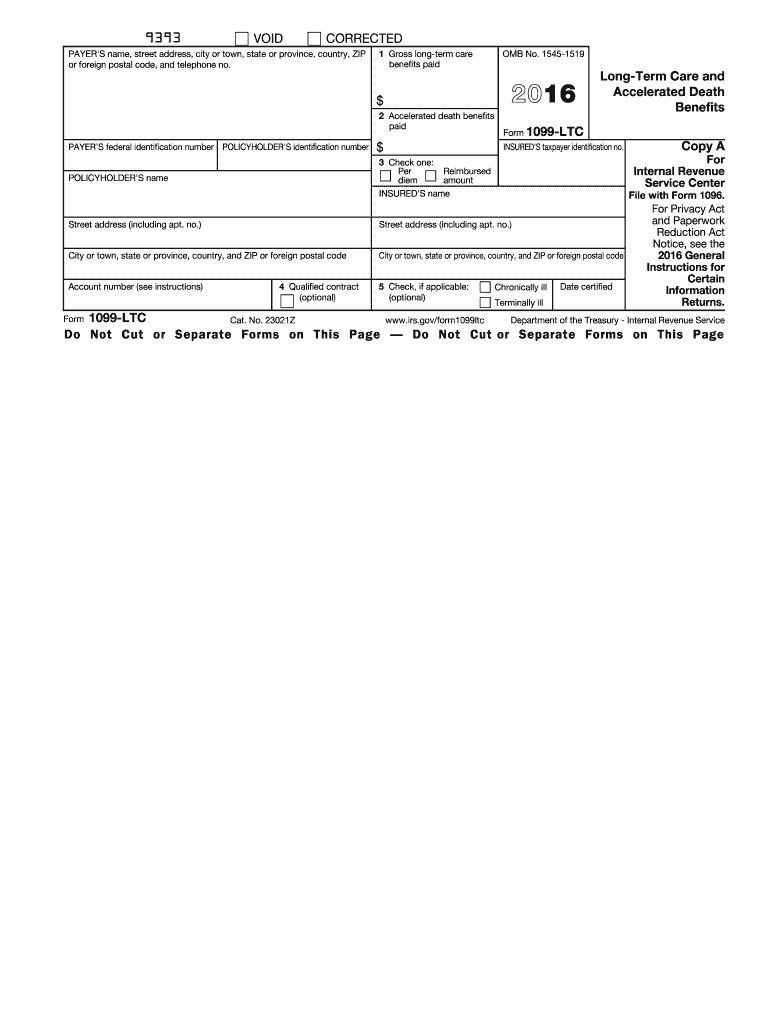







Definition and Purpose of Form 1099-LTC
Form 1099-LTC is issued by the Internal Revenue Service (IRS) to report long-term care benefits and accelerated death benefits paid to policyholders or insured individuals. These benefits are primarily associated with insurance policies, covering costs related to chronic illness or long-term care needs. The form details important information such as the gross benefits paid, which helps taxpayers accurately report these amounts on their tax returns.
Key Information Captured
- Gross Benefits Paid: The total amount paid to the policyholder during the tax year.
- Identification Numbers: Taxpayer identification numbers for both the payer and the recipient.
- Certification of Illness: Proof that the recipient meets criteria for chronic or terminal illness, qualifying them for tax-free benefits.
How to Use Form 1099-LTC
The form should be used by both payers and recipients to understand and report long-term care payments correctly. Payers must issue the form to recipients and the IRS, while recipients use the information to properly report any income received through long-term care benefits.
Steps for Recipients
- Review Details: Verify all information for accuracy, including personal details and the amounts reported.
- Determine Tax Implications: Use the figures to decide whether the payments are taxable. Generally, amounts used for long-term care services are not taxable if certain conditions are met.
- Report on Tax Return: Enter the necessary information on the appropriate tax forms, such as Form 8853, which is used to report income from health savings accounts and long-term care benefits.
Obtaining Form 1099-LTC
You can obtain this form from the payer of the long-term care benefits, who is required to issue it by January 31 of the year following the payment. If not received, recipients should contact the payer directly to request a copy.
Alternative Ways to Access the Form
- Online Access: Some insurers offer downloadable versions through their customer service portals.
- Request via the IRS: If unable to obtain the form from the payer, contact the IRS for assistance.
Completing Form 1099-LTC
Completing the form involves filling in sections related to payments made and received. The payer completes sections regarding the amount and type of payments, while specific instructions guide both payers and recipients in correctly reporting required information.
Key Sections
- Payer Information: Includes the payer's name, address, and taxpayer identification number.
- Recipient Information: Captures the recipient's details, ensuring that the form aligns with other tax documentation.
- Box Details: Specific boxes for distinguishing between qualified and non-qualified per-diem basis payments.
Legal Use and IRS Guidelines
The form adheres to detailed IRS regulations designed to standardize the reporting of long-term care benefits. It ensures compliance with statutory requirements ensuring accurate tax treatment of these payments.
Compliance With the ESIGN Act
Signatures and document submissions related to Form 1099-LTC can be conducted electronically, provided they comply with the ESIGN Act, ensuring legal recognition of digitally signed forms.
Filing Deadlines and Important Dates
Form 1099-LTC must be issued to recipients by January 31, with a copy sent to the IRS by February 28 if filing by paper or March 31 if submitted electronically.
Extensions
Extensions for the payer are possible but require a formal request to be submitted to the IRS before the filing deadline.
Penalties for Non-Compliance
Failing to furnish the form to recipients or to the IRS on time can result in financial penalties. These penalties vary based on the delay duration and whether non-compliance was due to reasonable cause.
Ways to Avoid Penalties
- Timely Filing: Submit required copies by the deadlines.
- Accurate Reporting: Ensure all relevant information is complete and correct.
Software Compatibility
Software like TurboTax and QuickBooks supports the e-filing of Form 1099-LTC, facilitating an efficient and error-free submission process. This compatibility streamlines the workflow by filling out forms using integrated data processing.
Benefits
- Efficiency: Direct import of payer and recipient details.
- Error Reduction: Automated calculations and checks ensure compliance.
Common Scenarios for Form 1099-LTC Use
Form 1099-LTC is typically used by individuals receiving significant long-term care insurance payments due to chronic illness or a condition necessitating long-term care.
Practical Examples
- Elderly Individuals: Often rely on the form to report benefits from long-term care insurance.
- Care Facilities: Utilize the form to inform resident patients or their family members of the benefits paid.


