




01. Edit your form online
Type text, add images, blackout confidential details, add comments, highlights and more.

Type text, add images, blackout confidential details, add comments, highlights and more.

Draw your signature, type it, upload its image, or use your mobile device as a signature pad.

Send it via email, link, or fax. You can also download it, export it or print it out.
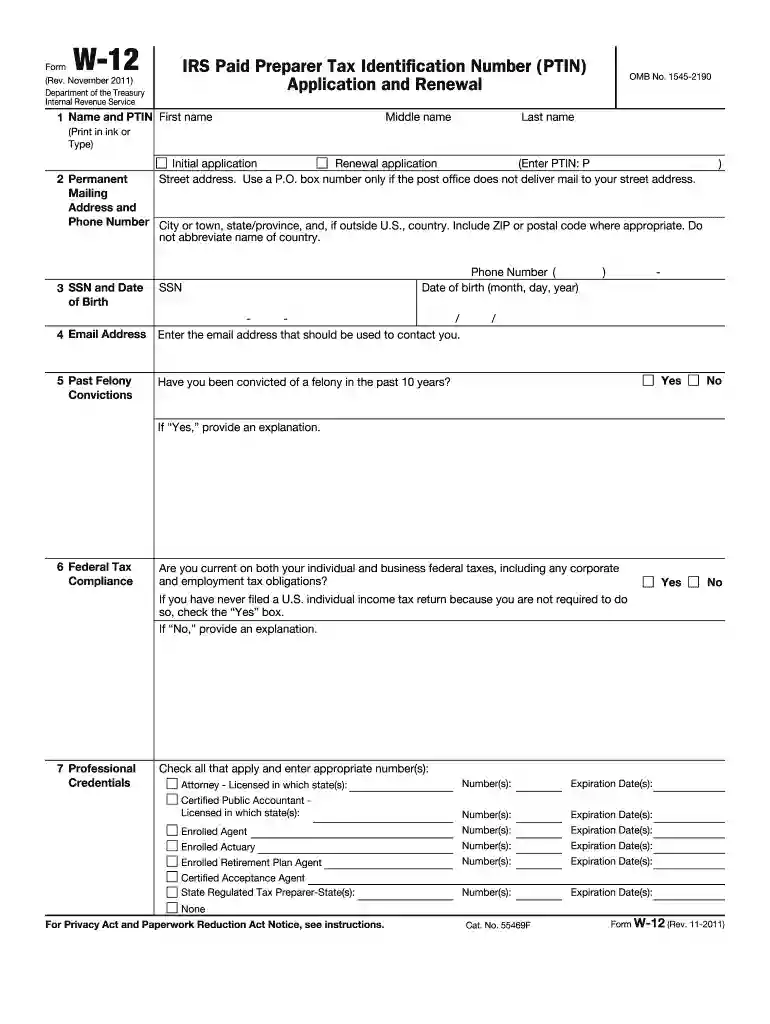
The Form W-12 is an application used by tax professionals in the U.S. to apply for or renew their Paid Preparer Tax Identification Number (PTIN). Issued by the IRS, it is crucial for anyone who prepares or assists in preparing federal tax returns for compensation. The document captures personal information, professional credentials, compliance status, and other legal information of the applicant.
The most straightforward method to acquire the 2011 version of Form W-12 is through the IRS website. Users can download a PDF file of the form directly without any associated costs. This ensures the form is obtained from a reliable source.
Individuals may also request a physical copy by contacting the IRS via mail. This option is beneficial for those who prefer hard copies or do not have easy access to a printer.
Completing Form W-12 involves several steps, primarily focusing on accurately providing the necessary information to ensure IRS acceptance.
Using the Form W-12 legally ensures individual tax preparers are authorized and meet IRS requirements:
The form comprises several critical sections, each of which must be completed accurately:
The IRS establishes guidelines ensuring consistent PTIN application and renewal processes:
Tax preparers utilizing IRS Form W-12 need to adhere to federal regulations. Failure can result in penalties:
We've got more versions of the 2011 w 12 form form. Select the right 2011 w 12 form version from the list and start editing it straight away!
| Versions | Form popularity | Fillable & printable |
|---|---|---|
| 2025 | 4.7 Satisfied (38 Votes) | |
| 2024 | 4.6 Satisfied (28 Votes) | |
| 2023 | 4.6 Satisfied (29 Votes) | |
| 2022 | 4.3 Satisfied (25 Votes) | |
| 2021 | 4.8 Satisfied (69 Votes) | |
| 2020 | 4.4 Satisfied (86 Votes) | |
| 2019 | 4.4 Satisfied (59 Votes) | |
| 2017 | 4.4 Satisfied (61 Votes) | |
| 2017 | 4.4 Satisfied (205 Votes) | |
| 2015 | 4.4 Satisfied (325 Votes) | |
| 2014 | 4.1 Satisfied (55 Votes) | |
| 2013 | 4 Satisfied (29 Votes) | |
| 2012 | 4 Satisfied (56 Votes) | |
| 2011 | 4 Satisfied (54 Votes) |
At DocHub, your data security is our priority. We follow HIPAA, SOC2, GDPR, and other standards, so you can work on your documents with confidence.
If you are renewing your PTIN, your fee is $63.00 The fee is nonrefundable. Full payment must be included with your request/renewal or it will be rejected. MakeRead more
Part I. Taxpayer Identification Number (TIN). Enter your TIN in the appropriate box. The TIN provided must match the name given on the Name line.Read more
Complete the laboratory specific respiratory outbreak lab form and fax to the lab as instructed on the form. See Appendix 6 for the BCCDC Respiratory


