




01. Edit your form online
Type text, add images, blackout confidential details, add comments, highlights and more.

Type text, add images, blackout confidential details, add comments, highlights and more.

Draw your signature, type it, upload its image, or use your mobile device as a signature pad.

Send it via email, link, or fax. You can also download it, export it or print it out.
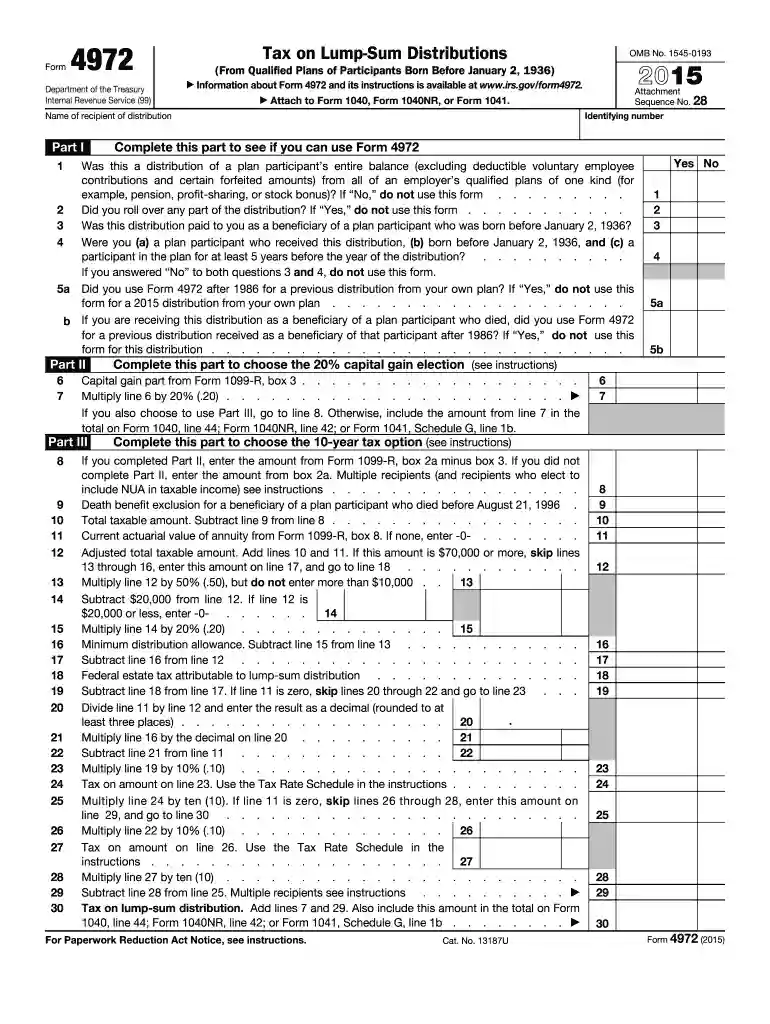
Form 4972 is a significant document used to compute the tax on lump-sum distributions from qualified retirement plans. It is particularly relevant for individuals born before January 2, 1936. The form enables taxpayers to leverage specific tax options, potentially lowering their overall tax obligation compared to standard income reporting. Different sections of the form allow taxpayers to navigate eligibility, reporting, and calculation procedures. Understanding these elements is pivotal to correctly filing the 2015 version of Form 4972.
Taxpayers can utilize Form 4972 to choose advantageous tax treatments for their lump-sum distributions. Available options, such as the 20% capital gain election and the 10-year tax option, can significantly affect the final tax liability. Taxpayers need to assess these options based on their financial circumstances to identify the most beneficial path. This form requires precise calculations to report the taxable amount, given the unique treatment these distributions may warrant.
Several terminologies are vital for understanding Form 4972. For instance, "lump-sum distribution" refers to a participant's complete withdrawal from a retirement plan upon leaving an employer or plan closure. Other terms like "ordinary income," "capital gains," and "special tax treatment" are crucial in navigating the form's instructions. Familiarity with these terms enhances comprehension and execution efficacy when filing.
Eligibility to use Form 4972 involves specific criteria. You must be a plan participant or beneficiary born before January 2, 1936. The distribution should represent the entirety of the benefits payable under the plan. These requirements ensure that special tax treatments are appropriately applied to qualifying individuals. The IRS offers guidelines to aid taxpayers in determining their eligibility.


Form 4972 features several critical components, including:
The IRS offers specific guidelines to optimize the correct use of Form 4972. These instructions provide clarity on eligibility, calculation methods, and submission timelines. Comprehensive reading of these guidelines is recommended to ensure accurate completion and adherence to IRS standards. The guidelines also cover potential penalties for non-compliance or incorrect filings.
Timeliness is critical when filing Form 4972. Adherence to specific deadlines must be preserved to avoid penalties. Generally, these timelines align with the regular tax filing period, typically April 15. However, extensions or special circumstances may affect this date. It is imperative to verify current year deadlines to avoid missteps in filing procedures.
Failure to comply with filing requirements or misreporting figures can result in significant penalties. Given the complexity of lump-sum taxation options, precise adherence to regulations is essential to avoid fines or legal challenges. Understanding these consequences fosters a diligent approach to completing and submitting Form 4972 accurately.
We've got more versions of the 2015 form 4972 form. Select the right 2015 form 4972 version from the list and start editing it straight away!
| Versions | Form popularity | Fillable & printable |
|---|---|---|
| 2025 | 4.7 Satisfied (40 Votes) | |
| 2024 | 4.5 Satisfied (30 Votes) | |
| 2023 | 4 Satisfied (50 Votes) | |
| 2022 | 4.5 Satisfied (53 Votes) | |
| 2021 | 4.9 Satisfied (37 Votes) | |
| 2020 | 4.3 Satisfied (193 Votes) | |
| 2019 | 4.2 Satisfied (36 Votes) | |
| 2018 | 4.3 Satisfied (60 Votes) | |
| 2017 | 4.4 Satisfied (242 Votes) | |
| 2016 | 4.4 Satisfied (677 Votes) | |
| 2015 | 4 Satisfied (30 Votes) | |
| 2014 | 4.2 Satisfied (25 Votes) | |
| 2011 | 4.3 Satisfied (66 Votes) |
At DocHub, your data security is our priority. We follow HIPAA, SOC2, GDPR, and other standards, so you can work on your documents with confidence.
Form 4972, tax on lump-sum distributions from qualified retirement plans.-journal.
Apr 29, 2026 Use this form to figure the tax on a qualified lump-sum distribution using the 20% capital gain election, the 10-year tax option, or both.Read more


